Introduction
Greetings and salutations, friends!
Is your arm constantly getting tired of working the bolt on your Lee-Enfield all of the time? Have you ever wished that your rifle would just… cycle itself? Are you disturbed by the lack of a BR IV Allied Tech-Tree rifle? Ever wanted to shoot a Jerry or Tojo with a rifle made by the same company that manufactured your washing machine or dishwasher?
Then look no further than the Electrolux Charlton!
In this suggestion, I will be proposing the addition of three new weapons, all based on this rifle: a 10-round version, a 20-round version, and a 30-round version. Let’s get started!
Historical Background and Design

The Electrolux Charlton was, in almost every respect, a further development of the Charlton Automatic Rifle. Designed in 1941 by Philip Charlton of the Charlton Motor Workshops in New Zealand, the Charlton Automatic Rifle was developed with the intention of supplementing New Zealand’s stocks of light machine guns. For this purpose, a somewhat clunky gun (as almost all bolt-action conversions are) could be supplied to the Home Guard, freeing up precious Bren guns for use with the military overseas - a pressing need when Japan was knocking at the door.
Unlike the Kiwis, who were adopting the Charlton in the face of adversity early in the war, Australia only began exploring the possibility of adopting one for themselves later on. In 1944, the war was still raging in both the Pacific and Europe, but things were no longer quite as dire as they had once been. Japanese forces that had once threatened the north of the country were now either tied down or displaced, whilst Australia was benefiting from regular deliveries of arms, aircraft, and tanks from both Britain and the United States, supplementing ever-growing domestic production.
It is therefore theorised that this improved wartime situation gave the Australians some breathing room to explore the possibility of adopting a more ‘modern’ weapon than their current standard rifle. It is important to keep in mind that the Aussies - like much of the Commonwealth - never adopted or entered into production the No. 4 Lee-Enfield rifle, and were still using the No. 1 Mk III* of pre-WW1 vintage. It is understandable, then, that they were looking for something a little more technically impressive for their forces.
When Australia began looking at the Charlton, however, they were not interested in it as a substitute for their existing LMGs, but rather as an inexpensive supplementary weapon: a first-of-its-kind (for the Aussies) self-loading shoulder rifle, rather than an automatic rifle with a bipod.
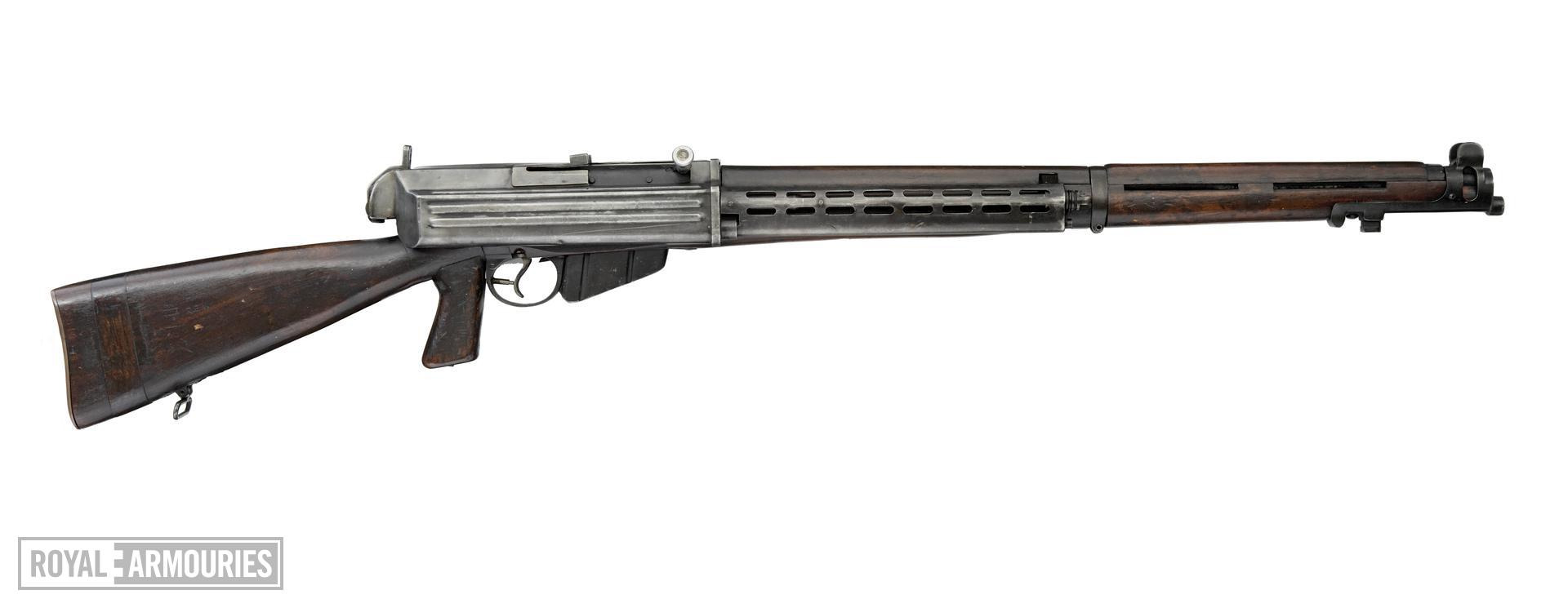
To this end, the Australians at Electrolux made a number of alterations. First of all, this rather steampunk-looking gun was converted from standard and up-to-date No. 1 Mk III* rifles, rather than the outdated Lee-Metfords and ‘Long Lees’ used in New Zealand production. The internals were almost - but not entirely - identical to those of the Kiwi Charltons, differing mainly in the lack of a fully automatic setting.
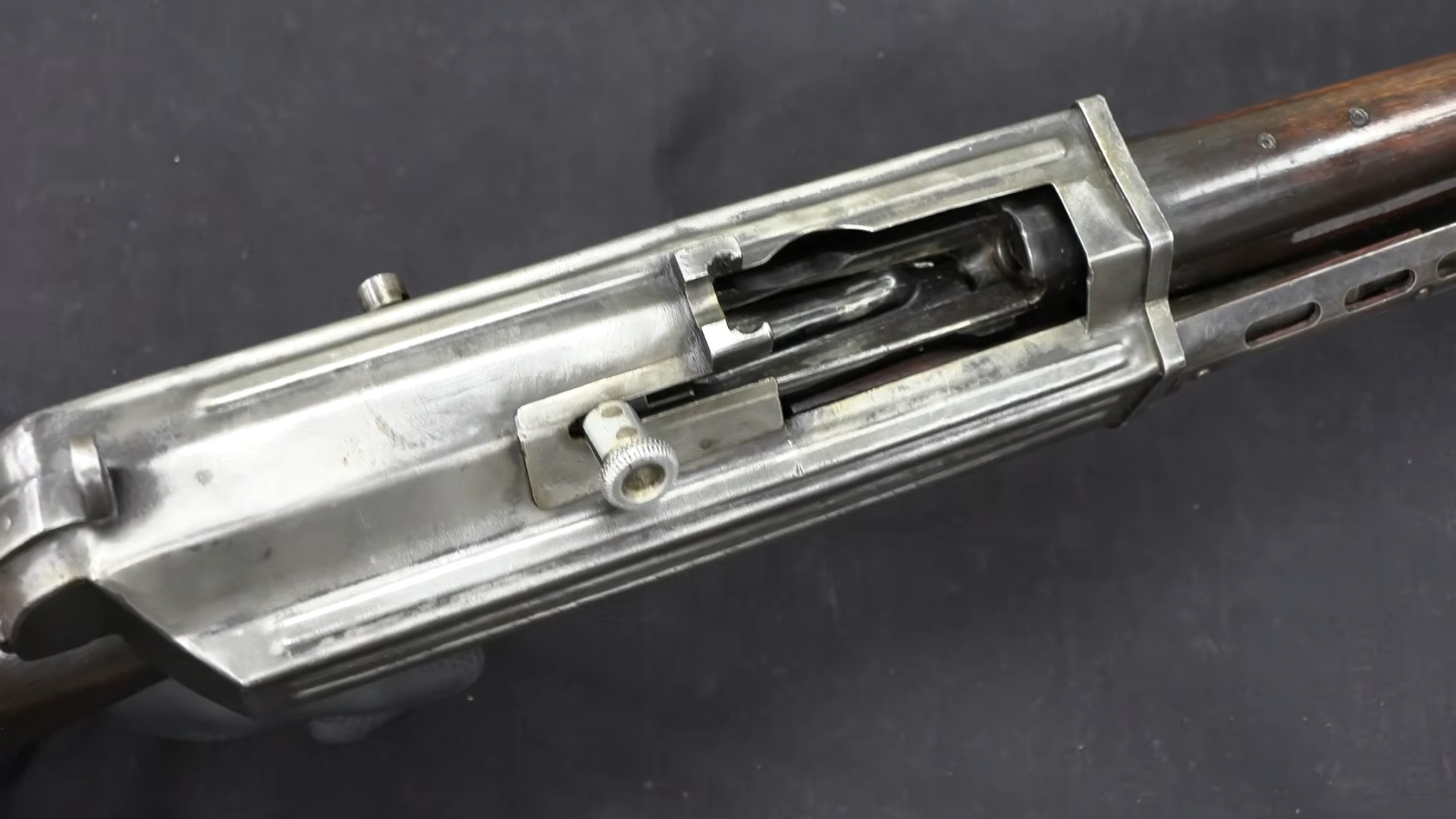
Externally, the differences were more obvious. The buttstock was lengthened, whilst the complex moving parts of the conversion, which were left mostly exposed on New Zealand examples, were covered with thin sheet-metal plates. The fore-end of the rifle was deliberately left unaltered (with the exception of some cooling slots cut into the wood), allowing it to accept the standard No. 1 bayonet. The bipod and foregrip of the Kiwi rifle were left off, but a slightly different pistol grip by the trigger was retained.
The result of using standard and up-to-date rifles during manufacture, combined with a generally higher standard of production, fit, and finish, was a surprisingly mature and streamlined semi-automatic shoulder rifle.
The design was approved and adopted by the military, and Australia placed an order with the local branch of the Swedish-origin home appliance company Electrolux to manufacture 10,000 of these rifles. The order remained active for some time, and Electrolux established serious production of the gun, even producing a notable quantity of parts for these new rifles. However, the contract was cancelled in June 1944 before any rifles could be assembled or delivered.
Post-war, these parts were sold by the Australian government as part of a lot of regular No. 1 rifle parts, with the buyer unaware of what they had actually purchased. The parts were subsequently destroyed by the private buyer due to concerns over the legal status of Charlton components under Australian firearms law. This leaves us today with, as far as I am aware, only the initial prototypes still in existence today.
Why the contract was cancelled, we can only speculate. My guess is that the Australian military had come to the conclusion that the war wasn’t going to last forever, and that investing further time, resources, and money into this non-ideal self-loading rifle would be a waste when they could adopt something more modern and less clunky after the war.
This mirrors the British story with their Patchett Machine Carbine, another firearm that was seriously considered and almost adopted, but was ultimately set aside because the British believed they would be using something else in the near future anyway. In their case, they were putting their money on the horse that would eventually become the EM-2 and, later, the L1A1 - a rifle that Australia would also end up adopting.
Still, the Electrolux Charlton was a genuine, if ultimately unfinished, attempt by the Australian military to adopt a self-loading rifle during the war. Had things gone differently, we might actually have seen Australian servicemen in 1945 carrying some Electrolux Charltons into battle.
Technical Information
Name (in-game options): Electrolux Charlton, Elektrolux Charlton - using the company’s historical Swedish name, Australian Charlton Automatic - legally safe, but rather bland
Overall Length: Longer than the No. 1 Mk III due to its extended buttstock (No. 1 Mk III: 44.45 inches / 1132 mm)
Barrel Length: 25.2 inches (640 mm)
Weight: Approx. 16 lb (7.3 kg) unloaded, similar to the New Zealand Charlton Automatic
Cartridge: .303 British (7.7×56mmR)
Action: Gas-operated, closed-bolt, semi-automatic
Fire Selector: F (Fire), L (Lock Open), S (Safe)
Muzzle velocity: 750m/s (standard .303 velocity)
Bayonet: Yes - compatible with No. 1 Rifle bayonets, including the Pattern 1907 already in-game
Sights: Rear aperture sights with three selectable holes, paired with a front post. Exact aperture measurements are unknown.
Feed System: Detachable box magazines in sizes of 10, 20, and 30. Charger-bridge capable of accepting standard 5-round Lee-Enfield charger clips.
It is unknown whether there was planned usage of 20-round trench magazines or New Zealand Charlton magazines, 10-round standard Lee-Enfield magazines seem to have been the intended main standard.
The Three Rifles

I propose that all three magazine options should be added to the game - and, even more uniquely, that all three should be fed through charger clips. My decision to go with charger clips isn’t because the Electrolux Charlton couldn’t be reloaded by changing magazines (it could), but rather because it provides a nice bit of flavour for the guns, whilst also serving as a balancing choice.
Australia was not blessed with limitless wartime industrial capacity, and this limitation provides a rather nice way of representing that within the game. Thus, this would be a deliberate gameplay/balance limitation which just happens to have very appropriate flavour to it.
That would mean the following guns should be added:
- Electrolux Charlton - BR III, charger-clip fed.
- Electrolux Charlton 20 - BR IV, charger-clip fed.
- Electrolux Charlton 30 - BR IV, charger-clip fed.
Working on three guns that share the same basic model - with almost certainly identical or near-identical animations - at the same time would also cut down on development time, even if they are ultimately released separately. Essentially, this would give us three different weapons for a development cost not much greater than that of a single one.
With charger feeding, the 10-round rifle would fit neatly into BR III, preferably as a Tech Tree weapon. The 20-round version could occupy a Tech Tree position at BR IV as well, with the slower charger reload helping to counteract its increased magazine capacity and making it more comparable to the faster-reloading 10-round rifles already found in the Tech Trees.
Finally, the rarer 30-round variant could be introduced as an Event, Battle Pass, or Premium weapon at BR IV, whilst retaining the same charger-fed limitation for balance.
Arguably, it is the 20-round version which is most needed, as it would help fill the Allied BR IV Tech Tree rifle gap. However, I think it would be unfortunate not to add the basic 10-round version to the Tech Tree as well.
Whilst there is a general Allied need for another BR IV rifle, there is also the matter of sub-faction representation at BR III. The United States currently has two rifles available there, whilst the Commonwealth has none.
Polls
- Aye
- No
- Tech Tree (Author’s choice)
- Event
- Battle Pass
- Premium
- Any
- I voted No
Why should you consider the Tech Tree?
If it is the desire of the community to have a Commonwealth TT BR III rifle, then the Electrolux Charlton is probably the rifle with the most deserving historical pedigree behind it.
Its main contender in this regard is the SLEM-1, a semi-automatic design developed in the UK by the exiled Belgian designer Dieudonné Saive (the same man behind the Browning Hi-Power). Whilst it is arguably the more refined design - being purpose-built rather than a conversion - it was never adopted by any Commonwealth nation, nor did it ever enter production. It also uses non-standard ammunition in the form of 8mm Mauser.
The Electrolux Charlton, by comparison, uses the regular British infantry service .303 ammunition, and actually was accepted and adopted by the Australian military, with production being established - however briefly that may have been.
As such, one-for-one, I would argue that the Electrolux Charlton is more deserving of the TT position than the SLEM-1.
And, in my humble opinion, the SLEM-1 makes for a much more interesting Event/BP/Premium gun in BR III/IV than the Electrolux ever could - because of the historical legacy of Dieudonné Saive.
- Aye
- No
- Tech Tree (Author’s choice)
- Event
- Battle Pass
- Premium
- Any
- I voted No
Why should you consider the Tech Tree?
Similar reasoning applies here as with the 10-round version, with the additional point that there is a general need for another Allied BR IV rifle in the Tech Tree.
Another thing to consider is uniformity. If the 10-round version is already in the Tech Tree, why add a completely different gun when a second model of the same weapon already exists? We already have examples of this sort of thing with the PPSh-41 35 and 71, or the MG 42 50 and 100.
Again, the SLEM-1 had a detachable box magazine, and as such it could potentially be either BR III or BR IV depending on whether it is reloaded by charger clips or by changing magazines. The Electrolux Charlton, however, presents an opportunity for something rather more interesting. With the 20-round rifle being charger-clip fed, it could legitimately serve as a balanced Tech Tree option: trading its larger capacity for a slower reload from empty.
Not only would this make it a viable alternative to the existing BR IV rifles, it would also make it an entirely unique one. It would be the first Tech Tree rifle with a 20-round capacity, but a 20-round example that does not also have the fast magazine-change reload of the existing Event/BP/Premium 20-round rifles - giving the Allies a rather different flavour of BR IV rifle to play with.
- Aye
- No
- Tech Tree
- Event (Author’s choice)
- Battle Pass
- Premium
- Any
- I voted No
Why should you consider Event?
BR IV already features two Commonwealth Battle Pass rifles - a third one would be rather silly.
Additionally, in my opinion, a 30-round Electrolux Charlton would make for a rather poor and uninteresting Premium weapon. It is simply too much of a gimmick to justify the Premium price tag, whilst at the same time being far too unusual (and unbalanced) to work as a regular Tech Tree rifle.
Indeed, I would argue that the 30-round Electrolux could never be a Tech Tree rifle, since it is primarily going to be a gimmick weapon. With thirty rounds available to you before you need to reach for another charger, I’m going to call this particular monstrosity the ‘Never-Reload-Lee’ - because you’re almost certainly going to die before you’ll actually ever need to reload the rifle.
As an Event weapon, however, I think it would fit rather nicely: an unusual and slightly ridiculous variant of an otherwise practical rifle, available as a bit of a novelty.
Sources
Used
- Ian McCollum, “Australian Electrolux Charlton”, 12/10/2012 (retrieved 11/09/2026), Forgotten Weapons - article
- Ian McCollum, “Electrolux Charlton: Washing Machine Company Converts Bolt Action to Semiauto”, 25/03/2024 (retrieved 11/09/2026), Forgotten Weapons - article and video
- Ian McCollum, “Charlton Automatic Rifle”, 09/10/2012 (retrieved 17/08/2026), Forgotten Weapons - article
- Ian McCollum, “From Bolt Action Lee to LMG: The Charlton Automatic Rifle”, 26/07/2019 (retrieved 17/08/2026), Forgotten Weapons - article and video
Further Reading - currently not in possession
- Ian Skennerton, “The Lee-Enfield Story” (1993). Arms & Militaria Press, Australia.
- Ian Skennerton, “Small Arms Identification Series No. 13: Special Service Lee-Enfields; Commando & Auto Models” (2001). Arms & Militaria Press, Australia.
ATTENTION:
While I am certain about facts presented in this topic (primarily that it is a semi-automatic rifle, uses .303 ammunition, is related to the NZ Charlton Automatic, and uses compatible Lee-Enfield style magazines), more sources are especially welcome for this surprisingly prominent but obscure rifle.
Let this serve as a call for action from the members of the community to pool our combined resources and sound minds together - please share any sources you possess on the topic, with information on where you got them (a page excerpt from a book is useless unless we know from what book it came from, for example).
Conclusion
That has been all I have to say on this topic. I hope you will consider the inclusion of the Electrolux Charlton rifles, and the placements I have laid out above.
Until next time, dear readers, and remember: you’d best start believing in the Aussie steampunk dishwasher dystopia - you’re in one.
Signed,
Lt. Ogge King, 3rd Experimental Tea Infusion and Small Arms Appreciation Company, Home Guard (Reserve)
God save the King, and God bless Australia.

