Working Through the Errors — Type 4 and Type 5 Anti-Tank Grenade Launchers 🇯🇵

Working Through the Errors — Type 4 and Type 5 Anti-Tank Grenade Launchers

Introduction


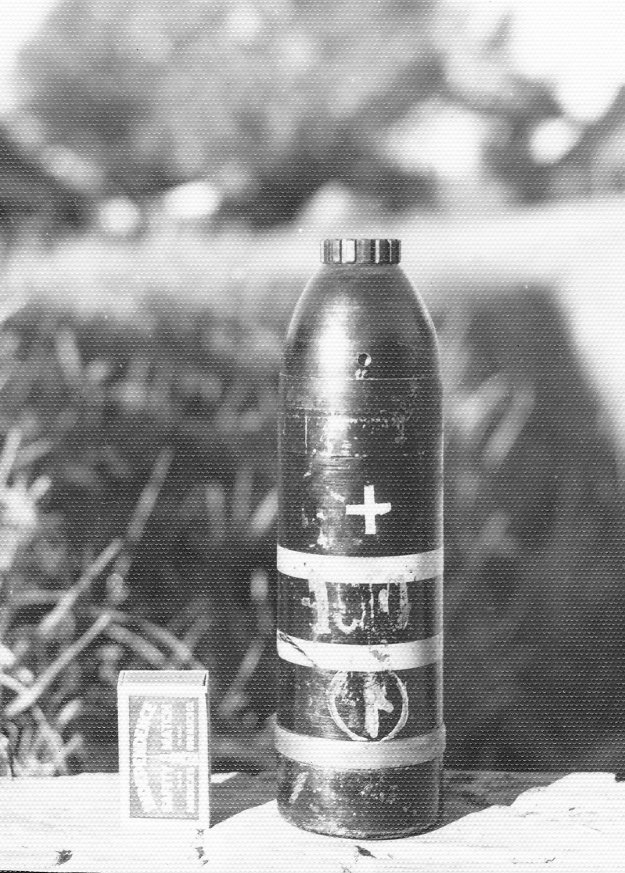
Type 4

Unfortunately, documents containing information about the armor penetration of the Type 4 launcher are not available in open sources, so all data about it is taken from the Japanese Wikipedia, which in turn references books by the Japanese weapons researcher Jirō Sayama.

The penetration of the Type 4 is stated as 80 mm, but at impact angles from 60° to 90°. From this, a logical conclusion can be drawn that the launcher is capable of penetrating 80 mm at an angle of 60°. Therefore, using the formula b(e) = b(n) / cos(α) (where b(e) is the effective or line-of-sight thickness, b(n) is the nominal thickness, and α is the angle of impact or inclination), one can calculate the real penetration at an angle of 90°.

b(e) = 80 mm / cos(90° − 60°) ≈ 92.4 mm

What is especially important is the following note:
«陸上自衛隊幹部学校戦史教官室の所蔵資料である、近衛第3師団の調整資料『現有対戦車兵器資材効力概見表』によると、ロタ砲の貫通力は100㎜となっており、有効距離50mとし、M4中戦車に対しては、命中すれば如何なる部位も貫通するとしている。».

Translation:
“According to the ‘Overview Table of the Effectiveness of Existing Anti-Tank Weapons and Materiel’ — a document prepared by the 3rd Guards Division and preserved in the archives of the War History Instructors’ Office of the Japan Ground Self-Defense Force Command and Staff College — the penetration of the Ro-Ta launcher [Type 4] is 100 mm. With an effective range of 50 meters, it is stated that, if it hits, it can penetrate any part of the M4 medium tank.”

This only confirms the calculations and the logic of the penetration values found in Japanese documentation. It is worth noting that the penetration of the 90 mm version of the Type 4, which is given as 120 mm, was also most likely measured at angles other than 90°. It is unlikely that such a significant increase in caliber and explosive mass would have increased penetration by only 20 mm.

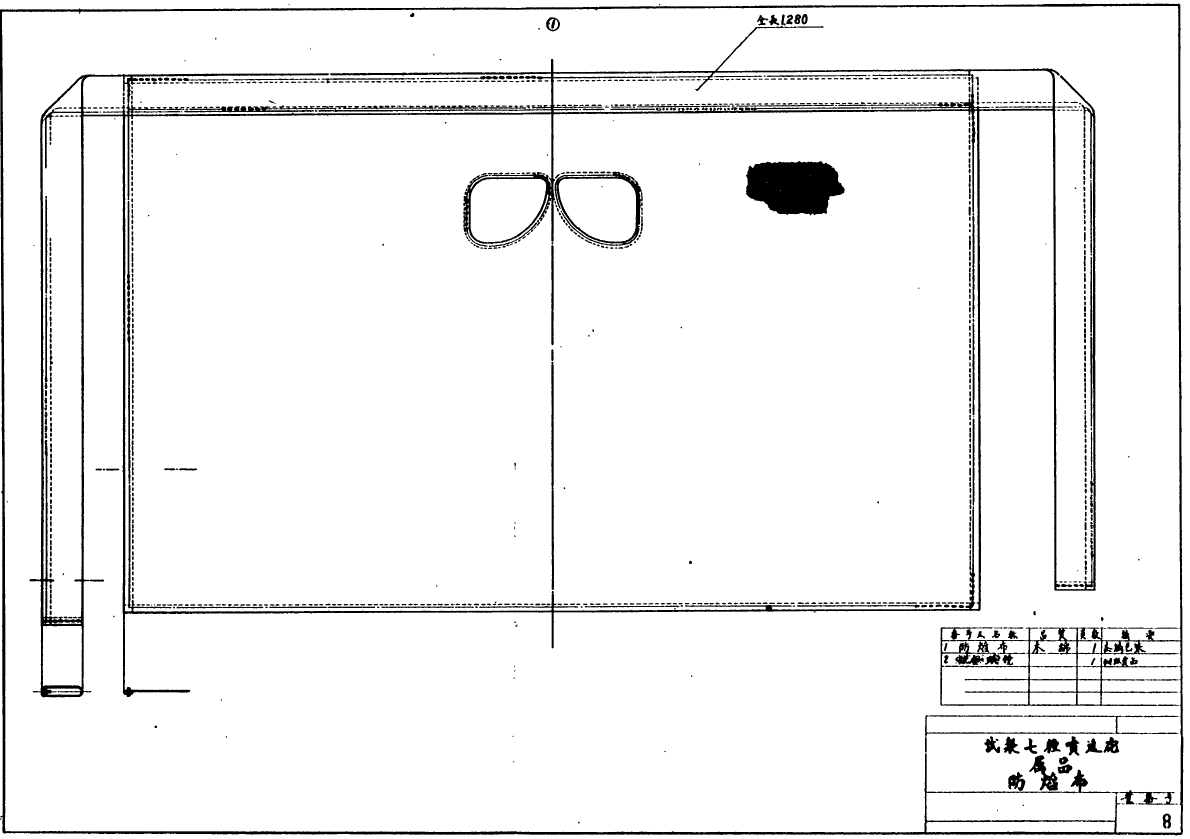
The muzzle velocity of the Type 4 projectile on the same Wikipedia page is given as 100 m/s, and the maximum velocity as 160 m/s. In the only JACAR document on the 70 mm Type 4 launcher, A03032210200, it is stated that protection from hot gases is required when firing the launcher. The document even contains drawings of protective clothing.

Снимок экрана 2026-01-10 135227


On page 9 it says: “射手ハ機關ヲ保護スル為眼鏡ヲカケル”. This can be translated as: “The gunner (shooter) must wear protective goggles to protect the eyes.”


Drawing of the protective mask on page 23.

The mass of the projectile, according to the same Wikipedia page, is 4.08 kg.

In the game, the Type 4 launcher has 80 mm of penetration at 90°, a muzzle velocity of 66 m/s, a projectile mass of 1.6 kg, and the gunner has no protection from hot gases. The last issue could easily be solved by issuing a gas mask similar to the one used with the Ofenrohr.


Type 5

In the JACAR document A03032150000 there is a detailed description of the Type 5 launcher and its grenade. According to the document, the launcher’s penetration is indeed 100 mm, but at impact angles from 45° to 90°.

1943d96d67ee7ef96056e057dd38d65f460c08e6 (1)

On page 14 it says: “第一 本弾ノ鋼板ニ對スル貫通威力ハ著角九〇度ヨリ四十五度附近ノ場合ハ厚サ一〇〇耗ノ鋼板ヲ貫通スル”. This can be translated as: “The penetration capability of this projectile against a steel plate: at angles of impact from 90 to approximately 45 degrees, it penetrates a 100 mm thick steel plate.”

From this, a logical conclusion can be drawn that the launcher is capable of penetrating 100 mm at angles close to 45°. Therefore, using the formula b(e) = b(n) / cos(α) (where b(e) is the effective or line-of-sight thickness, b(n) is the nominal thickness, and α is the angle of impact or inclination), one can calculate the real penetration against a steel plate at a 90° impact angle.

b(e) = 100 mm / cos(90° − 45°) ≈ 141 mm

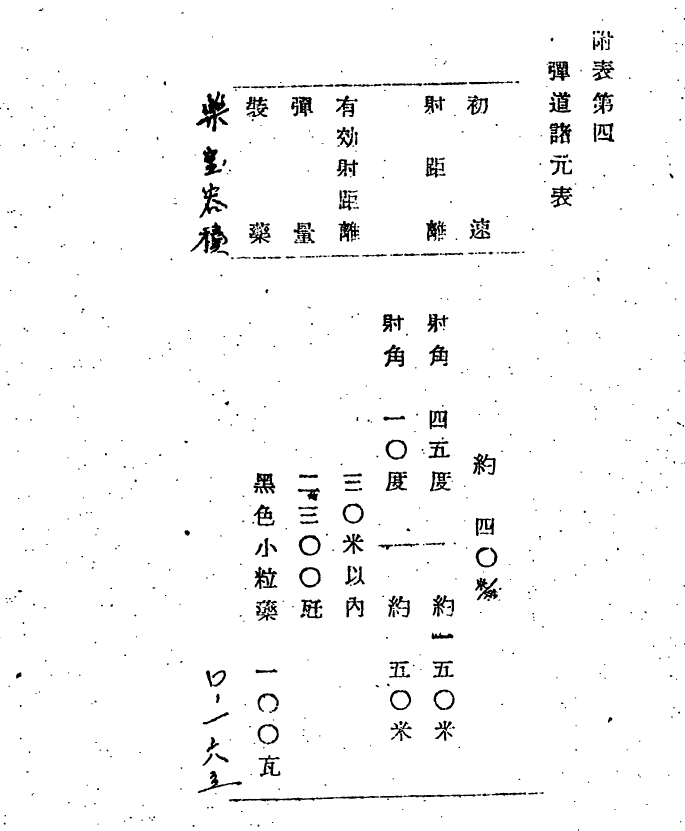
Next, the ballistic properties of the grenade should be noted. The muzzle velocity of the grenade is about 40 m/s. The mass of the grenade is 2.300 kg. Elevation angles and range:

  • At an angle of 45° — a range of about 150 meters.
  • At an angle of 10° — a range of about 50 meters.
eb1a410bf98e4e1a6331601d4db7d55a69d8cf64

On page 21 it says: " 初速 約 四〇米/秒, 彈量 二三〇〇瓩, 射距離 射角 一〇度/四五度 約 一五〇米/五〇米". This can be translated as: “Projectile velocity about 40 m/s, projectile mass 2,300 kg, firing distance at angles of 10°/45° is 150/50 m.”

In the game, the Type 5 launcher has 100 mm of penetration at 90°, a muzzle velocity of 82 m/s, and a projectile mass of 1.6 kg.


Poll

Increase the penetration of the Type 4 launcher?
  • Yes, up to 90 mm
  • Yes, up to 100 mm
  • No
0 voters
Increase the muzzle velocity of the Type 4 launcher projectile?
  • Yes, up to 100 m/s
  • No
0 voters
Increase the projectile mass of the Type 4 launcher?
  • Yes, up to 4.08 kg
  • No
0 voters
Give the Type 4 launcher gunner a gas mask?
  • Yes
  • No
0 voters
Increase the BR of the Type 4 launcher?
  • Yes, up to BR 3
  • No
0 voters
Increase the penetration of the Type 5 launcher?
  • Yes, up to 140 mm
  • No
0 voters
Decrease the muzzle velocity of the Type 5 launcher projectile?
  • Yes, down to 40 m/s
  • No
0 voters
Increase the projectile mass of the Type 5 launcher?
  • Yes, up to 2.3 kg
  • No
0 voters
Increase the BR of the Type 5 launcher?
  • Yes, up to BR 3
  • No
0 voters

Sources


THANK YOU FOR YOUR ATTENTION


10 Likes

Type 5 rocket launcher has no sights and is inaccurate so even with 140mm pen, its downsides are reasonable for BR2.

As for Type 4 rocket launcher IMO, there no need to increase its BR since the penetration won´t improve it significantly enough to be as capable as BR3 ATs like Panzerfaust 60 or M9A1 bazooka and the added penetration is often needed to effectively fight BR3 tanks.
While M1 Bazooka on BR2 has more than enough pen to deal with any BR3 Japanese or German tank, so this buff will only put Japan 1:1 with Allies in effect.

Axis can also get a slightly improved Hungarian bazooka with 100mm pen for BR2.

For BR3 Japan could get the more capable Type 4 RL prototype in 9cm

OR maybe Type 97 20mm with Ji-Te Dan
image

9 Likes

Yes, of course. I just need to include these polls to gather comprehensive feedback on the topic and clear up any controversial points that could be misinterpreted.

Actually, I’m curious about how they calculated the armor penetration here. If 120 mm of penetration—same as the 70 mm version—was achieved at an angle between 60° and 90°, then according to the b(e) = b(n) / cos(α), the actual penetration of the grenade launcher is ≈139 mm. That’s already much better for 3 BR.

Sigh… It’s such a shame we have so little information regarding Japanese experimental anti-tank grenades developed during WWII. Besides the grenade for the Type 97, there was a similar rod grenade for the Type 99 rifle, which utilized the shaped charge cone from the Type 3 shell (used in the 70 mm Type 92 gun). This shell could penetrate up to 75 mm of armor at angles between 60° and 90° (for some reason, the Japanese almost always used this peculiar way of calculating penetration). The main feature of this grenade is that it’s a rod-type, which technically means it could be used on automatic rifles, for instance, since all you need to mount it is a barrel of a specific caliber.

6ae64c4fb880af28594358a554719fd7ec526de0

Type 3 HEAT shell used by the Type 92 70mm infantry gun.

3 Likes

Whole lot of text most people can’t read and no pictures… no dopamine for zoomer brain

1 Like

Nearly double the pen for having to use experience instead of sights is not reasonable.

Yeah increase pen of type 4 to 90mm. Increasing velocity would be fine too. But if type 5 pen increase happens that gives it a lot more pen than the m9 bazooka so would have to be br 3

try using the Type 5 RL before commenting.

I have buddy. Look up what 140mm of pen does before commenting

let me take a wild guess, penetrate 140mm of homogeneous armour.
Whats your point?
If you did use it, you know full well that hitting a tank with it from a reasonable distance is unlikely.

1 Like

Look up how easily that pens tanks of br 4 3 and 2 before commenting.

expert

Most AT launchers can easily penetrate all tanks they can normally face (unless you bring a BR2 launcher like PIAT to BR5 and similar shenanigans, but thats on you) so armour is NOT the tank´s main protection against infantry held anti-tank weapons, but its mobility and distance from them.
Hitting a tank 30-50m behind enemy lines is far from easy especially if it keeps moving, even veterans with the best anti-tank weapons can struggle with it, often needing multiple adjusting shoots before a single hit.

Now imagine trying to hit a tank without any sort of sights, you will either run out of shells or die to the tank before you could hit it.
And one hit is usually not enough, unless you hit a weakspot.
So all in all, unless Type 5 gets significant buffs to its accuracy and post-pen effect, it wont be any better than Type 4 RL even against BR4 tanks.

1 Like

M9 bazooka totally easily pens an angled tiger. Grb easily pens t34 and kv1. Offenhor easily pens king tiger. The only launcher that that’s rlly true with is pf60 which is kinda op right now.

1 Like

all mentioned launchers have enough of penetration to frontally deal with said tanks.
Even Grb-39 has 90mm of penetration, the issue with Grb-39 has always been the aim.

The reason these launchers can still fail to pen mostly boils down to angle of impact, hitting the armour plate from a bad angle will heavily reduce the effect of the HEAT shells which doesnt have a very powerful post pen effect to begin with.
Something that can only be solved by good aim. How long do you wish to run these circles?

1 Like

They can but they don’t easily pen them and most cant pen them angled. ThTs the difference. Ur asking for a launcher with nearly double the pen of every other nations launcher at the br.

One numbers is not everything. We been over this a few times already.

1 Like

One number is prettt fucking important buddy.