Hello bajtársak and fellow forumdwellers,
This suggestion is closely related to “the flowermouth” topic so please read that too if you haven’t yet.
Also, I would like to apologise to Euthy as well, I know full well that the Type 16 Tsing Tao has already been suggested and noted down, however I couldn’t bring myself to write a short complimentary suggestion, I spent a lot of time researching this gun, so I wished to share it in its entirety.
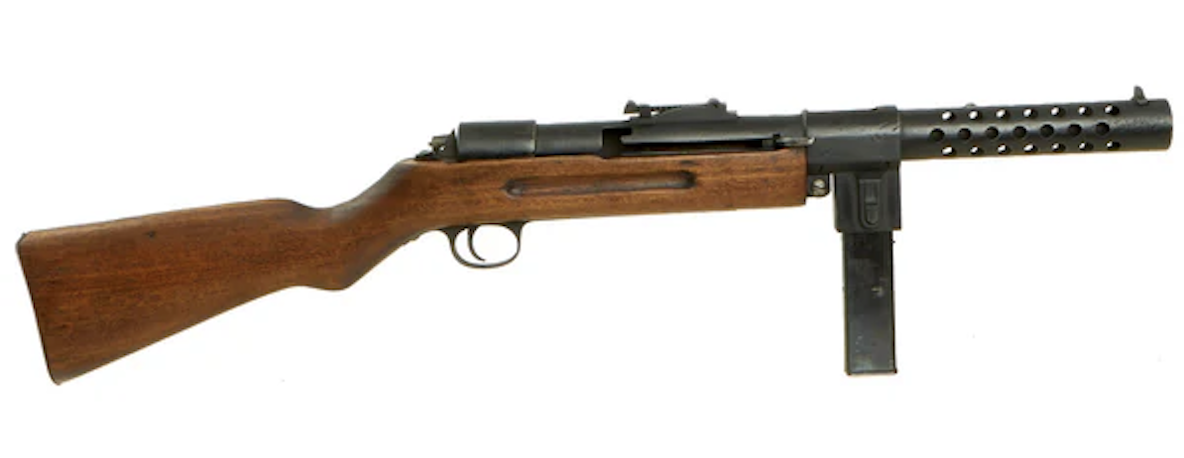
Just like all Flowermouth guns, the Type 16 was conceived by copying a SIG M1920 submachine gun. However one crucial change was made to the gun, the magazine well was rotated from the left side of the gun to the bottom.
There is no documentation of why this was done, thus this change has left historians baffled for years.
To understand why these changes were introduced, we need to take a look at the SIG M1930.
The SIG M1920 had a serious design flaw: there was no convenient place to hold the gun so soldiers would grab it by the magazine, however this could result in feeding failures or even damaging the magazine. To prevent soldiers from holding on to the gun by the magazine, the magazine well on the SIG M1930 was moved from the left side to the right side of the gun and a vertical grip was added as well.

Japanese soldiers in brutal urban combat, one of the soldiers is using a SIG M1920 and he is grasping it by the magazine.

The engineer staff of Tsingtao Iron Works was confronted by the same issue but instead of dedicating resources and extra work hours to equip their guns with grips, the magazine was moved beneath the gun, turning the long magazine into a psedu-monopod.

Some of you may get the idea that Chinese designers were forward thinking and used the magazine catch as a grip, similar to the Mp40, however that is not the case. The Type 16 was still meant to be held by the stock when fired while standing and it would be impractical to hold the gun by the magazine catch because of the magazine release button.
Remarkably, the Type 16 was mainly meant to be fired from a prone position, with the magazine pressed against the ground. Based on historical photographs this was the doctrine way of deployment of the Type 16 across most if not all users.
Considering the chronic machine gun, especially light machine gun shortages in China at the time, it should come as no surprise that the Type 16 was often used as a support automatic weapon to suppress the enemy positions.


Following the Type 16’s success, Taku Naval Shipyard has also started producing Flowermouth guns with their magazine well moved to the bottom of the gun, these guns are marked as Type 17 Taku and are very similar to the Type 16.
Externally the most obvious difference is that the Type 16 has its markings on the magazine catch while the Type 17 has its markings on the receiver.

The Type 16 also has a more comfortable and higher quality stock with an integral grip just behind the trigger, but the most helpful detail is the hand groove on the stock, which is cut much closer to the magazine on the Type 17 than on the Type 16.
These differences are as subtle as they sound thus differentiating a Type 16 from a Type 17 is only possible by close inspection.

There is conflict in the sources of when production began.
According to designations, the production of the Type 16 Tsingtao should have begun in the 16th year of the republic (1927) and the production of the Type 17 Taku in 17th year of the republic (1928), however sources suggest that production at Taku Navalyards began in 1926.
Production first ended at Taku as the Nationalist government had terminated production in 1935 due to political pressure.
Production at Tsingtao Iron Works continued until the Japanese invasion had reached the factory in 1938.
Production output is unknown, but is probably limited to a few thousands submachine guns.

Shanghai police before the Second Sino-Japanese war.
Before I would list the characteristics as usual, allow me to elaborate a little here.
The Type 16 and Type 17 are chambered in 7.63x25 Mauser only, there is no evidence that these guns would have been made in other calibers. Some people claim that these guns were also made in 7.65x21 parabellum, confusing Type 16 and Type 17 guns with the broader Flowermouth submachine gun family, some of which were indeed chambered in 7.65, but not Type 16 or Type 17.
Ammunition: 7.63x25mm Mauser
Magazine capacity: 20, 30, 40 or 50 rounds magazines
Muzzle velocity: 430 m/s
Weight: 4.3 kg (empty) of the Type 16; 4.2 kg (empty) of the Type 17
Length: 832 mm
Barrel length: 200 mm
Rate of fire: 500 rounds per minute for the Type 16; ~600 rounds per minute for the Type 17

A guard armed with a Type 17 Taku at the gate of Yan Xishan’s Jinxi garrison
There is no production data available from either factories and in army inventories both Type 16 and 17 guns were often not noted down separately from other Flowermouth guns, thus the most reliable source for researching users are photographs.
Based on all the information available to me:
Both the Type 16 Tsing tao and the Type 17 Dagu were used by the Fengtian clique (war lord faction in China); The Revolutionary Army of the Nationalist Government (Republic of China) and the Empire of Japan including its puppet troops.
Chinese soldiers had relied on the Type 16 and the Type 17 during the earlier years of the Anti-Japanese war, using them to great effect against the Japanese in close quarters combat, however all flowermouth submachine gun production was terminated by ~1940. Any loss to these guns were irreplaceable, thus Chinese troops relied less and less on these guns over time.
Its also worth noting that German trained divisions of the National Revolutionary Army did not use or only used Type 16 and Type 17 guns on a very limited scale.
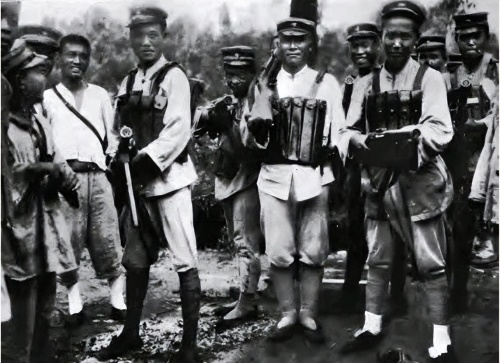
Soldiers of Fengtian clique.

soldiers of Fu Zuoyi’s army, National Revolutionary Army (Republic of China)

Soldiers of National Revolutionary Army during the Burma campaign or post war in south-west China.
Japan has captured significant numbers of the Type 16 Tsingtao as well as the type 17 Taku. These submachine guns were used by Japanese soldiers themselves in the early years of the war than they were redeployed to Manchuria to be used by security troops. In the later stages of the war, the security troops were the biggest users of both the Type 16 and 17.

Japanese soldiers posing for a propaganda picture during the battle of Xuzhou, a Japanese soldier is visible with a Type 17(?) in firing position.

famous Japanese depiction of their spoils of war

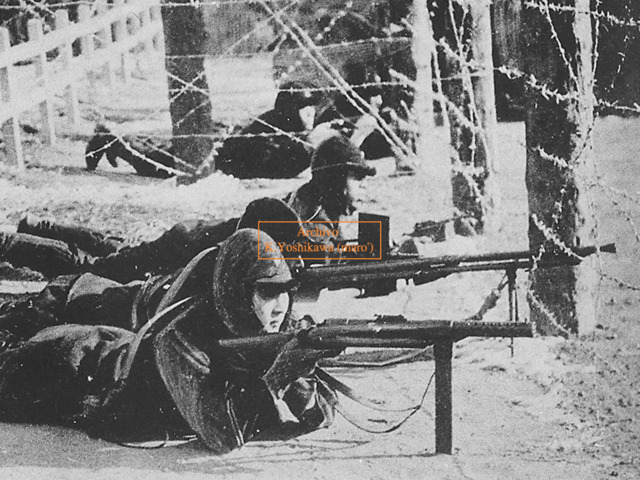
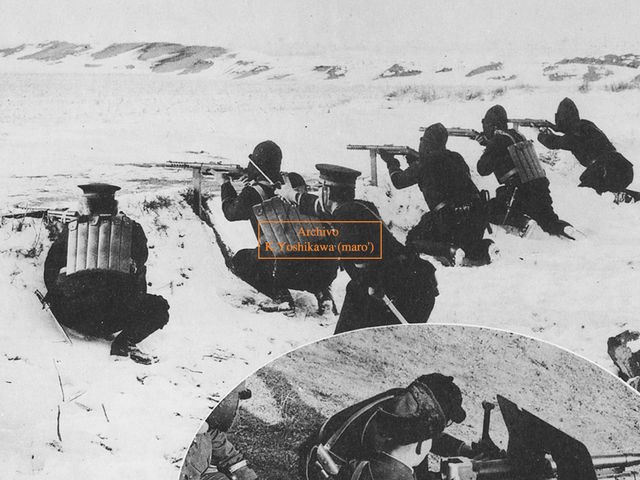
Japanese security troops in occupied Manchuria
I have no evidence that either Type 16 or Type 17 would have been used by Communist China or the Soviet Union during the Second World War. The People´s Liberation Army has indeed used both of the guns after the war, but it seems that they captured them in the aftermath of the Second World War.

Sailors of People´s Liberation Army Navy armed with Type 16 or 17 submachine guns, the PLAN was only founded in 1949.
Sources:
The Taku Naval Dockyard - Arms of China
Tsingtao Type 16 submachine gun (China)
China’s Small Arms of The 2nd Sino-Japanese War (1937-1945) - B. Shih
Rays of the Rising Sun, Volume 1: Japan’s Asian Allies 1931-45, China and Manchukuo
Because the Type 16 and Type 17 accept the same 7.63 SIG magazines as any other 7.63x25 flowermouth submachine gun, both guns can be loaded with: 20; 30; 40 and 50 round magazines.
Now, Japan already has the SIG M1920 and M1930 in BR3, plus the Mp28 (7.65) in BR2 so a 50 round version wouldn’t be interesting for them. It’s also worth keeping in mind that Japan could get a SIG M1920 or M1930 with a 20/30 round magazine as well so I wont go crazy and suggest all possible variations here (they can still be used later on).
Besides, Nationalist China subfaction deserves a slice of the cake as well.
Type 16 Tsing tao with 30 round magazine for Japan
Arguably Japan needs another BR1 submachine gun the most right now. The type 16 would fit in BR1 very nicely, it would have higher muzzle velocity, higher fire rate and more comfortable recoil than the S1-100, but less damage, no fire selector, no bayonet and worse dispersion.
- Yes
- No
- Tech Tree
- Premium/Event squad
- Event weapon
- Battle Pass weapon
A 30 round 7.63x25 SIG style mag loaded into a Flowermouth SMG.
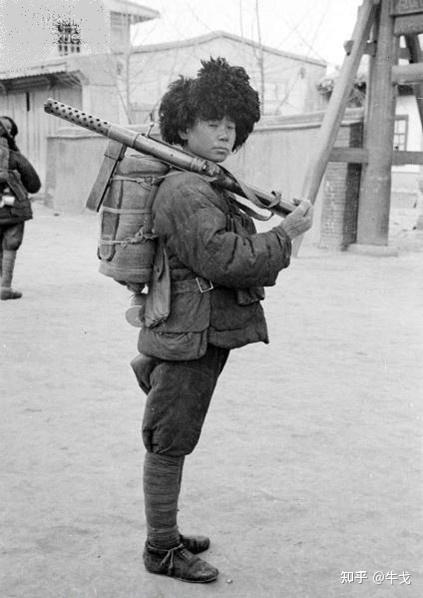
Type 17 Taku with 50 round magazine for Nationalist China subfaction
50 round magazines were the most common for flowermouth submachine guns so it would be most fitting to add the 50 round variant of the Type 17 Taku. In terms of stats, it would perform fairly similar to the SIG M1930.
- Yes
- No
- Premium squad
- Event squad
- I disagree