This is a continuation of the following two topics:
VG 1-5 Rebalance & VG 1-5 Feels Overly Op
I was about to post my reply to the latest one (first of the two above), but it was closed right as I was about to hit send. Unfortunate, but now I got time to rework my response into something more… ambitious.
Introduction
Greetings and salutations, friends!
This is no suggestion post - more of a rant I’ve decided to subject you all to. I’ve still got several suggestion posts on the production line, no ETA as of yet, but let’s talk about someone else’s suggestion in the meantime! Let’s get right into it.
The Topic
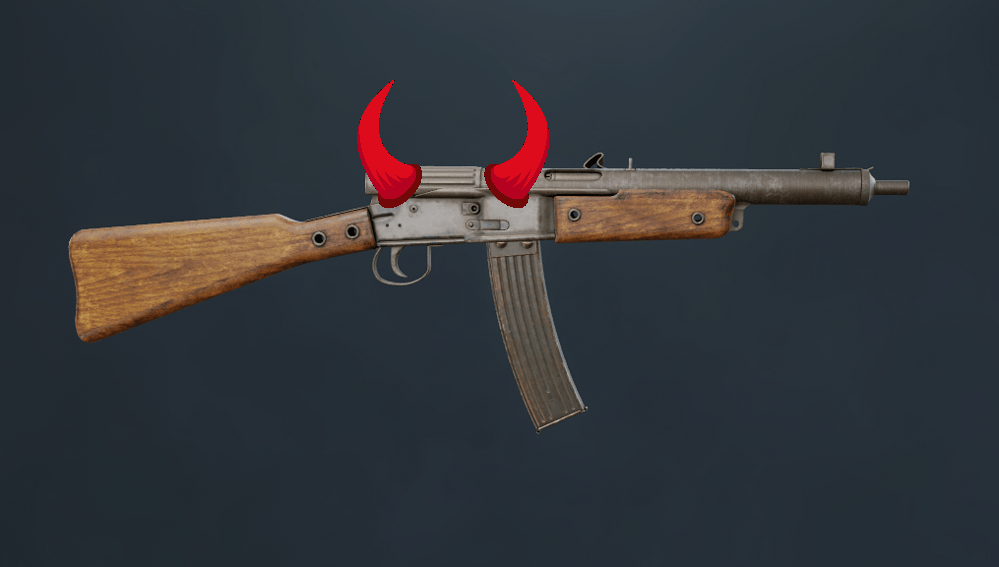
Seemingly, there are two camps when it comes to the VG 1-5. Either you’re of the opinion that:
- There is nothing wrong with the VG 1-5; it’s perfectly balanced as is.
- The VG 1-5 is a brutally oppressive sci-fi laser gun and thoroughly unbalanced.
Those are radically different, and incompatible, viewpoints. Irreconcilable disagreement is far from a rarity on the forum, of course, but in this case I do think there is a middle-point to be reached.
I happen to believe that most everyone on this forum, including on this specific topic, are rational agents. They have legitimate concerns and observations, even if the level of legitimacy does differ (quite wildly so) from concern to concern. People have reasons for why they believe as they do, good or bad, and if we’re going to meaningfully disagree with them, we ought to understand those reasons first.
That is why I feel comfortable in saying; both perspectives are each sitting on a kernal of incomplete truth.
Yes, look at me, the Swede is being neutral and democratic.
The Concerns - for and against
Concern 1 (for), comparative carbine balance.
The biggest concern with the VG 1-5, at least for me, is that it will forever outperform every other weapon in its own weapon class to a noticeable degree. And I don’t mean that simply because it is a particularly strong weapon right now; there is a more fundamental problem here.
The VG 1-5 is the only semi-automatic carbine in the game that benefits from an intermediate cartridge. Lets look at the three broad categories of cartridges used by the other carbine-like weapons:
- Intermediate - an intermediate-power cartridge, offering relatively high damage and velocity.
- Pistol - pistol-calibre carbines, offering lower damage and velocity.
- Carbine - the .30 Carbine and similar cartridges, sitting somewhere between the two above.
The VG 1-5 therefore gets the advantages of the most powerful cartridge used by a carbine, but without suffering a correspondingly significant disadvantage. One might expect the more powerful cartridge to result in substantially greater recoil, for instance, but the pistol-calibre carbines are the only ones which really get a noticeable recoil advantage. In fact, the VG 1-5 itself has less recoil than the M1 Carbine.
That doesn’t mean the VG 1-5 has literally no disadvantages whatsoever (the 0.1 second worse reload compared to the M1 Carbine does exist), but it does mean that its ballistic advantage isn’t being adequately offset by its handling. It gets substantially higher damage and velocity without paying a comparable price for doing so.
Now, the eagle-eyed among you have probably noticed the obvious counterpoint: the VG 1-5 is also the only carbine-like weapon at BR III, and therefore already sits a full BR above the M1 Carbine and either one or two above its other carbine counterparts. Surely that is the balancing factor?
I don’t think it is - at rather, not one that actually targets the true issue.
Lets take the hypothetical 30-round M1 Carbine as an example, which would obviously also be BR III. Many of us, myself included, would like to see the M1 Carbine 30 added to the US tech tree at some point. We can rightly assume that it will retain the basic characteristics of the existing M1 Carbine, while gaining a 30-round magazine and bayonet attachment.
Now compare that theoretical M1 Carbine 30 to the VG 1-5. Both would have the same magazine capacity, so the VG 1-5’s advantage in that department disappears. The M1 Carbine 30 would also have a bayonet, giving it a singular - small - advantage.
Is a bayonet really the equivalent of noticeably higher damage and noticeably higher velocity, though?
Obviously not. There has to be some disadvantage to compensate for the VG 1-5’s considerably more powerful cartridge, otherwise the weapons aren’t really trading advantages and disadvantages at all.
And this is where I genuinely do think the VG 1-5 is overperforming. I don’t think it is overperforming by some massive, game-breaking degree. BR III balance isn’t ruined or unplayable because the Germans has the VG 1-5 - it is my favourite BR across all factions, but the gap is nevertheless too large. Compared to the regular M1 Carbine at BR II, the VG 1-5 has noticeably more damage, noticeably more velocity, twice the magazine capacity, marginally less dispersion and even marginally less recoil - despite firing a substantially more powerful cartridge.
That isn’t a gentle increase in performance which can easily be explained by moving from BR II to BR III. The jump is sufficiently large that it starts to resemble the performance increase from BR IV tech tree semi-auto to V select-fire rifles.
And then there is one final consideration: the VG 1-5 can be given to absolutely anybody, as it has no class restrictions. I don’t consider that a problem in itself, though. If anything, unrestricted access should simply become standard for all carbine-style weapons.
And to be absolutely clear, I am not arguing that the VG 1-5 is too powerful for BR III as a whole. The fact that it is an exceptionally strong weapon at BR III isn’t, by itself, a problem. BR III contains plenty of very capable weapons (I love the Lanchester 50, for example), and the VG 1-5 being one of them does not constitute some sort of balance emergency.
My concern is specifically with its performance relative to other carbines. It is simply too far ahead of the weapons occupying the same general niche. And that distinction is important, because it means there is some room to bring the VG 1-5 down slightly without turning it into a bad weapon. It can afford to lose something while remaining an extremely capable BR III weapon.
Concern 2 (for), the lack of equivalent weapons to add.
This leads into the second problem, and one which I think is rather easy to overlook when people suggest simply giving the other factions something equivalent.
“Just add something similar for the other nations” sounds like an obvious solution to the VG 1-5’s comparative advantage. If Germany gets an unusually powerful semi-automatic carbine, then surely the Allies, Japan, and the Soviet Union should get something comparable in BR III?
The problem is that history doesn’t really cooperate with us here.
The VG 1-5 is unusual precisely because it combines a semi-automatic carbine format with an intermediate cartridge. Other nations certainly produced plenty of self-loading rifles (and quite a few examples of semi-automatic carbines), but their solutions generally went in different directions: pistol-calibre weapons, such as the S&W Light Rifle, M1903 w/Pedersen Device, or Beretta M1918/30, or dedicated carbine designs using a cartridge like .30 Carbine, which occupies a middle ground between pistol ammunition and the intermediate 8mm Kurz cartridge used by the VG 1-5.
And therein lies the problem. If we have established that the VG 1-5 gets a substantial ballistic advantage from its intermediate cartridge without suffering a correspondingly substantial handling disadvantage, then simply giving every other faction a historically appropriate pistol-calibre or .30 Carbine weapon in their tech trees does not actually reproduce the same performance.
A 30-round M1 Carbine would solve the magazine capacity comparison, for example, but it would still be firing .30 Carbine. It would therefore still have the lower damage and velocity inherent to that cartridge. It wouldn’t really be an American equivalent of the VG 1-5; it would just be a very good M1 Carbine.
That is the main issue of the VG 1-5 for me. The VG 1-5 isn’t overperforming against other BR III weapons, at least not by much, it is inherently overperforming anything that could ever come close to matching its gameplay role.
And this is where I think some of the criticism of the previous discussions misses the actual problem. Yes, giving other nations competitive weapons is generally preferable to simply nerfing one faction’s weapon into the ground. But, that only works if those nations actually have historical weapons which can occupy the same niche.
Germany does.
The others, for the most part, don’t.
That means we cannot simply assume that every faction can be given its own VG 1-5 equivalent and call the problem solved. If the VG 1-5 is allowed to retain its current combination of high damage, high velocity, and comparatively mild recoil, all with no drawbacks, then there is no obvious historical route for the other factions to catch up within the same weapon class.
And if the solution instead becomes “give them ahistorical weapons, or historical weapons artificially and arbitrarily made to perform like the VG 1-5”, then we’ve solved one balance problem by creating an entirely different one.
So, ironically, the fact that the VG 1-5 is historically unusual is itself part of the balance problem. It isn’t merely a matter of one weapon being somewhat better than all its contemporaries; it occupies a niche which the other factions cannot easily replicate without either bending history or stats to a unreasonable degree, giving them weapons which don’t actually belong in that niche, or giving everyone yet another round of captured or magically teleported weaponry.
That is why I don’t think “just add equivalent weapons to the other nations” is a satisfactory answer on its own.
Concern 3 (for), dispersion and historical considerations.
The third concern is a somewhat different one, and this time it is primarily historical.
The VG 1-5 was not designed to be the next great German service rifle. It was a last-ditch weapon, intended to arm the Volkssturm quickly and cheaply as Germany’s ability to produce conventional military equipment was rapidly collapsing. Like the other so-called Volkssturmgewehr weapons, it was designed around simplified construction and was produced under the increasingly desperate industrial conditions of the final months of the war, rather than being a mature service weapon manufactured to the standards of Germany’s established arms industry.
That does not mean the VG 1-5 should “shoot sideways”. Obviously not. A last-ditch weapon can still be perfectly functional, and individual examples could certainly be more accurate than others. Nor am I suggesting that every VG 1-5 ever produced was inherently inaccurate - I lack the data to make a definiative statement.
What I am suggesting, and what I think OP was suggesting, is that the current dispersion statistic is rather difficult to reconcile with the weapon’s historical context.
The VG 1-5 has a dispersion of 0.19, making it the most accurate BR III tech-tree rifle in the game. That is admittedly only 0.01 better than the 0.20 of the M1 Garand, SVT-38 and G41, but consider what that actually means: the game is currently telling us that this hastily produced last-ditch Volkssturm rifle is more accurate than several full-powered service rifles actually adopted for military use. Why…? Even without a historical lens and focusing just on gameplay, why…?
And it gets even more amusing when we look further up the German tech tree.
The Mkb 42(H) has 0.25 dispersion. The StG 44 has 0.22. Both are BR V assault rifles - two full BRs above the VG 1-5, and both are considerably more sophisticated weapons that were actually designed and manufactured as proper military arms, using the same magazine and ammunition as the later VG 1-5. The VG 1-5 is, according to the game’s statistics, more accurate than both of them.
I am quite happy to accept that Enlisted’s statistics are not intended to be a perfect simulation of historical weapon performance. There are balance considerations, gameplay considerations and all sorts of other abstractions involved. But there is a limit to how much abstraction I think is necessary here. I simply don’t see a good reason for the VG 1-5 to be one of the most accurate rifles in its entire BR III bracket, let alone more accurate than the Mkb 42(H) and StG 44 it was supposed to act as a desperate substitute for.
And unlike some of the other proposed balance changes by OP (which have ranged from the absurd to the insignificant, but rarely inbetween), this is one where there is plenty of wiggle room. Increasing the VG 1-5’s dispersion does not require us to pretend that it was incapable of hitting the broad side of a barn. It merely means that we stop treating it as an exceptionally accurate rifle.
The previous topic did not specify an exact value for this, but personally I think somewhere around 0.29–0.31 would be perfectly reasonable - less accurate than assault rifles, but noticeably more accurate than the majority of submachine guns. That would still leave the VG 1-5 as a perfectly usable - indeed, a still very good - BR III weapon, whilst bringing its accuracy down to something which makes considerably more sense both in terms of its place amongst other carbines and its historical circumstances.
And again, this is not an argument that the VG 1-5 needs to “shoot sideways”. That’s just needless hyperbole. The comparison here isn’t between the VG 1-5 and some fictional weapon which can’t hit anything; it is between the VG 1-5 and actual service rifles and assault rifles which are already in the game - and I see no one calling either inherently inaccurate.
In short: the VG 1-5 does not need to be inaccurate. It simply doesn’t need to be the most accurate rifle in the room, either.
Concern 4 (against), the hyperbole - a balance crisis?
So, having now spent several paragraphs explaining why I do think there are legitimate problems with the VG 1-5, I think it is only fair that I turn my attention to the other side of the argument.
The VG 1-5 is a very good weapon. I have already said as much, and I am not going to pretend otherwise just because I am about to defend it from some of the criticism it has received. But, there is a rather significant difference between saying that a weapon is “very good” and saying that its existence represents some sort of existential crisis for the game’s balance.
I don’t think the VG 1-5 is an existential crisis.
The two previous topics, at various points, painted the VG 1-5 as if BR III Germany had somehow been handed a futuristic death ray which completely invalidates everything below it and besides it. That is rather difficult to take seriously when we actually start comparing it to the rest of the game.
The basic complaint about BR II players encountering the VG 1-5 when uptiered is, in itself, perfectly legitimate. Nobody particularly enjoys being on the receiving end of a stronger weapon or vehicle. But that is quite literally what an uptier is: you are being placed into a battle containing weapons and vehicles which are, by design, not necessarily equal to your own. The question therefore isn’t whether a BR II player is less well equipped than a BR III player. Of course they are. The question is whether the particular difference created by the VG 1-5 is so extraordinary that it constitutes some unique matchmaking problem.
I don’t think it does.
There are plenty of substantially more dramatic examples elsewhere in the game. A BR II Allied player with their Bren encountering an Axis MG 34 is not exactly receiving the same experience as they were fighting with a BAR. A BR II Axis tanker facing a KV-1 can find themselves in a rather more substantial technological disagreement than “my semi-automatic carbine has slightly worse ballistic performance than yours”. And these are hardly the only examples.
BRs are not intended to produce perfectly symmetrical match-ups between every weapon and vehicle. If they were, there wouldn’t really be much point in having a Battle Rating matchmaking system in the first place.
That doesn’t mean that every disparity is automatically acceptable. Quite the opposite: the entire purpose of discussing balance is to identify disparities which have become excessive. But we need to distinguish “the way this weapon is balanced is an issue for additional future content” from “this is so much stronger that the matchmaking system has fundamentally failed”. The VG 1-5 falls into the former category, not the latter.
And then there is the matter of statistics.
A surprising amount of the criticism in the previous topics was framed around personal experience. I don’t want to dismiss personal experience, not entierly. If enough players are having a particular experience, that is worth investigating. But personal experience is not, by itself, a particularly good measurement of weapon balance - and certainly not a useful point if it is effectively agreed to only by one person.
Especially in a game like Enlisted, where individual encounters are affected by positioning, range, player skill, loadout, terrain, latency, weapon handling, and a dozen other variables, ‘this weapon keeps squad-wiping me’ is not exactly a statistical argument.
If we’re going to call the VG 1-5 catastrophically unbalanced, then I would like to know compared to what?
How much faster does it kill? At what ranges? How much more controllable is it? How much more effective-ammunition can it put down before reloading? How much more often does it win comparable engagements? How large is the performance gap relative to other BR II-III weapons? Those are the sorts of questions which can actually establish the size of the supposed problem.
The VG 1-5 is very good. It has a powerful cartridge with good damage and velocity, a large magazine, relatively low recoil and excellent dispersion. Those are all legitimate reasons to question its current statistics, as I have already done. But “very good” does not automatically become “game-breaking”, and “stronger than a BR II weapon” does not automatically become “unfair matchmaking”.
So yes, by all means, let us criticise the VG 1-5. I am doing exactly that myself. Just let us keep the criticism proportional to the problem.
If the VG 1-5 is a particularly strong BR III carbine which could use some sensible adjustments, then let’s discuss those adjustments. If it is a sci-fi laser gun which has single-handedly brought the entire Battle Rating system to its knees, however, I would appreciate seeing the evidence.
The End, finally

Anyway, that has been all I have to say on this topic. Sorry for subjecting you all to this giant wall of text, I considered that mostly everyone (on both sides) was suffering from a distinct lack of perspective on the subject - I could not let that stand uncorrected. So, I placed myself in the very enviable position that puts me at odds with everyone all at once - yay me.

Until next time, dear readers, and remember: balance is a more complex topic than we all give it credit for.
Signed,
Lt. Ogge King, 3rd Experimental Tea Infusion and Small Arms Appreciation Company, Home Guard (Reserve)
God save the King