Introduction

Greetings and salutations, friends!
This time around, I’d like to suggest the addition of the Australian No. 1 Mk III* HT sniper rifle as a BR II bolt-action sniper for the Allied faction (USA/Commonwealth), introduced in the tech tree.
This rifle would help fill the gaps in the Commonwealth’s sniper options, specifically for BR II, giving us a WW2 appropriate “SMLE” sniper. It’d also represent the only genuinely successful attempt to turn the SMLE platform into a proper sniper rifle, which Australia righfully deserves praise for accomplishing.
Historical Background and name
Background

The British (and the Commonwealth in general), like others at the time, did not go into WW1 with sniper rifles. When Germany started using rifles with hunting scopes as prescion weapons against them, the actual battlefield value of a sniper was found to be insignificant but the morale value to be descisive. In response, the British started experimenting with their own scoped rifles, of all kinds of scope + rifle combinations and mounting variations, all of them lacking proper and unique designations/names until some sort of standard was forced through by the war’s end.
By the Second World War, no British SMLE/No. 1 sniper rifles remained in service.
All First World War SMLE snipers had their scopes removed, the optics either surplussed or discarded if they didn’t meet standardisation requirements, and the rifles themselves returned to general service. The Pattern 1914 (T) rifles, with specifically the Pattern 1918 Aldis scope, were retained as the sole Empire-wide sniper platform. This is the same rifle we see in game as a BR I premium.
This was not without reason. During WWI, the British were consistently unimpressed with the SMLE’s performance as a precision rifle. Offset scope mounting, variable accuracy due to rifle bedding, rear locking-lugs on the bolt, and lacking reciver strength, plus the limits of early production meant that the No. 1 never truly excelled in the sniper role, consistently performing worse compared to the P14.
During WW2 Australia, however, succeeded where others had not.
The Rifle No. 1 Mk III* HT - all manufactured and refited by Lithgow Small Arms Factory, Australia - represented a serious and ultimately the only successful effort to turn the SMLE into a proper, high-quality sniper platform. Using carefully selected rifles for accuracy, deliberately using only heavy barreled marksmen/target rifles, carefully bedding and fitting each rifle during the conversion process, and sticking to a centre-mounted scope mounting solution, Australia produced a sniper rifle that was not merely functional, but respected for its performance.
Between November 1944 and February 1946, approximately 1,612 rifles were assembled. While this was fewer than the roughly 2,000 WWI-era P14 (T) rifles available across the Empire before the war (especially during the war before production finished), the No. 1 HT was nonetheless:
- A genuine WWII-era production weapon
- Formally adopted and issued
- Used operationally during the last year of the war and retained in service well into the post-war period
This makes it historically preferable to various experimental, obsolete, or purely notional SMLE sniper configurations that never existed in wartime inventories.
There’s also a nice piece of legacy here, as there might well be a few Australian players who had their fathers or grandfathers (or even themselves!) trained on this sniper’s weapon in the 60s and 70s.
Name
It should be added to the game as the “Lee-Enfield No. 1 Mk III* HT”.
The No. 1 is self explanatory, after 1926 all SMLEs were redesignated as “Rifle No. 1” to fit the new standardised rifle nomenclature system. The Mk III* means that it’s a Mk III SMLE/No. 1 rifle, without the magazine cut-off. The H stands for “Heavy barrel”, these barrels were indeed heavier than the standard rifles, because these rifles were designed to be either military marksmen rifles from the ground up or intended as civilian target rifles. The T stands for “telescopic”, denoting the fact that it has a scope on it.
It’s fully correct name is “Rifle No. 1 Mk III* HT”, this was the name it was officially adopted and manufactured as, calling this rifle a “Sniper SMLE Mk III” would be incorrect, and would confuse it with earlier WW1-era British rifles.
Scope and Configuration

The rifle would use the Aldis Pattern 1918 scope, already present in Enlisted on the BR I Premium P14 sniper rifle. The historical diference here is that these scopes were domestic Australian production scopes, whereas the scopes on the P14 were WW1-era vintage, but that’s no reason to create a completely new model. This makes implementation simpler by avoiding the introduction of a completely new optic.
Additionally, the sniper rifle came in two main different configurations based on how the Pattern 1918 scope was mounted; Either a high-mount scope (“Medium bracket” officially), or a low-mount (“Short bracket” officially). Both high and low mounts were centre-mounted. Additionally, a wooden cheek piece could be added to or removed from the buttstock by a armourer, if requested by the individual sniper.
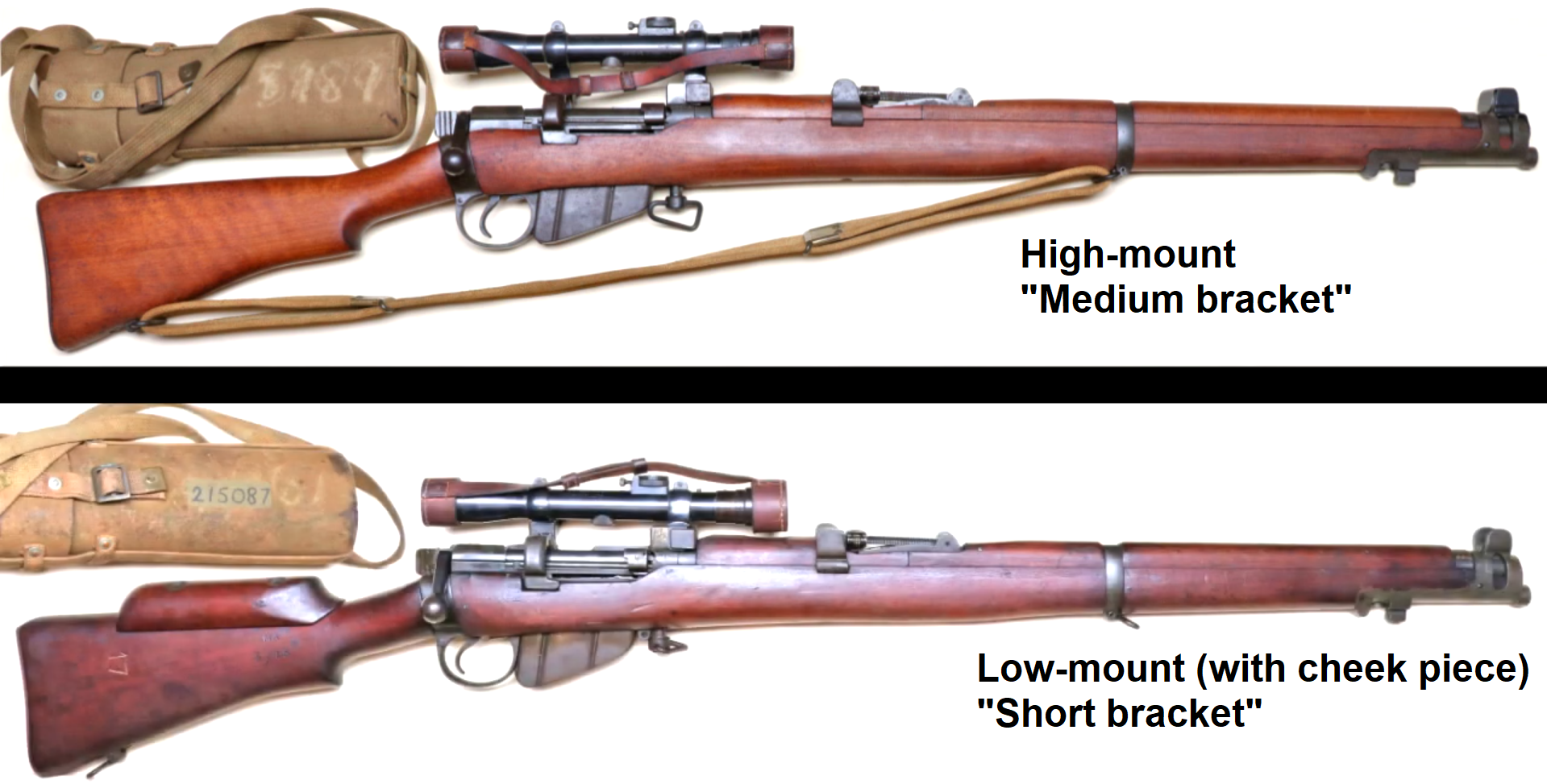
Personally, I like the look of the cheek piece, it makes the rifle look more distinctive, so I think it should be on the wepaon in game. As for the specific scope-mounting solution, I have no perticular opinion, both look good. Though, it seems that most photos depict the high-mount style.
Tell me down below which one you prefer (then I’d also know if you were a good boy/girl/tank that read through this suggestion)!
Stats

Stats would be identical to the current SMLE Mk III tech tree rifle in game, apart from:
- It’d have a 4x power magnification scope.
3x IRL, but in game the Pattern 1918 has 4x power on the P14 (T), and no scope in game (as far as I am aware) has less than 4x power, so the No. 1 HT should have the same performance here as well.
- Use single bullet reloads only, to justify its BR II placement.
It would be incapable of accepting stripper clips (“charger clips” in British/Commonwealth service) due to its centre-mounted scope, and making it reload through mag changes would just have us creating a slightly weaker No. 4 (T) rifle in BR III. In other words, it’d reload like the Pre-war Kar98k currently does in game.
- Aye
- No (please explain why below)
- I hate all sniper rifles
Tech Tree Rationale
The No. 1 Mk III* HT should be a tech tree unlock because:
- It represents a standardised, adopted, produced, issued, and used weapon of WW2, not a prototype.
- It provides Commonwealth players with a second sniper option outside of their sole other tech tree choice, the No. 4 in BR III.
As a true wartime sniper rifle, it deserves priority over ahistorical or experimental alternatives that did not see service.
Image Gallery
Arthur Francis Hill posing with his No. 1 HT.

A No. 1 HT with high-mount scope as displayed on the Australian War Memorial webpage.
A No. 1 HT with high mounted scope and cheek piece.

A loose No. 1 HT cheek piece.

A close up of the No. 1 HT buttstock with a cheekpiece mounted.

Private L. Tunks of C Company, Australian Imperial Force 2/43rd Battalion, August 1945. The scope a high-mount and is equipped with a rubber eyepiece.
Snipers Corporal Clayton “Chicka” Donnelley and Lance Sergeant Gordon “Bill” Burley, 2/4th Commando Squadron on Tarakan Hill, Borneo, 5 May 1945. High-mount scope.

Sources Used
NRA American Rifleman - 'A Grisly Business:' Australia’s Lee-Enfield Sniper Rifle | An Official Journal Of The NRA
Lee Enfield Rifle Association of Australia Inc. (LERAA) - Lithgow SMLE No1 Mk3 HT – Lee Enfield Rifle Association of Australia Inc. (LERAA)
Lithgow Small Arms Factory Museum - Lithgow Small Arms Factory Museum
Youtube video by Ian Skennerton, Australian firearms expert and member of the LERAA - https://youtu.be/-zh_t1v3O2U?si=1Gt1TRHRvM0WjE3Y
Conclusion
The Australian No. 1 Mk III* HT offers a rare combination of:
- A BR II Commonwealth Sniper option
With,
- Strong historical legitimacy
It would give the Commonwealth specific players a much wanted BR II sniper rifle (so they don’t have to rely on US Springfields anymore), showcase a unique Australian contribution to WWII small-arms development, and finally allow the SMLE to shine in a role it was unable to fully during the First World War — through no small amount of Australian persistence and ingenuity.
Thanks for reading, and remember: It turns out the No. 1 had it in it after all.
Signed,
Lt. Ogge King, 3rd Experimental Tea Infusion and Small Arms Appreciation Company, Home Guard (Reserve),
God save the King.

