Will you use the rifle at BRI? At BRII it’s massively outclassed by anything else the soviets have.
What about the Moschetto M91, the Berthier M16 or the Arisaka 38 Carbine for the soviets? Are they horrid because they’re BR1 premiums? The squad is what needs to be interesting and a chinese squad can be exactly that.
I would rather it be a premium at that point than waste an event squad slot where truly unique weaponry can be showcased, yes. And we would still need to find literally 1 piece of equipment USSR can have added on their own update.
Germany annexed/occupied Czechoslovakia with all its factories.
And while I am also not a fan of ZH-29 being available for the Germans, I can at least get the idea behind it.
Chinese weapons in the Soviet tree, on the other hand, make as much sense as Saudi weapons would make in Japan’s tree:
USSR never received lend-lease from China, never annexed Chinese territories with factories to produce any weapons, hell I’d even bet that not a single soldier of the Red Army EVER went to battle with a Chinese weapon.
It makes no sense.
Ngl I prefer 0 content to fake unrelated content.
And truth be told, almost all relevant Soviet WW2 content has already been added to the game.
If you ask me what they should get eventually, that’d be SG-43 MG, ISU-122/152 and a Soviet high BR AT cannon.
Did it tbh? Not even the soviboo mains were asking for that.
At least the Chinese War Mod will get a nice new weapon for it at least.
Saying this, this is the least egregious of Chinese weapons to added, it should have been a limited event squad or even premium squad, not TT, but I digress.
Two wrongs dont make a right, and certainly not 101 wrongs.
Look I get why your mad at him, Veekay is a bit much a lot of the time, bordering on extremist, however he still has valid points sometimes and we cant just disregard that because of personal feelings.
They annexed the factories and land far after the zh-29 was produced and shipped out. KE-7 was a swiss gun that they most certainly didn’t annex to begin with. I would still disagree with it being in there in general if we wanna go off “historical accuracy”
KE-7 was 1929-1938
ZH-29 was also 1929. And only around 150 were made. I doubt they had any left in 1939 when the annexation and stuff kicked off. After China already contracted and bought the batch from the Czechs.
It is with great honor and the highest respect for the Soviet and Chinese people who liberated their land together that I begin publishing material describing one of the many battles that raged in Manchuria during the days of the defeat of Japan.
I would personally love a Hungary campaign. As we would then have Allied Romania fighting with the USSR to take Budapest. We could add Hungarian Turan and Zrinyi tank models and maybe a gun or two for Axis TT.
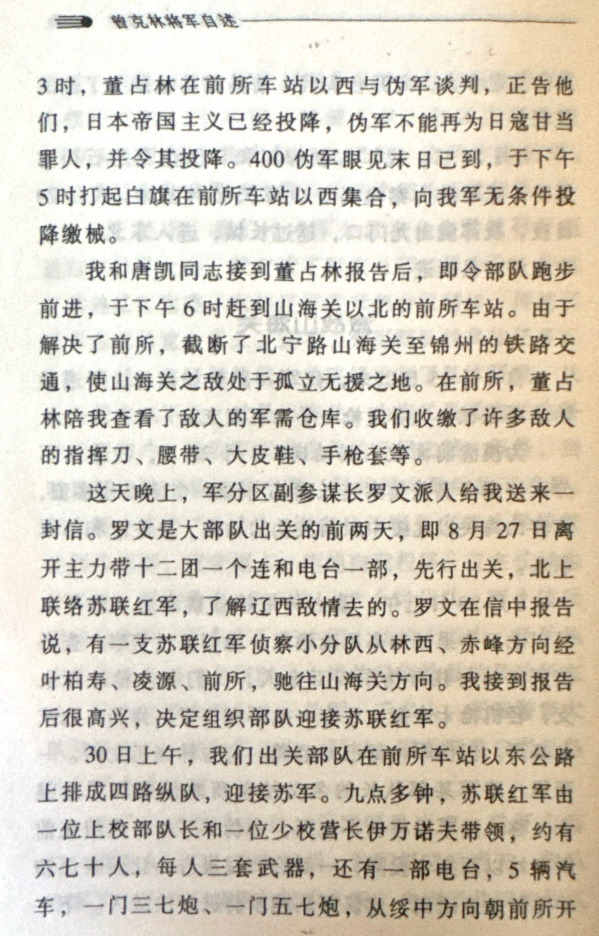
That evening, Deputy Chief of Staff Luo Wen of the military sub-district sent me a letter. Luo Wen had left the main force two days before the six units advanced beyond the Great Wall, on August 27. He led a company from the 12th Regiment and a radio unit ahead to move beyond the Great Wall, heading north to liaise with the Soviet Red Army and gather intelligence on the enemy situation in western Liaoning. In his letter, Luo Wen reported that a Soviet Red Army reconnaissance unit was heading from the direction of Linxi and Chifeng, via Yebaishou, Lingyuan, and Qiansuo, towards Shanhaiguan. I was very pleased upon receiving this report and decided to organize our troops to welcome the Soviet Red Army.
On the morning of the 30th, our troops that had advanced beyond the Great Wall formed into a four-column formation on the highway east of Qiansuo Station to welcome the Soviet forces. A little after 9:00 a.m., the Soviet Red Army, led by a Colonel as the unit commander and a Major (Ivanov) as a battalion commander, arrived from the Suizhong direction towards Qiansuo. The unit consisted of about sixty to seventy soldiers, each carrying three sets of weapons. They also had a radio unit, five vehicles, one 37mm artillery piece, and one 57mm artillery piece.
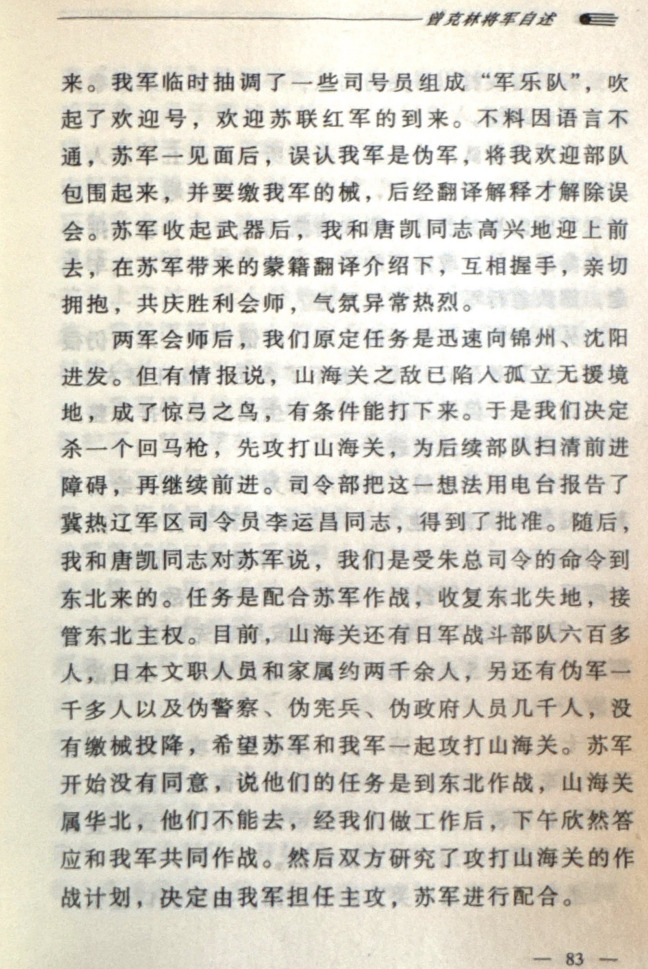
Our troops temporarily assembled some buglers to form a “military band,” playing welcome music to greet the arrival of the Soviet Red Army. However, due to the language barrier, the Soviet forces initially mistook our welcoming troops for puppet soldiers upon meeting. They surrounded our welcoming unit and attempted to disarm them. The misunderstanding was only resolved after explanations through a translator. Once the Soviet soldiers put away their weapons, Comrade Tang Kai and I happily stepped forward. Introduced by the Mongolian translator accompanying the Soviet troops, we shook hands, warmly embraced, and jointly celebrated the victorious meeting in an exceptionally enthusiastic atmosphere.
After the two forces joined, our original mission was to swiftly advance toward Jinzhou and Shenyang. However, intelligence indicated that the enemy forces in Shanhaiguan had become isolated and without support, like birds startled by the mere twang of a bow—vulnerable and potentially defeatable. Therefore, we decided to turn back and attack Shanhaiguan first, clearing obstacles for the follow-up forces before continuing the advance. The headquarters reported this idea via radio to Comrade Li Yunchang, Commander of the Ji-Re-Liao Military Region, and received approval. Subsequently, Comrade Tang Kai and I explained to the Soviet forces that we had come to the Northeast under orders from Commander-in-Chief Zhu De. Our mission was to coordinate with the Soviet Red Army in combat, recover the lost territories in the Northeast, and take over sovereignty. Currently, in Shanhaiguan, there were still over 600 Japanese combat troops, approximately 2,000 Japanese civilian personnel and their families, as well as over 1,000 puppet soldiers and several thousand puppet police, military police, and government personnel who had not surrendered their weapons. We expressed our hope that the Soviet forces would join us in attacking Shanhaiguan. Initially, the Soviet side did not agree, stating that their mission was to operate in the Northeast, and Shanhaiguan belonged to North China, which was outside their operational scope. After further discussion, they happily agreed in the afternoon to conduct joint operations with our troops. Subsequently, both sides studied the combat plan for attacking Shanhaiguan and decided that our forces would take the main assault role, with the Soviet forces providing support.
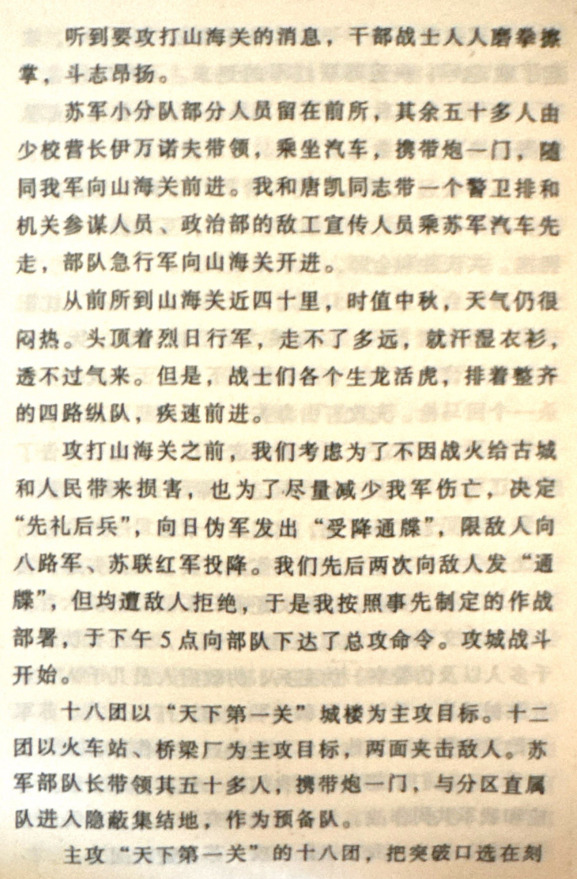
Upon hearing the news of the impending attack on Shanhaiguan, all officers and soldiers were eager and high-spirited, their fighting morale soaring.
Part of the Soviet reconnaissance detachment remained at Qiansuo, while over fifty others, led by Battalion Commander Major Ivanov, advanced toward Shanhaiguan by vehicle with one artillery piece, accompanying our troops. Comrade Tang Kai and I, along with a guard platoon, staff officers from the command organ, and enemy propaganda personnel from the political department, rode in Soviet vehicles ahead of the main force, which marched rapidly toward Shanhaiguan.
The distance from Qiansuo to Shanhaiguan was nearly forty li . Though it was Mid-Autumn, the weather remained sultry and oppressive. Marching under the blazing sun, our clothes were soon drenched in sweat, and breathing became difficult. Yet, the soldiers were vigorous and lively, advancing swiftly in neat four-column formations.
Before launching the attack on Shanhaiguan, we considered avoiding damage to the ancient city and its people from the flames of war, as well as minimizing our own casualties. We decided to “try peaceful means before resorting to force” and issued an “ultimatum for surrender” to the Japanese and puppet troops, demanding their surrender to the Eighth Route Army and the Soviet Red Army. We delivered the ultimatum twice, but both times it was rejected by the enemy. Consequently, following the pre-established combat plan, I issued the general assault order to the troops at 5:00 p.m. The battle to capture the city began.
The 18th Regiment targeted the “First Pass Under Heaven” tower as their primary objective. The 12th Regiment focused on the railway station and bridge factory, attacking the enemy from both sides. The Soviet unit commander led his fifty-plus men, equipped with one artillery piece, and joined the division’s direct units in concealed assembly areas, serving as the reserve force.
The 18th Regiment, tasked with the main assault on the “First Pass Under Heaven,” selected their breakthrough point at the carved…
Japan had already ceased combat operations by this point, as Japan had accepted the terms of surrender by the 15th, only rogue elements or units not yet aware of the surrender were still fighting.
Overall still no proof of joint combat action against Japan.
How coordinated.
Promising, what’s the date…?
Is it past the 27th of August…?
(Also assuming the third image is continuing on from that one).
I hope you aren’t trying to pass off suppressing rogue Japanese soldiers as the Soviet and (any) China fighting a coordinated war against Japan…?
Otherwise, by that logic, the US and the Philepines were still fighting the Japanese decades after their surrender.
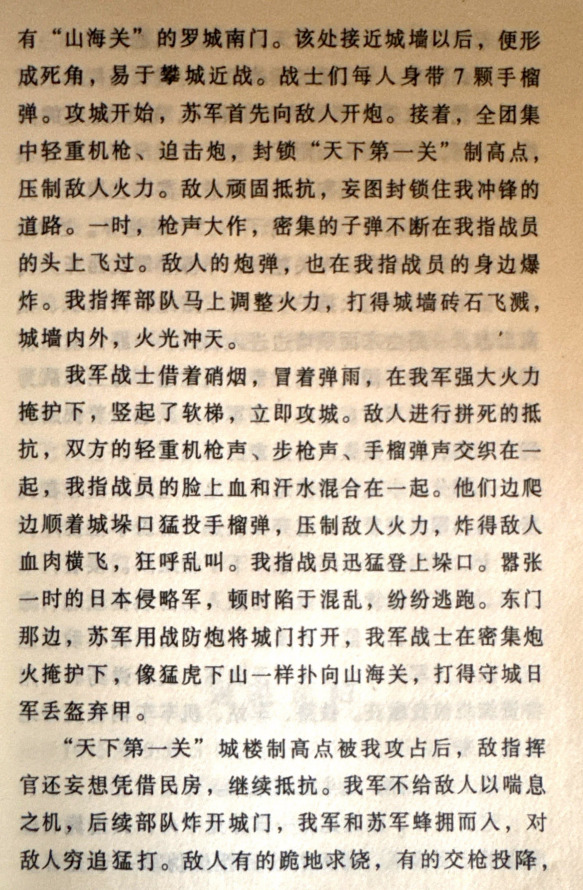
……at the south gate of the Luocheng Fortress, where the characters “Shanhaiguan” were inscribed. Upon approaching the wall near this location, it created a dead angle, making it easier to scale the wall and engage in close combat. Each soldier carried seven grenades. As the assault began, the Soviet forces fired the first artillery shots at the enemy. Immediately after, the entire regiment concentrated their heavy and light machine guns and mortars to suppress enemy fire and blockade the commanding height of the “First Pass Under Heaven.” The enemy put up a stubborn resistance, attempting to block our path of advance. For a moment, gunfire erupted intensely, with dense volleys of bullets whistling over the heads of our commanders and fighters. Enemy shells also exploded around them. Our command quickly adjusted the firepower, striking the city wall so fiercely that bricks and stones flew in all directions. Inside and outside the walls, flames lit up the sky.
Under the cover of thick smoke and a hail of bullets, and with the support of our powerful suppressing fire, our soldiers erected rope ladders and immediately began scaling the wall. The enemy resisted desperately. The sounds of heavy and light machine guns, rifles, and grenades from both sides intertwined. On the faces of our commanders and fighters, blood mixed with sweat. As they climbed, they fiercely hurled grenades over the battlements, suppressing enemy fire and blowing the enemy into disarray, with limbs flying and cries of panic echoing. Our commanders and fighters swiftly ascended the battlements. The once-arrogant Japanese invaders quickly fell into chaos and began to flee in disarray. At the eastern gate, Soviet forces used an anti-tank gun to blast open the gate. Under the cover of intense artillery fire, our soldiers charged into Shanhaiguan like tigers descending a mountain, striking the defending Japanese troops so hard that they abandoned their helmets and armor.
After our forces captured the commanding height of the “First Pass Under Heaven” tower, the enemy commander still attempted to continue resistance using civilian houses. Our troops gave the enemy no chance to catch their breath. Follow-up forces blasted open the city gates, and our soldiers, along with the Soviet troops, swarmed in, relentlessly pursuing and attacking the enemy. Some enemy soldiers knelt and begged for mercy, others surrendered their weapons…
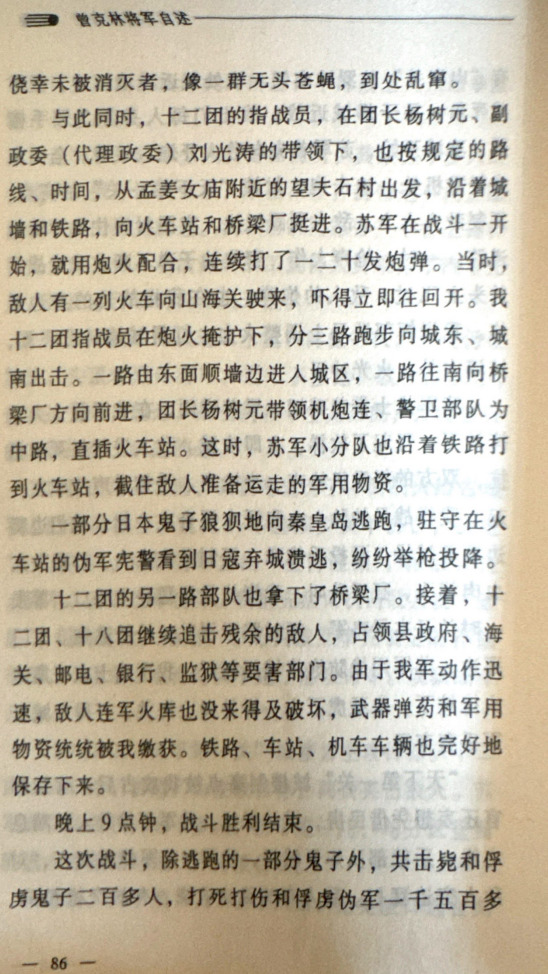
At the same time, the officers and men of the 12th Regiment, under the leadership of Regimental Commander Yang Shuyuan and Deputy Political Commissar (Acting Political Commissar) Liu Guangtao, set out from Wangfushi Village near the Meng Jiangnu Temple along the predetermined route and schedule. They advanced along the city wall and railway toward the train station and bridge factory. As the battle commenced, the Soviet forces provided artillery support, firing over ten rounds in succession. At that time, an enemy train was heading toward Shanhaiguan but immediately turned back in fear. Under artillery cover, the 12th Regiment split into three columns, advancing rapidly toward the eastern and southern parts of the city. One column entered the urban area from the east along the base of the wall, another moved south toward the bridge factory, while Regimental Commander Yang Shuyuan led the machine gun-artillery company and security forces as the central column, striking directly at the train station. Simultaneously, the Soviet reconnaissance unit advanced along the railway to the train station, intercepting military supplies the enemy intended to transport.
Some Japanese troops fled in disarray toward Qinhuangdao. The puppet military police stationed at the train station, seeing the Japanese abandoning the city and retreating, surrendered one after another, raising their weapons. Another unit of the 12th Regiment also captured the bridge factory. Subsequently, the 12th and 18th Regiments continued to pursue the remaining enemy forces, seizing key locations such as the county government, customs office, post office, bank, and prison. Thanks to the swift actions of our troops, the enemy had no time to destroy the arsenal, and all weapons, ammunition, and military supplies were captured. The railway, stations, and rolling stock remained intact.