copypaste content in case SAR site acting weird again
By Frank Iannamico
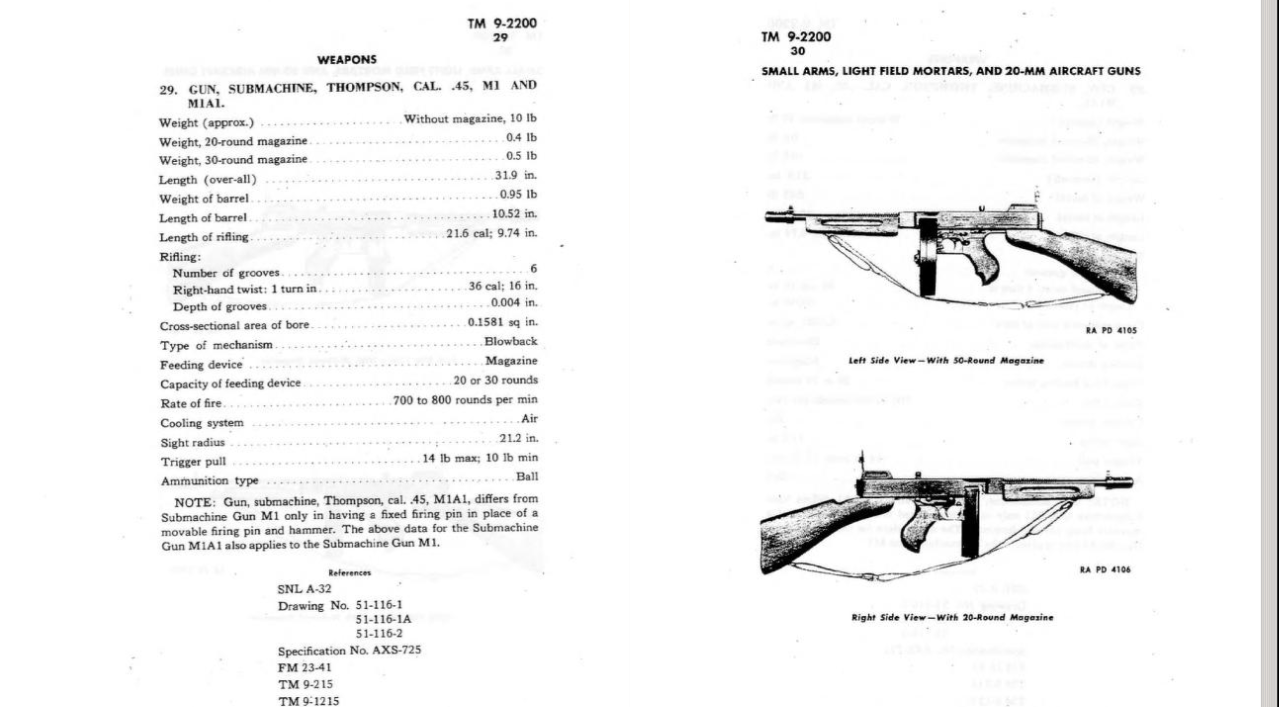
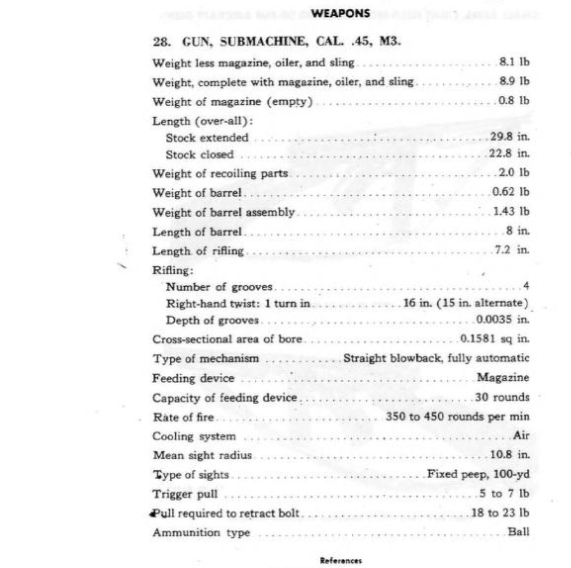
While researching my military Thompson book American Thunder, I discovered quite a few World War II Ordnance Department documents that expressed great concern over the excessive, and sometimes erratic, cyclic rate of the new M1 Thompson submachine gun. The M1 Thompson was adopted to replace the older, more complex M1928A1 model.
I first discovered that in July of 1942, the Springfield Ordnance District had rejected the entire lot of early production M1 model Thompsons that were manufactured at Auto-Ordnance’s Bridgeport factory. The reason given for the rejection of the weapons was that they exceeded the Ordnance Department’s maximum rate of fire specification for the M1 of 750-800 rounds per minute. However, at the same time, similar M1 Thompsons that were being produced by the Savage Arms Company in Utica, New York were being accepted by the Rochester Ordnance District with no reported problems. There was no explanation of the different acceptance policies of the two districts in any documents.
The Ordnance Department felt that the M1 model’s fast rate of fire would create undesirable muzzle climb. Extensive testing had convinced Ordnance that accuracy increased as the cyclic rate of fire was decreased. The United States Ordnance Department was fervently opposed to any infantry weapon that they considered to have a high rate of fire. This policy was not limited to submachine guns, but applied to all types of automatic small arms.
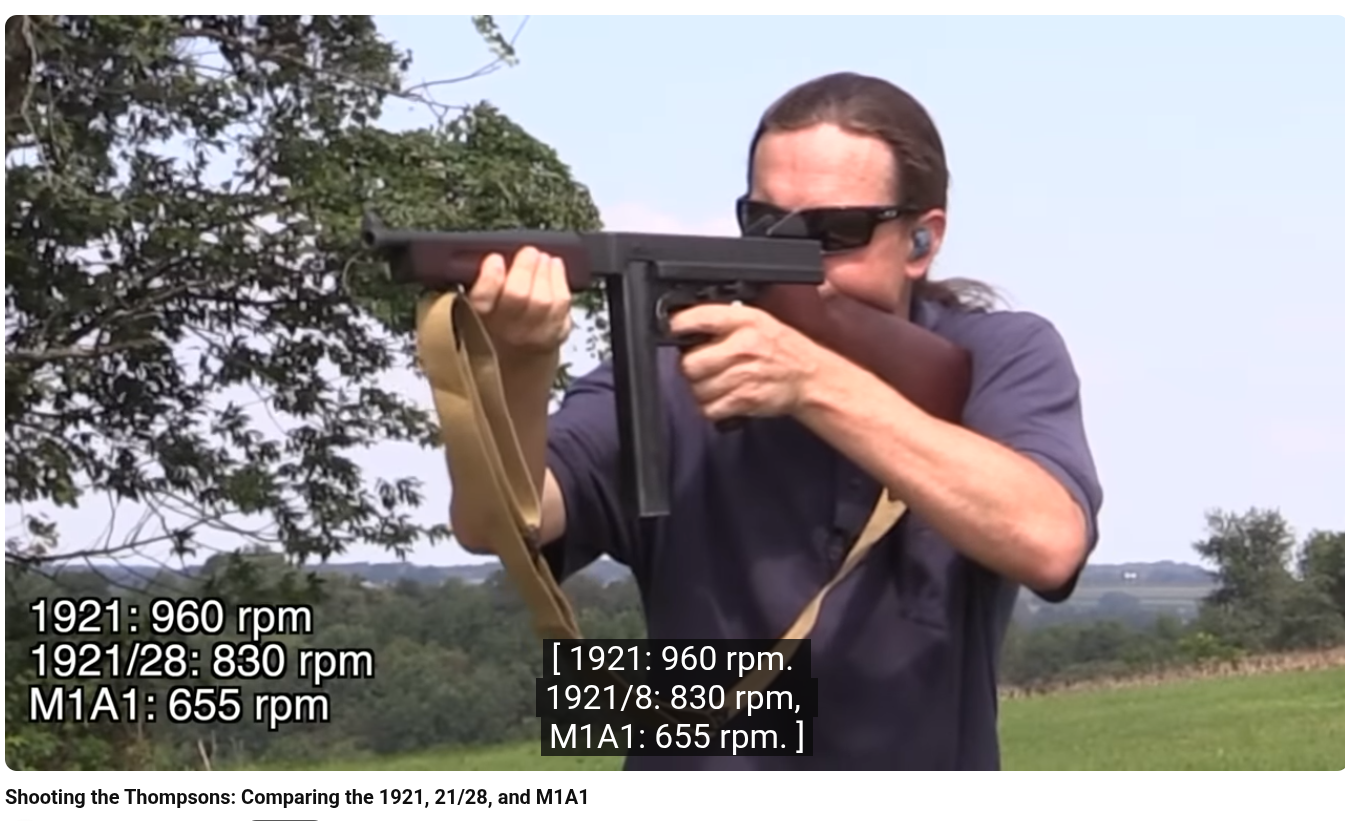
In the first firing report of the M1 held at the Aberdeen Proving Ground in March of 1942, the new M1 Thompson recorded a cyclic rate of fire as high as 814 rounds per minute, although the average rate of fire of the test was calculated at 775 rpm. In August of 1942, another test was conducted at Aberdeen. During this testing M1 Thompson serial number 3563 recorded a cyclic rate of 810 rpm, while M1 serial number 7990 averaged 735 rpm. Subsequent tests of the M1 recorded the weapon’s cyclic rate as high as 920 rpm (M1 serial number 301798). It was noted that the M1928A1 Thompson had a cyclic rate of approximately 650 rpm.
Several methods to solve the rate of fire problem were attempted by both the Auto-Ordnance Corporation and the U.S. Ordnance Department. The Auto-Ordnance Corporation, knowing the increased cyclic rate of the M1 over the earlier M19128A1 model could possibly present a problem with the Ordnance Department, had tried to reduce the rate of fire by experimenting with various chamber dimensions. Their early research failed to produce the desired results.
The Ordnance Department’s engineers also failed to provide a workable solution to bring the Bridgeport manufactured M1’s cyclic rate below the specified number. A number of methods were attempted to slow down the rate of fire. These included; increasing the weight of the bolt, altering the recoil spring, incorporation of a flat spring inside the receiver, increasing the length of the slot in the receiver, different buffer materials and increasing the weight of the bolt handle. The most successful results were achieved by increasing the weight of the bolt handle. The Ordnance tests, methods and results will be covered in more detail in the second part of this article.
Because of the dire need for weapons, the Ordnance Department headquarters in Washington, D.C. issued a waiver to accept the M1 weapons in question on 9 December 1942.
In the interim, engineers at Savage had been working to further simplify the relatively new M1 Thompson. They redesigned the breech bolt to eliminate several parts, which included the firing pin, the firing pin spring, the hammer and the hammer pin. This was accomplished by replacing the aforementioned parts with a fixed firing pin that was nothing more than a protrusion machined onto the face of the bolt. This also eliminated several machining operations on the bolt. In September of 1942 the Aberdeen Proving Ground was instructed to test a M1 submachine gun fitted with the new style bolt.
The testing at Aberdeen indicated that the M1 submachine gun equipped with a fixed firing pin functioned slightly better than the standard M1 submachine gun. It was also noted that the fixed pin design saved considerable manufacturing time, and that the bolt was substantially strengthened by elimination of the deep drilling operation necessary to accommodate the firing pin and spring.
In the first firing report of the modified M1 (M1A1) Thompson conducted on 9 and 10 September 1942, it was noted that the average rate of fire of the modified M1, when fitted with a fixed firing pin bolt, was 667 rpm. A high of 746, and a low of 622 rpm was recorded. This was compared with the standard M1’s average rate of fire of 775 rpm. A total of 5,780 rounds of .45 caliber service were fired during the testing. The ammunition used in the test was manufactured by the Western Cartridge Company lot #6183. The only malfunctions recorded during the two-day test was the bolt failed to remain rearward after the magazine was emptied on eight occasions.
The Springfield Ordnance District was notified that manufacture of a fixed firing pin bolt for use in the M1 submachine gun was authorized. In order to distinguish between submachine guns equipped with separate firing pins and fixed firing pins, the submachine guns fitted with the fixed firing pin would be designated as Gun, Submachine, Caliber .45, Thompson M1A1. It was also noted that the bolts with and without the fixed firing pin were interchangeable. The M1A1 Thompson was formally approved at an Ordnance Committee meeting held on 29 October 1942. There was no excessive rate-of-fire discrepancies reported.
By the time the rate-of-fire waiver letter was received from the Ordnance Department, the short-lived M1 model had been replaced by the new M1A1 version as the standard U.S. submachine gun. As a result virtually all of the Auto-Ordnance Bridgeport manufacture M1’s that were initially rejected were refitted with the new M1A1 fixed firing pin bolt. The receivers of the weapons had the suffix A1 added to the M1 designation on their receivers to indicate that they had the fixed firing pin style bolt installed in them.
Due to the hard use small arms encountered during World War II, many required complete rebuilding after serving for only a brief period in the field. During the ordnance rebuilding of the M1 Thompson, the subject of replacing the M1 bolt with an M1A1 bolt to reduce the rate of fire was addressed in many Ordnance Department documents. However, in an attempt to conserve material, rebuilding facilities were instructed to use serviceable M1 bolts.
Intrigued by the Ordnance reports that a Thompson fitted with an M1 bolt would have a higher rate of fire than one equipped with a M1A1 bolt, I decided to conduct a few tests of my own. The first step was to obtain several M1 and M1A1 bolts. Both variations of the bolts were manufactured in several configurations. One was the “bright” or so called “nickel” bolt, although common in the earlier 1928 models, M1 and M1A1 “bright” bolts are less common. However, I did have a few on hand to test. The most common M1 and M1A1 bolts encountered were those that are blued, followed by used, serviceable bolts that had been Parkerized during Ordnance rebuild programs (The Ordnance rebuild specifications issued in 1943 stated that “all parts except for the springs be Parkerized”).
One could logically reason that an M1 Thompson would cycle faster, perhaps because an M1 bolt was lighter than an M1A1 bolt. The first step in my investigation was to check and record the weight of the various bolts to be used in the testing. I used a recently calibrated postal style scale calibrated in ounces. Surprisingly, every M1 and M1A1 bolt checked weighed almost exactly the same at 1 pound 11.5 ounces. The only variation was that two of the M1 and M1A1 “bright” bolts were 0.25-ounce lighter than the others. I concluded that the weight of the various bolts would have little or no effect on the cyclic rate of the weapon. The Aberdeen Proving Ground test document of September 1942, reported that the M1A1 bolt weighted 1.82 pounds while the M1 bolt weighed 1.76 pounds.
Although the goal of the testing was to determine the cyclic rate of the M1 Thompson Submachine Gun, I decided to use several different brands of ammunition for the testing. The brands used were Wolf (Russia), Federal (U.S.A) Winchester (U.S.A.) and PMP (S. Africa). The ammunition had a profound effect on the cyclic rate of the weapons.
I had originally planned to conduct the rate of fire testing at the Thompson Collectors Association meet in August. Although we got started, we encountered some technical problems with the timer we were using, and the testing had to be stopped. I finally was able resume the testing a few weeks later.
For the test I used two different M1 Thompson Submachine Guns, I also timed the rate of fire of a World War II M1928A1 model for comparison.
I chronographed the velocity of each brand of ammunition to give the reader some idea of the power of each individual brand. I included the velocity of the rounds fired from a World War II U.S. Remington-Rand 1911A1 pistol, because most published pistol caliber velocities are obtained by firing rounds from a short five-inch barrel. The published standard average velocity of the .45 ACP 230-grain FMJ cartridge is commonly recognized as 850 feet per second.
Conclusion
- Although the rate of fire varied, in every case the guns ran slower with a M1A1 fixed firing pin bolt installed.