Greetings and salutations, bajtársak and fellow forumdwellers,
@Valkay and @OggeKing return with another shared suggestion, this time on the classic British submachine gun, the Sten mk.V.
The Sten gun was never intended to represent the long-term future of British small arms design.
At the start of the war, the British had already rejected the SMG in its entirety, seeing them as little more than “gangster guns,” not as legitimate tools of war. In short, to the British the SMG as a concept was initially seen as unserious, ungentlemanly, foreign, and frankly a bit vulgar. But in the aftermath of Dunkirk, Britain had accepted that the SMG did in fact have a place on the modern battlefield. Efforts were then made to acquire and field, en masse, this new weapon system across the entire Commonwealth armed forces, from scratch, under wartime circumstances.
By 1943, Commonwealth militaries were heavily reliant on the Sten, a deliberately crude SMG produced to meet urgent needs. Early marks prioritised speed and economy above all else, and successive improvements reflected the pressures of production. The Mk I and Mk I* were superseded by the cheaper-to-produce Mk II, while the Mk III, which used a different manufacturing technique, was largely incompatible with Mk II parts. Mk III production ended in September 1943, with existing examples mostly relegated to the Home Guard; Mk IIs were prioritised for active forces. The Mk IV never entered production; the designation was reserved but ultimately unused, to avoid confusion.
With production stabilising and the strategic situation allowing engineers to focus on refinement rather than output alone, British engineers were finally able to breathe, and the Sten Mk V emerged: a more soldier-focused iteration of the stop-gap design, featuring improved handling, durability, and presentation, all to create a more confidence-inspiring weapon than the Sten Mk II. Yet the Mk V was still constrained by the platform’s expedient origins.
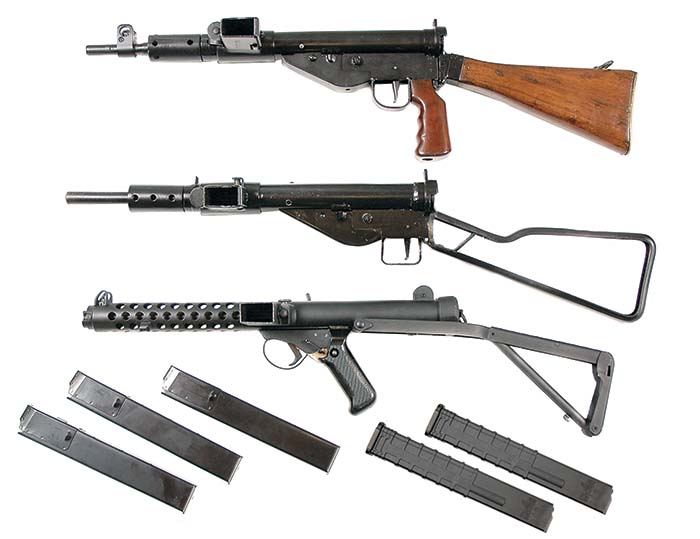
A picture of the Sten mk.V (top), Sten mk.II (in the middle) and the post war Sterling (bottom)
Mechanically identical to the Mk II, the Mk V introduced wooden furniture, front and rear pistol grips, a No. 4 rifle front sight with bayonet compatibility, a detachable rifle-style wooden buttstock, enhanced safety features, and higher manufacturing standards. Internal components remained interchangeable (even though the trigger group was moved forward to accommodate the rear pistol grip). The cost was a gun that took twice as long to manufacture than the Mk II, and twice as expensive as well.
However, the Mk V was still not the submachine gun Britain truly wanted; that vision was already being pursued through the contemporary Patchett design, developmentally unrelated to the Sten but arising from the same 1943 period of experimentation (or even earlier). The Patchett (what would become the Sterling) was for the future; the Sten Mk V was merely to supplement the present.
Produced between February 1944 and May 1945, with over half a million examples manufactured, the Mk V represents the final wartime evolution of Britain’s stop-gap SMG philosophy. It remained in British military service at least into the 1960s, a testament to its robustness and the careful refinement applied where circumstances allowed. The Mk V demonstrates the balance between urgent necessity and professional development — a weapon honed as far as the platform permitted, the link between emergency expedients and the postwar era of professional, purpose-built SMG designs.
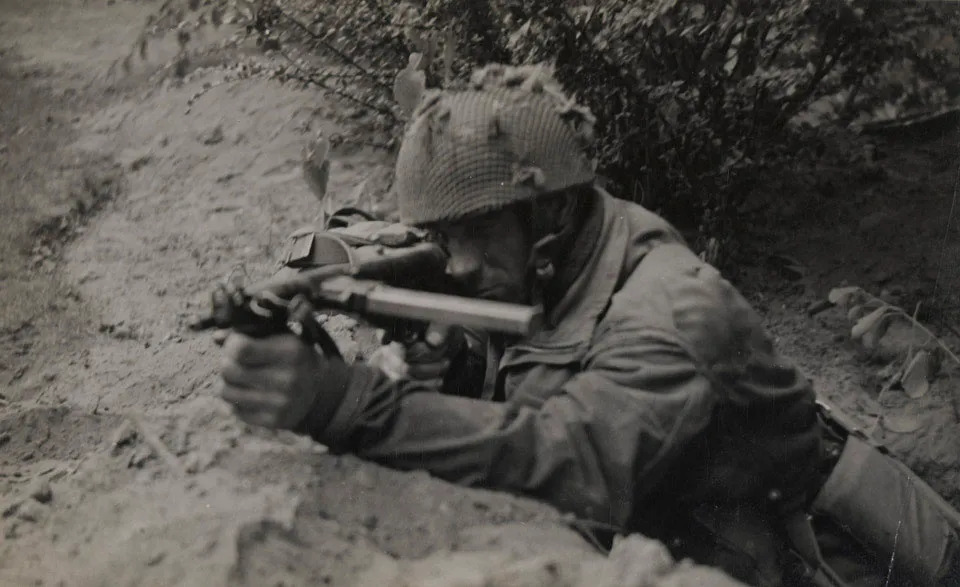
Private J Connington, 20th of September 1944, Arnhem.
Statistics:
Calibre: 9mm parabellum (9x19)
Magazine capacity: 32 rounds (standard) or 50 rounds with Lanchester magazine
Rate of fire: 600 rpm
Initial muzzle velocity: 365-370 m/s (same as the Sten mk.II)
Weight unloaded: 3.9kg
Weight fully loaded: 4.47kg
Overall length: 762mm
Length with bayonet: 968mm
Barrel length: 198mm
The mk.V is the final irritation of the Sten gun and its improvements over the mk.II are well reflected in our proposed stats. The fundamentals of the mk.II remain the same with the mk.II and mk.V sharing damage, muzzle velocity and reload time however the wooden stock, pistol grip and front grip provide remarkably better control of the mk.V’s recoil which feels really little and easy to control even when fired from the hip.
The new better calibrated sights and longer barrel improved the shooter’s accuracy, this is well mirrored with the decreased dispersion compared to the mk.II.
Finally the fire rate had increased to 600 rounds per minute from 550, which was most likely not a planned but accidental change to the gun with the slight redesign of the fire control group which got moved forward to make space for the pistol grip.
| Submachine Guns | Damage | Reload Timings (s) | Statcard Recoil | Effective Recoil | Moving Spread Increase | |||||||||||||||||||
|---|---|---|---|---|---|---|---|---|---|---|---|---|---|---|---|---|---|---|---|---|---|---|---|---|
| Weapon Name | Obtained | BR | 10m | 100m | Velocity | Magazine | Reload | Alt Reload | Rate of Fire | Vertical | Horizontal | Recoil Control | Vertical | Horizontal | Dispersion | While Aiming | Hipfiring | Visual Recoil | Recoil Dir | ADS Speed | Recoil Offset | Sprint Factor | Weight | Additional Info |
| Sten Mk V | 45000 RP | II | 6.6 | 3.4 | 370 | 32 | 2.3 | 1.89 | 690 | 24 | 7 | 0.3 | 7 | 2 | 0.75 | 0.0 | 10.0 | 0.7 | 0.4 | 0.8 | 0.3 | 100% | 4.5 | 32/128 |
| Sten Mk II | 20000 RP | I | 6.6 | 3.4 | 370 | 32 | 2.3 | 1.89 | 630 | 28 | 17 | 0.3 | 8 | 5 | 0.81 | 0.0 | 15.0 | 0.7 | 0.4 | 0.8 | 0.3 | 100% | 4.0 | 32/128 |
| Lanchester | 58000 RP | II | 6.8 | 4.0 | 400 | 32 | 2.3 | 1.8 | 690 | 30 | 11 | 0.4 | 12 | 4 | 0.71 | 0.0 | 15.0 | 1.6 | 0.1 | 0.8 | 0.3 | 100% | 5.2 | 32/128 |
| M1A1 Thompson | 105000 RP | II | 8.2 | 5.5 | 265 | 30 | 2.3 | 1.8 | 690 | 36 | 14 | 0.4 | 14 | 5 | 0.73 | 0.0 | 15.0 | 1.2 | 0.4 | 0.72 | 0.3 | 100% | 4.6 | 30/90 |
| Submachine Guns | Damage | Reload Timings (s) | Statcard Recoil | Effective Recoil | Moving Spread Increase | |||||||||||||||||||
|---|---|---|---|---|---|---|---|---|---|---|---|---|---|---|---|---|---|---|---|---|---|---|---|---|
| Weapon Name | Obtained | BR | 10m | 100m | Velocity | Magazine | Reload | Alt Reload | Rate of Fire | Vertical | Horizontal | Recoil Control | Vertical | Horizontal | Dispersion | While Aiming | Hipfiring | Visual Recoil | Recoil Dir | ADS Speed | Recoil Offset | Sprint Factor | Weight | Additional Info |
| Sten Mk V 50 | 80000 RP | III | 6.6 | 3.4 | 370 | 50 | 2.3 | 1.89 | 690 | 24 | 7 | 0.3 | 7 | 2 | 0.75 | 0.0 | 10.0 | 0.7 | 0.4 | 0.8 | 0.3 | 100% | 4.6 | 50/100 |
| Lanchester 50 | Silver Chest | III | 6.8 | 4.0 | 400 | 50 | 2.3 | 1.80 | 690 | 18 | 9 | 0.4 | 7 | 4 | 0.71 | 0.0 | 15.0 | 1.0 | -0.4 | 0.74 | 0.3 | 100% | 5.6 | 50/100 |
| M1928A1 Thompson | 110000 RP | III | 8.2 | 5.5 | 265 | 30 | 1.5 | 1.5 | 810 | 32 | 13 | 0.4 | 13 | 5 | 0.61 | 0.0 | 15.0 | 1.0 | 0.3 | 0.72 | 0.3 | 100% | 4.0 | 30/90 |
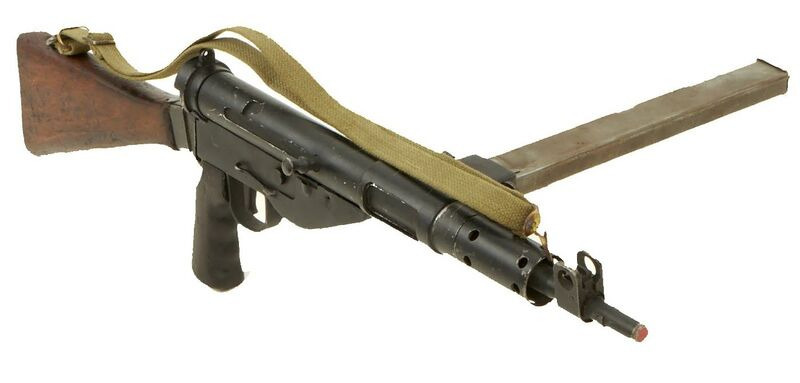
A deactivated Sten mk.V loaded with 50 rounds Lanchester magazine, please note that it has the front grip missing
The mk.V’s front grip was plagued with issues, it’s held in place by a screw which gets loose by continued use and tightening the screw may result in breaking the grip.
An even more pressing issue is that prolonged use could damage the ratchet teeth which is locking the barrel in place and theoretically the barrel could come loose.
According to Ian McCollum from Forgotten Weapons (who goes by the unofficial internet nickname of “gun jesus”) the front grip was declared obsolete early on, if you watch his video on the Sten mk.V, you may get the false impression that the front grip saw little service during WW2. I can’t stress enough that Ian McCollum has always focused on technical expertise rather than deployment history thus when researching use in the field, other sources must be consulted.
“The front pistol grip was declared obsolete on 1 June 1945 […] it was popular with troops engaged in street fighting during the drive into Germany as it allowed them to shoot quickly from the hip.”
- THE STEN GUN - LEROY THOMPSON
By the time the front grip was declared obsolete, order reached the troops to remove the grip and they actually bothered to do something about it, the war was over.
The front grip was most definitely widely used during the Second World War and was extremely popular with the troops using the mk.V thus, the front grip needs to be on the gun.

The Sten mk.V is the last mass-produced Western Allied submachine gun of the war that has not been added to the game yet, even though it would be highly beneficial to both game balance and historical authenticity.
Using the mk.V with British troops on BR II in late war campaigns such as Normandy and Bulge campaigns is far more realistic than using the Lanchester which was reserved for the Royal Navy by that point. The M1A1 Thompson submachine gun is also not a too authentic choice for British soldiers as it was lend-leased only in limited numbers.
Furthermore the Sten mk.V 50 would be an excellent BR III domestic British submachine and also a worthy alternative to the M1928A1 Thompson at the same time, the Thompson M1928A1 is the only tech tree submachine gun available to the faction on BR III.
The Sten mk.V should also be added to BR II with the 32 rounds magazine as well, because that was the most common configuration it had appeared in. Though the Lanchester is available on BR II, the mk.V -with our proposed stats- would be an easy to control low recoil submachine gun, something that is not currently at hand in the tech tree on BR II thus the mk.V would neither powercreep the Lanchester and M1A1 Thompson nor be overshadowed by them.
sources:
Leroy Thompson - The Sten gun (primary source)

Thomas B. Nelson - Submachine guns of the world
Forgotten Weapons - STEN mk.V
FIring mk.V with 50 rounds Lanchester mag
- Yes
- No
- Yes
- No
- Yes, with both
- Yes, but not with stats of the Sten mk.V (32)
- Yes, but not with stats of the Sten mk.V (50)
- No
Thank you for your time and attention!
Signed,
Lt. Ogge King, 3rd Experimental Tea Infusion and Small Arms Appreciation Company, Home Guard (Reserve),
Valkay, self proclaimed Panzer and TSF ace, 501. “Praetorian” schwere TSF abteilung,
God save the King.