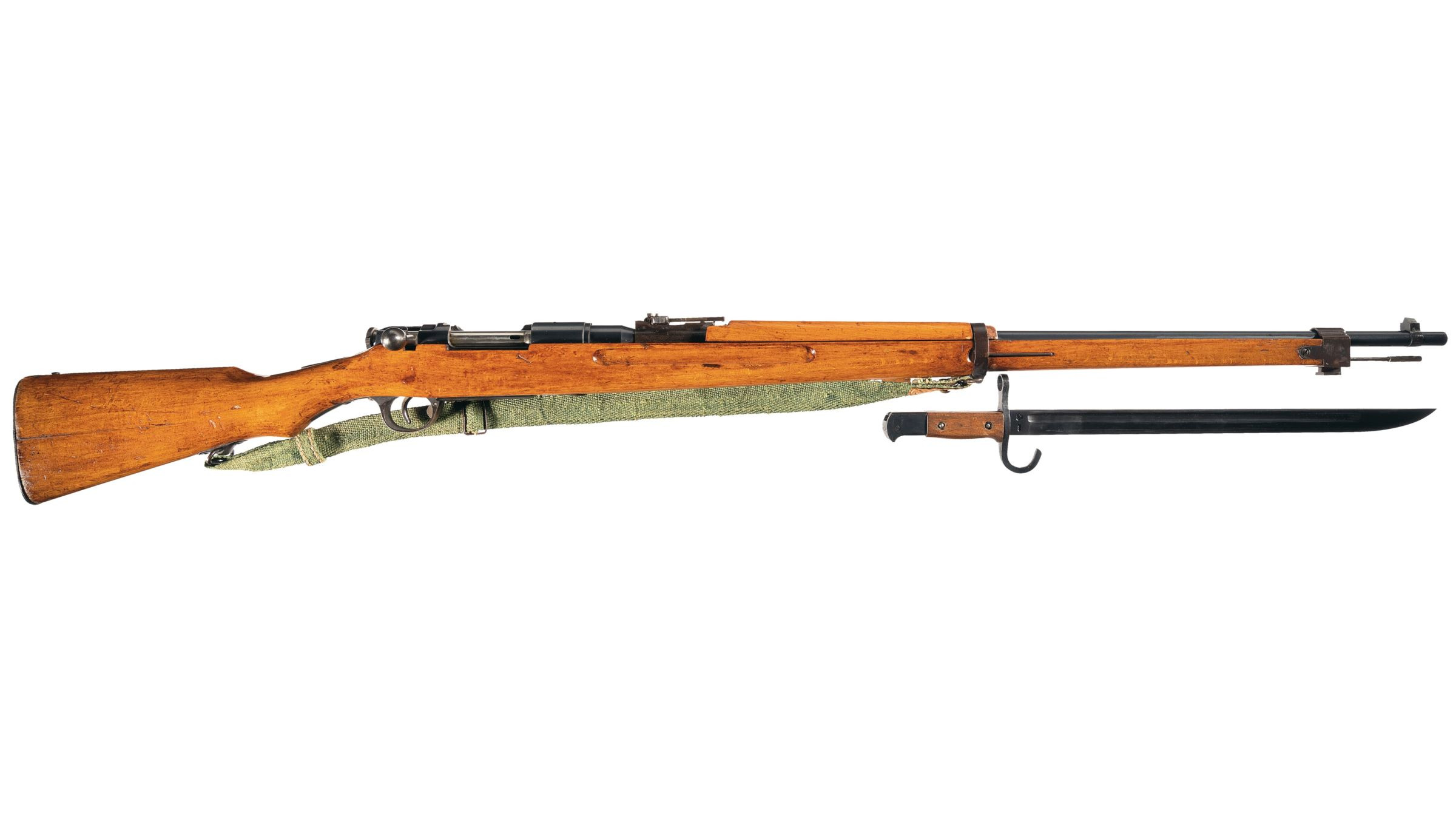
suggestion arisaka type 35 Japanese naval rifle
- should the type 35 be added yes or no
- yes
- no
Characteristics:
Action: turn bolt considered one of the strongest actions ever made, often equipped with a protective, removable sliding dust cover.
Caliber: 6.5×50mmSR Arisaka cartridge (Cartridge length 74.68 mm to 75.69 mm) fed by stripper clips. in a five round internal magazine similar to the arisaka type 38 rifle.
Rear Sight: features a unique delicate squeeze-style tangent rear sight similar to the one the dutch mannlicher m1895 rifle uses.
Safety & Bolt: replaced the type 30 rifles hook safety with a large plum-shaped knob (cocking piece) intended to protect the shooter from gas in case of a ruptured primer. It also featured an improved reinforced extractor and ejector components.
Dimensions: It is a long rifle measuring roughly up to 50 inches (1,273 mm) in total length, with a 31-inch (797 mm) barrel.
Production & Rarity: Produced from approximately 1902 to 1905 with only about 10,000 to 38,000 units making it into production making them a rarity as of today.
Bayonet: Used a modified Type 30 rifle bayonet, often referred to as the Type 35 bayonet which featured a sprung catch to secure it to the scabbard.
Description:
the arisaka type 35 is a pivotal but short lived design that served as a critical bridge between the type 30 and 38 arisaka rifles. Following the adoption of the type 30 arisaka rifle by the imperial japanese army in 1897 the imperial Japanese Navy (IJN) sought out a modern replacement for their aging type 22 murata rifles. 1902 the 35th year of the meiji era Captain Kijirō Nambu was tasked with refining and update the type 30 arisaka rifles design to fix field reported issues. It was manufactured at tokyo artillery arsenal from 1902 to 1905 with total production units estimated at 38,000 before being replaced by the type 38 arisaka rifle. The type 35 arisaka was the first rifle in the arisaka family to feature a manually operated sliding dust cover. Unlike the automatic ones featured on the later models this required the user to physically slide it shut to protect the action form dust and sea-spray a critical needed feature for the special naval landing forces. the original hook safety of the type 30 rifle was replaced with a large knurled knob. This design protected the user from hot gasses in the event of a blown primer a common issue with early rifle ammunition. It features a newly tangent- type rear sight and a quadrant-pattern V-notch
which was more robust which and a quadrant-pattern V-notch which was more robust but also considered somewhat more delicate than later rifle military sights. Though it was a vast improvement it was standard for only three years. The arrival of the type 38 arisaka rifle made the type 35 rifle obsolete almost immediately when introduced for primary front-line service. despite being replaced and decades old the IJN maintained these rifles for shipboard defence and secondary units by 1945 some were even converted to type 02/45 like the example in the image above as “last ditch” rifles or used in training devices like the Type Hiroki sub-caliber system for naval cannons. Beyond Japan, thousands were sold to Thailand (some bearing Siamese markings) and even supplied to Russia and later Britain for training during World War I.
Why It Should Be Added:
Historical Gap: it serves as the vital missing link between the standard type 30 and 38 arisaka rifles
Low-Tier Variety: japan currently is missing diverse bolt-action options at battle rating (BR) 1. The type 35 provides a slightly faster muzzle velocity (~765 m/s) and a more robust design then the type 30 making it a competitive early-war choice.
IJN Representation: Adding the Type 35 allows for more authentic Naval Landing Force squads as the IJN kept these rifles in shipboard service well into WWII.
Enhanced Sights: Its unique quadrant-pattern “fan out” sights would offer a distinct visual profile and sight picture compared to the standard Arisaka ladder sights.
How to Implement the Manual Dust Cover:
unlike the automatic dust covers on the later arisaka rifles that move with the bolt the type 35 rifles cover was independent and manually operated. To make this a compelling mechanic in Enlisted, it could be implemented as follows:
Passive Animation (Idle/Running): when the player is in a safe state (not aiming or firing) the soldier could be seen sliding the cover closed with their thumb to keep out the dirt , dust and sea-spray similar to how characters in video games occasionally wipe sweat or check magazines in other tactical shooters.
Firing Logic: Since the cover must be open to fire, the first shot from a “stowed” position should have a slightly longer draw time or an initial “click-slide” animation as the soldier opens the action.
Reload Animation: to reload using stripper clips it is essential that the manual dust cover must be pushed forward . This adds a unique three-stage reload:
-
Manually push the cover open.
-
Insert the stripper clip.
-
Close the bolt and optionally slide the cover back.
Visual Interaction: in the Weapon Inspection (default ‘I’ on PC), the soldier could demonstrate the spring-clip operation by sliding the cover back and forth to show the “Nambu” improved safety knob underneath.
[
Japanese Type 35 - The Forgotten Arisaka Rifle
www.youtube.com › watch
](https://www.youtube.com/watch?v=NWuJGg5xd1g)