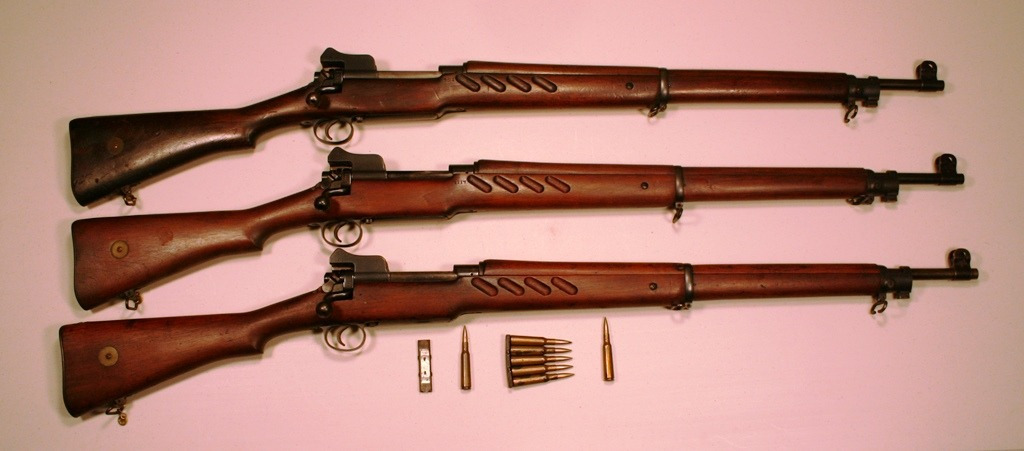
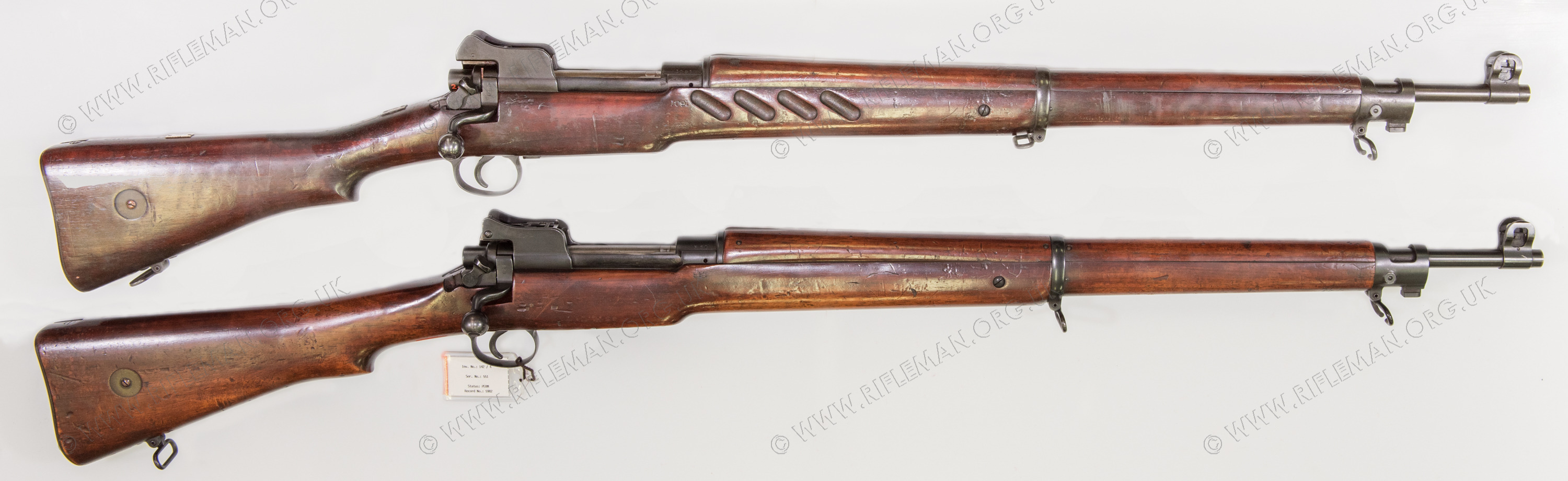
- yes
- no
Characteristics:
Weapon Type: Bolt-Action Rifle
weight: 8 lb 11 oz 3.94 kg
Barrel length: 26 inches (approximately 660 mm)
Caliber: 276 enfield experimental cartridge length 3.23 inches (82.0 mm) .
Rear Sight: Aperture (Peep) Sight .
safety and bolt: front-locking Mauser rifle-style action.
Muzzle Velocity: 853 m/s (2,800 fps)
Magazine Capacity: 5 round internal magazine inserted by stripper clips.
Rarity: only up to 1,251 to 1,257 rifles were ever manufactured national army museum
Bayonet: Pattern 1913 bayonet British WWI sword bayonet produced under contract in the United States by Remington and Winchester for the Pattern 1914 Enfield rifle.
description:
during the second boer war 1899-1902 british troops and infantry were shocked by the superior long range performance of the 7x57mm Mauser used by boer commandos. the british 303. rimmed round was slower less accurate at a long range distance and prone to rim-lock jamming in the magazine. in 1910 the war office decided the british needed a new universal rifle. they planned to abandoned the rear locking lee enfield design and looked at the mauser gewehr 98 for inspiration. the royal small arms factory (RSAF) enfield roughly produced 1,257 P13 rifles. these were sent to the most harsh environments on earth egypt , south africa and ireland for field testing. the goal was to replace the SMLE entirely before the next conflict. The .276 Enfield (7x60mm) was a monster of a round. it was a rimless “Magnum cartridge” designed to the the new most advanced cartridge in the world. however in trials it was two powerful , the muzzle flash was blinding , the recoil was punishable and it wore out barrels exceptionally fast rate. That trial troops were restricted to just 15 shots before cooling the rifle to prevent “cooking off” ammunition in the chamber. In august 1914 the great war broke out with a global conflict starting britain couldn’t afford to switch calibers so the P13’s design was quickly switched back to 303. british where the enfield pattern 1914 (P14) was born and later being chambered in 30-06 springfield for the americans the Enfield M1917 which can hold one extra round in the magazine. The original .276 P13s were relegated either to the scrap heap or museums.
Why it should be added:
Filling a Ballistic Vacuum: currently allied bolt action rifles feel sluggish compared to high velocity rifles like the Karabiner 98 Kurz (kar98k) with high velocity ammo. the P13’s 853 M/S velocity gives the Allies a dedicated long-range precision tool.
A “Prestige” Bolt-Action: it’s perfect for a gold order or event reward it represents the “ultimate british rifle” that never was an elite weapon for players who want historical “unicorns” that actually saw field testing.
Mechanical Variety: adding the p13 introduces a new different reload and bolt-cycle animation or the british tree. the mauser style claw extractor. and front locking lugs provide a sturdier more mechanical feel compared to the smooth, fast firing Lee-Enfield rifles.
Superior Competitive Iron Sights: Its aperture sight is historically noted as being better for accuracy than the SMLE Mk III rifle is. This allows a high-skill player to use it as a “counter-sniper” rifle without needing a scoped squad, making it a valuable strategic pick in the Battle Rating III rating.
Hidden Tactical Values:
Aperture Sight Buff: In-game, this should have a +15% zoom or a significantly clearer “peep” sight picture, making it the most accurate iron-sight rifle in the Allied arsenal.
Damage Drop-off: Unlike the Karabiner 98k rifle which loses power significantly past 150m the P13 should maintain its “one-shot” potential up to 250m, making it the ultimate counter-sniper tool.
Melee Modifier: Equipped with the P13 Sword Bayonet, it should have a long-range melee reach (similar to the Japanese arisaka Type 44) making it perfect for clearing trenches.
Pattern 1913 Enfield Trials Rifle
 YouTube·Forgotten Weapons·28 Apr 2016
](https://www.youtube.com/watch?v=KHQvKCPgmWM)