1、Carabine de Cavalerie Modèle 1890
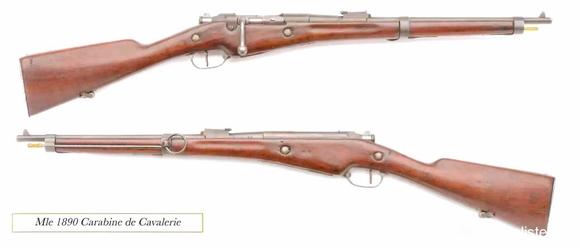
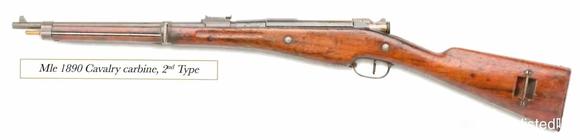
On December 10, 1890, it was adopted by the French Light Cavalry Corps and was equipped to 16 Dragoon Regiments, 33 Dragoon Regiments and 24 Cavalry Regiments. In 1905, it was also equipped to the military logistics transport units. Since it was originally developed for cavalry, it had no bayonet lug and the pull lever was bent downward, with a capacity of only 3 rounds to prevent the single row magazine protruding from the gun body and hindering its carrying behind the back. The front shoulder strap ring was a large circular ring located on the left side of the barrel clamp. The later mass-produced model moved the rear shoulder strap ring from the bottom of the stock to the left side of the stock. By 1905, the total production was 200,000 pieces. During World War I, to supplement trench warfare weapons, on July 15, 1915, the stock of this gun was modified to be a artillery carbine that could be equipped with a sword-shaped bayonet. The total length of the gun was 945mm, the barrel length was 453mm, and the empty gun weight was 3kg.
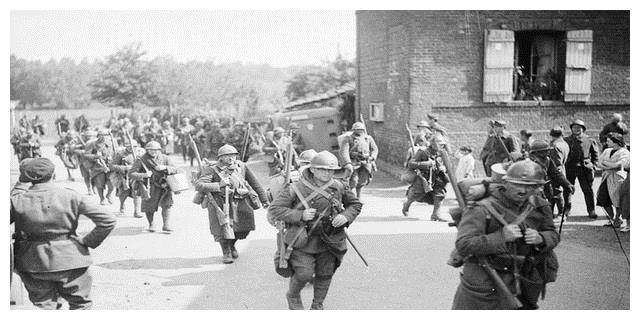
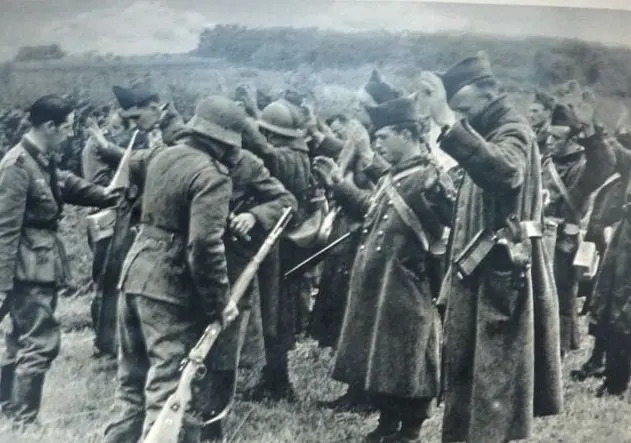
According to reliable sources, it was still in service during World War II and was used to arm the second-line troops.
2、Carabine de Cuirassier Modèle 1890
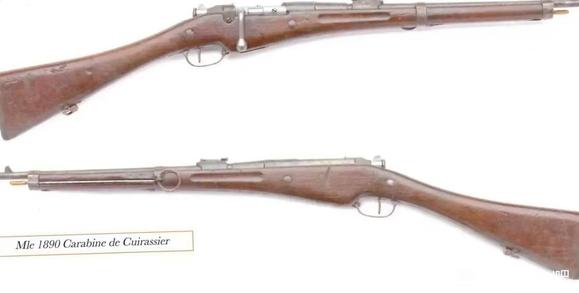
On December 10, 1890, it was adopted by the French heavy cavalry units and was equipped in 12 plate-armored cavalry regiments. In 1891, 20,000 of these guns were produced. Compared with the cavalry carbine, the shape of the stock is more suitable for the posture of holding the gun when plate-armored cavalry wear helmets and plate armor. The bottom of the stock is replaced by a softer and more easily damaged leather buffer pad instead of a metal base plate. The total length of the gun is 952mm, the barrel length is 453mm, and the empty gun weight is 2.98kg.
3、Carabine de Gendarmerie Modèle 1890
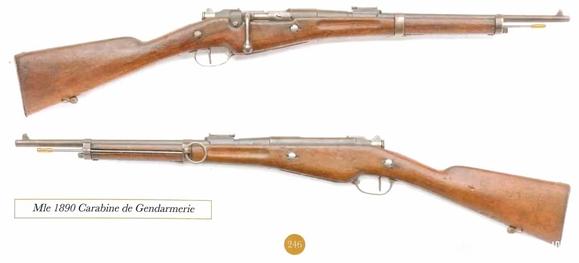
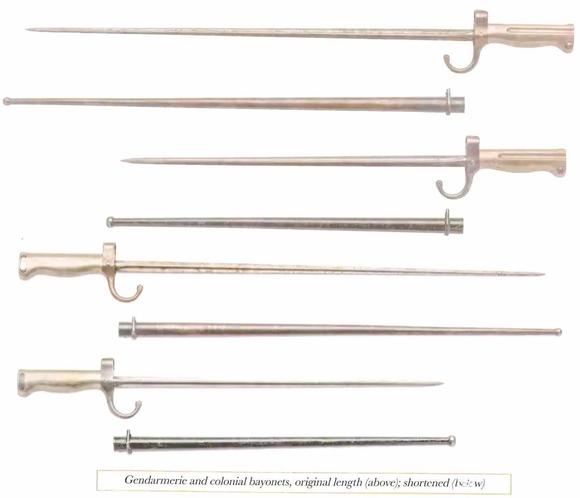
In January 1892, it was adopted by the French gendarmerie. The length of the protective stock at the muzzle was shortened, a scabbard was added, and a conical bayonet was fitted. A total of 80,640 were produced. Some were modified to be used with sabre-type bayonets as artillery carbines. The overall length of the gun was 945mm, the barrel length was 453mm, and the empty weight was 3.1kg.
4、Mousqueton d’Artillerie Modèle 1892
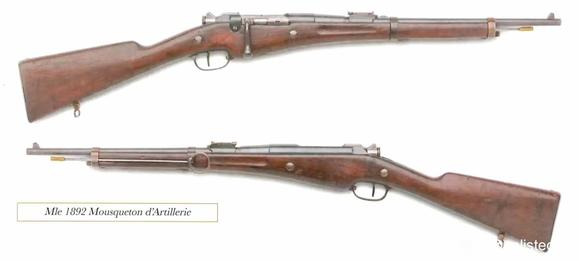
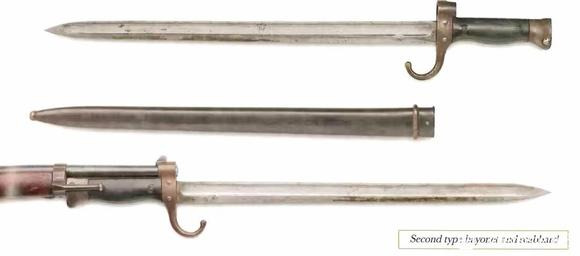
In August 1892, it was adopted by the French artillery. Later, it was also adopted by various military units such as engineers, car soldiers, machine gun teams, etc. It was the most produced and widely used Beretta rifle (carbine) before World War I. By 1918, the total production was approximately 730,000. The only difference from the police carbine is the use of a saber-type bayonet. The overall length of the gun is 945mm, the barrel length is 453mm, and the empty gun weight is 3.1kg.
5、
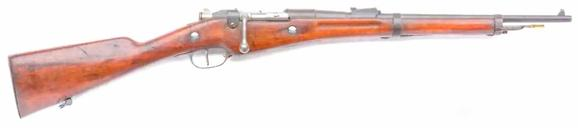
In January 1902, the artillery carbines with additional stack hooks were issued to the Alpine artillery company’s mountain artillery company. This might have been influenced by the Mle1902 Indo-China Light Infantry Rifle. This gun was not specifically named with a model number.
6、Fusil de Tirailleur Indochinois Modèle 1902
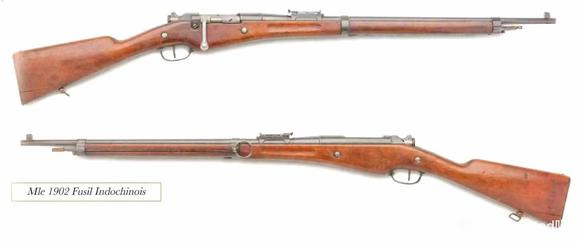
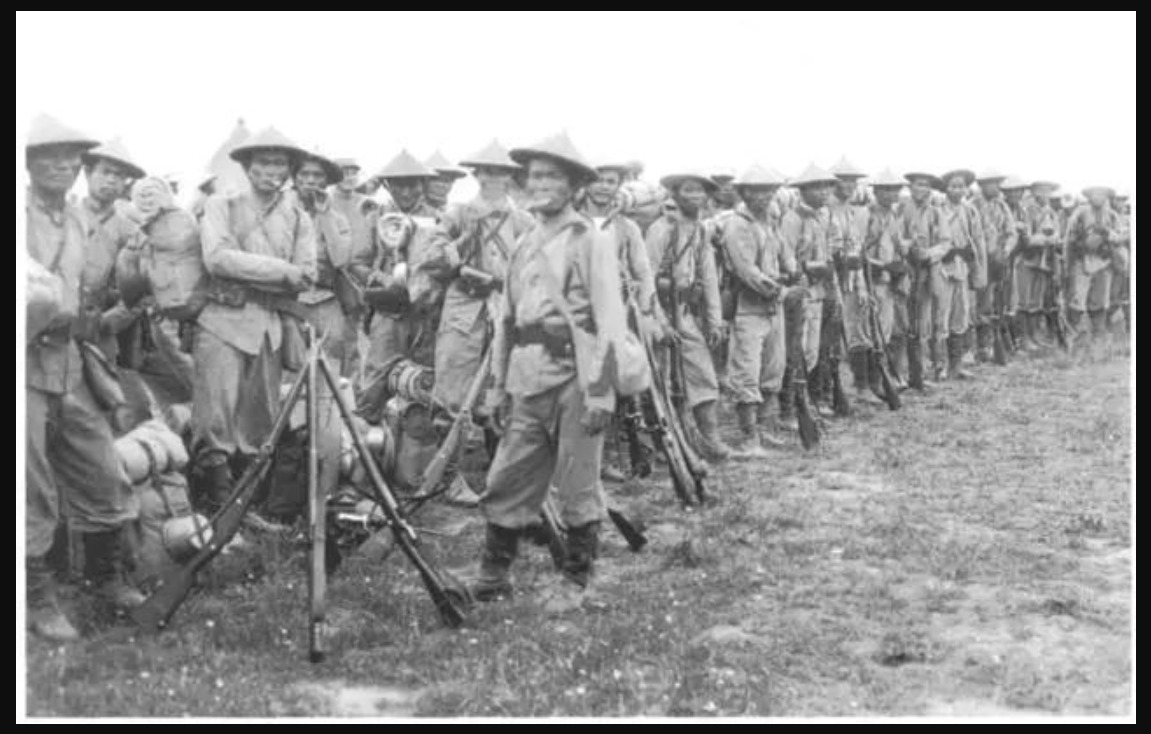
It was finalized on May 22, 1902 and was adopted by the light infantry units of the French Tokyo Protectorate, the Annam Protectorate and the Cochinchina Colony (which respectively covered northern, central and southern Vietnam). To accommodate the relatively slender physique of the local indigenous soldiers, the Mle 1892 artillery carbine carried by the local troops was lengthened to reduce recoil, increasing the maximum sighted range from the carbine’s 2000m to 2400m and replacing the bayonet with that of the police carbine. Due to the humid climate in Southeast Asia, the wooden stock of the gun often cracked at the gun neck when it got wet, so a fixed protrusion was added at the connection point between the receiver and the stock to disperse the recoil transmitted from the receiver to the stock when firing. In 1909, it became the standard configuration for all newly manufactured Berthier rifles (carbines). Since light infantry could not place their guns on horses like cavalry when resting, a stacking hook was added to facilitate the stacking and centralized storage of multiple rifles. By the outbreak of World War I in 1914, the total production was 33,900 rifles, of which 10,000 were exported to Persia. The full length of the gun was 1125mm, the barrel length was 635mm, and the empty weight was 3.6kg. “Tirailleur” originally meant “shooter”, referring to the light infantry who used skirmishing tactics outside the linear formation of line infantry in the era of Napoleon. From the 1940s to the 1960s, it referred to the light infantry units recruited and formed by France in its colonies.
7、Fusil Colonial Modèle 1907
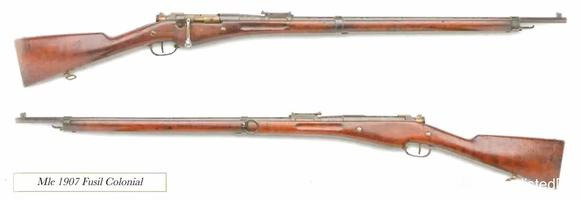
On September 18, 1907, it was adopted by the French colonial light infantry unit of Senegal. Initially, it was named “Fusil de Tirailleur Sènègalais Modèle 1907” (Senegal Light Infantry Rifle of 1907). The overall design was the same as that of the Mle1902 Indian Branch Light Infantry Rifle. Due to the taller and stronger physique of the indigenous soldiers in Senegal, the barrel was lengthened to the same length as the Lebel Mle1886 rifle. The slot for storing the barrel below the barrel was removed. On June 19, 1908, France decided to equip all African colonial light infantry units with this rifle, so it was renamed “Mle1907 Colonial Rifle”. By the outbreak of World War I in 1914, the total production was 24,569 rifles. The overall length of the rifle was 1,305mm, the barrel length was 800mm, and the empty weight was 3.8kg.
8、Fusil Modèle 1907-1915
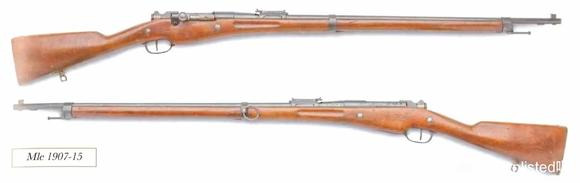
After the outbreak of World War I, the rate of rifle depletion in the French army exceeded expectations, and the stock of rifles was seriously insufficient. The Lebel Mle 1886 rifle used by the local troops not only had inferior performance but also had been discontinued in 1904. On February 26, 1915, the local troops adopted the Mle 1907 colonial rifle. Considering the inventory situation and usage habits of the local troops, its bayonet was modified to be compatible with the Lebel Mle 1886 rifle, and it was put into mass production. Soon after, the downward curved pull lever was changed to the straight pull lever identical to that of the Lebel Mle 1886 rifle. From 1915 to 1918, the total production was 2,137,466 rifles. From 1917 onwards, some of the produced rifles were equipped with a 5-round magazine. The overall length of the rifle was 1,305mm, the barrel length was 800mm, and the empty weight was 3.8kg.
9、Mle1916(Modèle 1916)& Mle M16(Modèle Modifiè 1916)
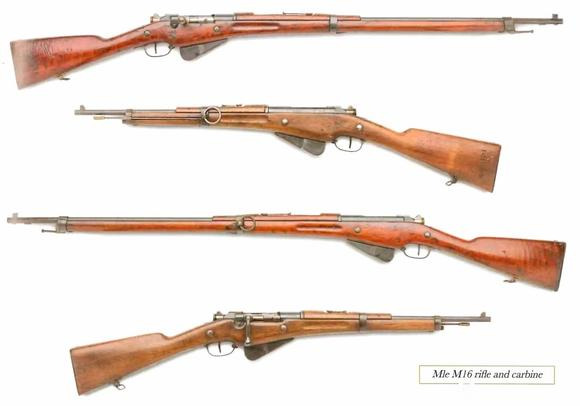
The Mle1907-15 rifle exposed several flaws on the battlefield during World War I. It had a low capacity of 3 rounds, was difficult to be moved with one hand due to overheated barrel, and had a narrow sight field that made it hard to aim at moving targets or in low-light conditions. On November 28, 1916, the 5-round magazine and 5-round clip developed by the Sartelero Military Factory (MAC) were adopted. The new magazine was compatible with the original 3-round clip.
By the end of World War I in 1918, the total production of the Mle1916/Mle M16 rifle was approximately 280,000 units. To prevent the new 5-round clip from disrupting the ammunition supply of the frontline troops, all of them were stored in reserve and not used in combat. The Mle1916/Mle M16 carbine was already in use at the end of World War I. From 1918 to the French surrender in 1940, the total production was approximately 494,000 units. MAC was the only manufacturer that continued to produce this gun after World War I. The full length of the Mle1916 rifle was 1305mm, the barrel length was 800mm, and the empty weight was 4.2kg; the full length of the Mle1916 carbine was 945mm, the barrel length was 453mm, and the empty weight was 3.25kg.
10、Fusil de Tirailleur Indochinois Modèle 1902 Modifiè 1916
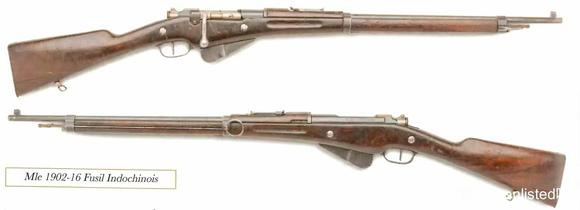
In 1920, the French ground forces, in order to replenish the rifles lost during World War I and to provide rifles for the establishment of new units, developed new types of rifles while also upgrading the Mle1902 Indian Expeditionary Light Infantry Rifle, which was already in M16 specifications. By 1929, the total production was 25,250 rifles. Additionally, 1,715 Mle1902 Indian Expeditionary Light Infantry Rifles in stock were upgraded to M16 specifications in 1925. There were also an unknown number of Mle1902 Indian Expeditionary Light Infantry Rifles that were upgraded to M16 specifications during routine maintenance.
11、Fusil Modèle 1907-1915 Modifiè 1934
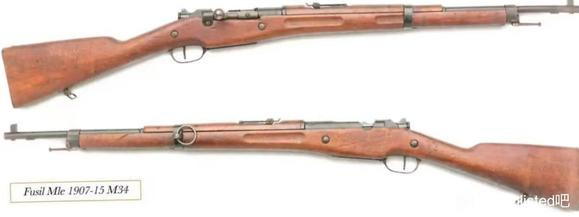
Before World War II, it was modified to use French 7.5mm rifle cartridges and adopted a 5-round double-row magazine and a 5-round bridge clip.
The differences in their appearance are not significant. I’m not very clear about the details of the additional data either. It’s just for reference and discussion.
Welcome everyone to join the discussion!