Finnish use: Never issued to military use or mass-produced either. Gas-action light machinegun designed by Aimo Lahti for Finnish military. Very promising design, which did not get beyond prototype-stage.
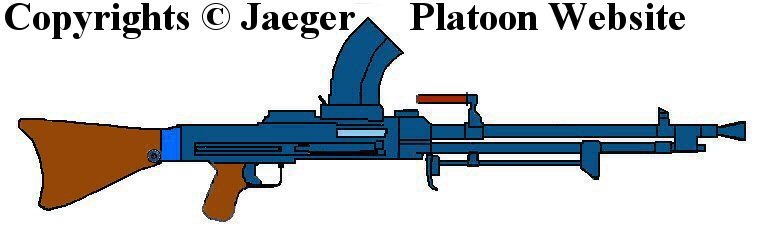
PICTURE: Drawing showing L-34 light machinegun prototype.
Weapons Design Committee, which controlled which weapons designs got accepted to use of Finnish Armed Forces at 1930’s simply hated gas-system weapons and were unwilling to accept any. Roots for this prejustice may lie in early Finnish military tests of light machineguns, in which two gas-action weapons (Vickers-Berthier and Colt-Browning) received a lot of minus points for their unreliability. What makes situation interesting however is the fact, that some members of the commission have been suspected possessing personal motives of rather questinable nature in this matter. Memoirs of Aimo Lahti suggest that he suspected some members of particular Committee to have private interests of financial nature when it came to this process of machinegun testing.
Lahti personally supported gas-action weapons and managed to get a tough deal (more like a bet) with Minister of Defence Arvi Oksala. Lahti had made the hard claim that he could develop a gas-action light machinegun, which would cost little as half of the price of Lahti-Saloranta M/26 and would also be about 40% lighter. Oksala promised 25,000 Finnish marks and a month to Lahti for designing of gas-action light machinegun. The sum of money provided proved to be too little to cover the expenses. But luckily VKT, where Lahti worked, paid the rest and one month proved to long enough for him. The new light machinegun that he came up had bolt system similar to his earlier machinegunner’s machinegun for aircraft use. However unlike machinegunner’s machineguns it had also gas-regulator, which allowed adjusting rate of fire. The new L-34 was clearly superior to Lahti-Saloranta M/26 light machinegun, which had entered to mass-production for Finnish military only few years earlier - It was notably lighter, much simpler (only 58 parts compared 118 of Lahti-Saloranta) and cheaper to manufacture. In addition also replacing of its barrel was faster and easier than with Lahti-Saloranta. Estimated production cost for L-34 run around 4,500 FIM (Finnish marks), while per unit cost manufacturing cost for Lahti-Saloranta M/26 was about 10,000 FIM. Whole structural design of this new light machinegun was very simple and reliable. The magazines intended for infantry version were 20-round box magazine and 30-round drum magazine. Reliability-wise L-34 excelled in all tests. During cold-weather testing this machinegun was tested by firing 6,000 rounds as fast as technically possible - the weapon passed the test with flying colours, even the gun barrel did not heat so much, that it would have required to be changed. In warm weather its gun barrel needed to be changed about as frequently as the gun barrel of Lahti-Saloranta. It also showed superior shooting accuracy compared to Lahti-Saloranta M/26 - the size of impact area of its bullets on target proved to be only about half of its competitor. In constant fire durability test (used to test how many shots can be fired before something in the weapon breaks) L-34 light machinegun prototype fired some 34,000 rounds before first problem - which was only a broken extractor. Simply said L-34 had all makings to be one of the best light machineguns available at that time. When equipped with 75-round pan magazines (designed for the version intended mainly as anti-aircraft weapon) it would have also been firepower-wise serious competitor to even best existing light machineguns of the era. End of year 1934 Defence Ministry Ordnance Department was planning of replacing Lahti-Saloranta in production with L-34.
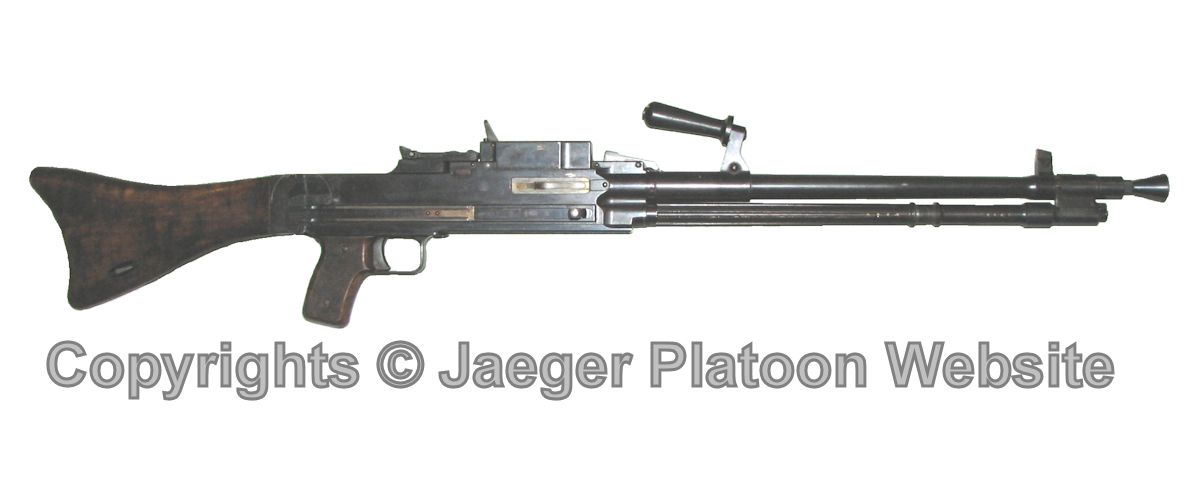
PICTURE: One of the L-34 light machinegun prototypes minus magazine and bipod. (Photo taken in Metsästysmuseo).
That was when leading generals of Finnish Army hit back. Inspector of Infantry General-Major A. S. Heikinheimo made clear that new light machinegun design would not be improvement large enough for Army unless it was belt- of strip-fed. According his own words if the weapon would have been belt- or strip-fed, he would have ordered few dozen immediately. His idea of strip-fed light machinegun was clearly outdated, but the one about belt-fed hit spot in estimating the future development of light machineguns. However, due to this Lahti-Saloranta M/26 remained in production - the last production series of Lahti-Saloranta M/26 was manufactured as late as year 1942. At the same time it also basically ended whole light machinegun L-34 project. Admitted production and training of Finnish military had just been organised for Lahti-Saloranta M/26 and adding a new light machinegun model would have demanded much more work with training and spare-part supply. The manufacturer, which Ministy of Defence had been intending for this weapon was also unusual to say the least - Konepaja (Engineering Works) of Saastamoinen Oy in Kuopio had no previous experience when it came to manufacturing firearms or even their parts and no production capacity for the intended 10,000 - 15,000 weapons. Aimo Lahti seems to have personally suspected that certain high ranking officers and officials had their financial interests involving the matter and these interests effected the matter from the start.
Still, my opinion is that L-34 for not being accepted to use of Finnish Armed Forces or not even being accepted to further development remains as one of the largest mistakes ever made by Finnish Armed Forces ordnance administration. Considering the rather poor reputation concerning reliability (or lack there of) that Lahti-Saloranta M/26 gained during World War 2 and its other limitations (weight, magazine capacity) L-34 light machinegun would have almost certainly been a much better weapon. Only two prototypes of L-34 were manufactured for Finnish military (both of them in year 1934). In addition to these two VKT manufactured four prototypes for foreign tests (and possible export deals, which they might produce) in 1934 - 1935. These export prototypes were sent to Brazil, Great Britain, Persia, Sweden and Turkey. However no export deals succeeded.
Blockquote YouTube
| Calibre: | 7,62 mm x 54 R | ||
|---|---|---|---|
| Length: | 1185 mm | ||
| Barrel length: | 575 mm | ||
| Weight: | 8,1 kg | ||
| Fire-rate: | 600 - 800/minute | ||
| Magazines: | 20-round box magazine and 30-round drum magazine for infantry version |
Do you think Lahti L-34 LMG “sampo” should be a Germany’s weapon?
- Yes,I think it should be a RP weapon.
- Yes,I think it should be a BP weapon.
- Yes,I think it should be a Event weapon.
- Yes,I think it should be a Premium team’s weapon
- No, I don’t want to see Lahti L-34 LMG “Sampo” in Germany