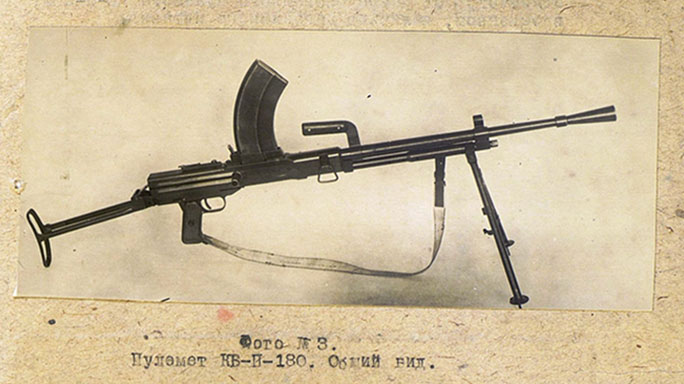
The weapon you are referring to is the KB-P-180 (КБ-П-180), an experimental Soviet light machine gun developed during World War II. Designed in 1942–1943 by renowned firearms inventor Vasily Degtyaryov at the Kovrov design bureau, it was created as a potential replacement for the standard Soviet DP-27 light machine gun. [1, 2, 3]
Key Characteristics & History
-
Caliber: Chambered in the standard Soviet 7.62×54mmR rimmed cartridge. [1]
-
Feed System: Fed from a curved box magazine, a major departure from the bulky top-mounted pan/disk magazines used on the DP-27.
-
Sister Project: Developed alongside the KB-P-260, which was essentially the same weapon mechanism but adapted to use a metallic belt-feed system instead of a box magazine. [1]
-
Rejection: Despite being slightly faster to manufacture than a standard DP-27 (requiring 21 machine-hours versus 24), it was rejected by military trials. The rimmed nature of the 7.62×54mmR cartridges frequently caused feeding failures in its box magazines, and the design did not meet the strict wartime requirements for simplified, ultra-high-volume mass production.

1 Like
Yooo is that a Soviet Bren I’m seeing? What’s their weight and rate of fire?
2 Likes
KB‑P‑260 (and KB‑P‑180) Rate of Fire
The KB‑P‑260’s rate of fire was intended to be in the ~100–120 rounds per minute range, similar to the DP‑27, but in practice it was limited by feeding problems and mechanical issues.
Historical context
The KB‑P‑260 was a 1943 Soviet experimental light machine gun by Vasily Degtyaryov, developed alongside the KB‑P‑180. The 260 used a metallic belt‑feed system instead of the box magazine of the 180  Enlisted. Both were chambered in 7.62×54mmR and designed as potential replacements for the DP‑27 Enlisted+1.
Intended performance
While exact test data is scarce, the KB‑P‑260’s design was based on the DP‑27’s mechanism, which had a cyclic rate of fire around 100–120 rpm in service. The belt‑feed version was meant to improve sustained fire and mobility, but the first prototype failed trials due to malfunctioning belt feeding — the official NIIPSVO report noted “the main and most characteristic delay of the KB‑P‑260 is the failure of the cartridge to move from the belt”  military-exotic.blogspot.com. This feeding issue would have directly reduced its effective rate of fire in real use.
Practical limitations
- Feeding problems: The belt feed was unreliable, causing stoppages and lowering the practical rate of fire military-exotic.blogspot.com.
- Mechanical design: Like the DP‑27, it used a delayed blowback action, which inherently limits cyclic rate to ~100–120 rpm for 7.62×54mmR Enlisted.
- Comparison to DP‑27: The DP‑27’s service rate of fire is often cited as ~100–120 rpm; the KB‑P‑260 was designed to match this, but its belt feed and mechanical quirks meant it could not sustain that in practice Enlisted+1.
The DP‑27’s = KBP 180
1 Like