Should the I.G.Mod.71/84 (Infanterie-Gewehr M1871/84)
- Yes
- No
Mauser Model 71/84
The Mauser Model 71/84 is a magazine-fed repeating rifle that features a tubular feed system . It was designed by Paul Mauser and is known for its innovative use of a tubular magazine, which allows for easier reloading and improved performance compared to single-shot designs. The rifle was officially adopted by the German Army in 1884 and is significant in the evolution of military rifles, marking a transition from single-shot to magazine-fed firearms. . 
The I.G.Mod.71/84 (Infanterie-Gewehr M1871/84), Germany’s first infantry repeater, is a further evolution of Mauser’s successful I.G.Mod.71, but it is not a conversion of the M71 nor a simple upgrade, but rather a newly-designed and newly built rifle merely based on the M71. The I.G.Mod.71/84 is an 1871 pattern rifle with a tubular magazine (itself a derivation of the Winchester system), coupled with a Mauser designed lifting mechanism and improved rear sight.
The most significant improvement was the addition of an 8 round tubular magazine in the forestock, loaded singly from the top with the bolt open. As a repeater, the M71/84 constituted a firepower improvement over the M1871 single shot, the under barrel tubular magazine was clumsy and time consuming to reload and served to provide only a backup for emergency firepower. Fully loaded, the rifle was very front-heavy and its center of gravity changed with every shot. The introduction of easily reloadable box magazine repeaters such as the Austrian Mannlicher in 1885-86 tolled the approaching end of the tube magazine repeater.
While the M71/84 was competitive at the time of its adoption, the introduction in 1886 by the French of their Lebel rifle chambering a revolutionary 8mm smokeless powder cartridge made the M71/84 obsolete almost overnight. This action escalated the great European arms race of the late 19th Century, and Germany embarked upon a crash program to adopt a competitive rifle.
Germany considered adopting an 8mm tube magazine Mauser design, but by the late 1880s the box magazine was starting to evidence its superiority in balance, reloading and reliability. While the removable box magazine was still being resisted, all agreed that the charger-loading magazine was becoming the way to go. The Germans settled on the Reichsgewehr M1888 Mannlicher (the “Commission” rifle), a box magazine variety. Although a blow to Mauser at the time, this move ultimately led to Mauser developing the successful M1889 and then the phenomenally successful M1898 series of rifles which served Germany and nations around the world through and past WWII.

During this time frame, as Germany continued to unify, military standardization amongst the various German states was a significant consideration. The M1869 Bavarian Werder was converted to the German M1871 cartridge and, notwithstanding the ongoing arms race with France and throughout Europe during this time, Germany maintained the continuity of its rifles system and ammunition until entering the smokeless powder era in 1888. Quantities of M1871s and M71/84s were even utilized by rear echelons during the early days of WWI.
Although the I.G.Mod.71/84 never saw front line military service, many saw service with the German navy, the German reserve and behind the lines units through WWI. Large numbers were sold to South American countries and as surplus in the US and Canada. Ammunition for them was made commercially into the mid‑twentieth century. The I.G.Mod.71/84 also represents what may be the height of small arms manufacturing refinement, its workmanship being since unsurpassed for a general issue infantry rifle.
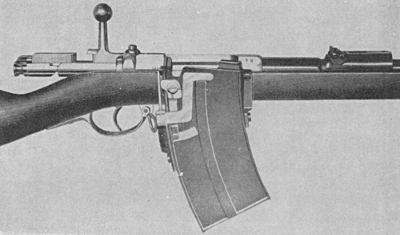
Special Mauser Box-Magazine Built On The Model 71 System
The 71/84 is a gun similar to the Murata 22 already in the game in that they are both high-capacity tube fed bolt action rifles. The Germans lack such a weapon in the tech tree or bp. This gun would improve the German Arsenal if added through an event. At BR2 it would be a side choice over the Italian 6 shot semi-automatic. Benifiting from the Bolt action accuracy with an increased ammo capacity over any rifle at BR2.
The M71 was also exported to Japan for testing and was used to improve the design of the Murata rifle.[21] Uruguay, Siam and Honduras also fielded the M71 from the 1880s.
 Colombia: Model 71[29]
 China: Model 71[30]
 Dahomey: Model 71[31]
 Dominican Republic: Model 71[32]
 Ecuador: Model 71/84[26]
 Ethiopian Empire: Model 71[17]
 Canada: Models 71/84, Quebec Home Guard use (rifles marked Q.H.G.)
 Germany: Models 71,b79 and 71/84[20]
 Nazi Germany: Model 71/84[20]
 Honduras: Model 71[15]
 Irish Republic: Model 71[15]
 Japan: Model 71[15]
 Korea: Model 71
 Serbia: Model 71 and Mauser-Koka[33]
 Ottoman Empire: Model 87[20]
 Transvaal: Model 71[15]
 Thailand: Model 71,[23] Model 71/84[34]
 Uruguay: Model 71[15]
 Venezuela: Model 71/84[25]
Of Course grasping at threads we could easily see Japan get their hands on this gun. Joining the Murata 22 as a limited weapon obtainable through an event. Either directly from Germany or through Thailand. Used as a weapon of last resort it could be a way of increasing the emperor’s arsenal.