🇯🇵 Hinō-Komuro M1904 Pistol & It's Variants, Extensive Overview

Hello everyone! Today I’ll be putting forward to you what I hope will be the most comprehensive and up to date study and examination of the weapon I intend to suggest for Japan, the Hinō-Komuro M1904 Pistol & Some potential Hinō-Komuro M1904 variants!
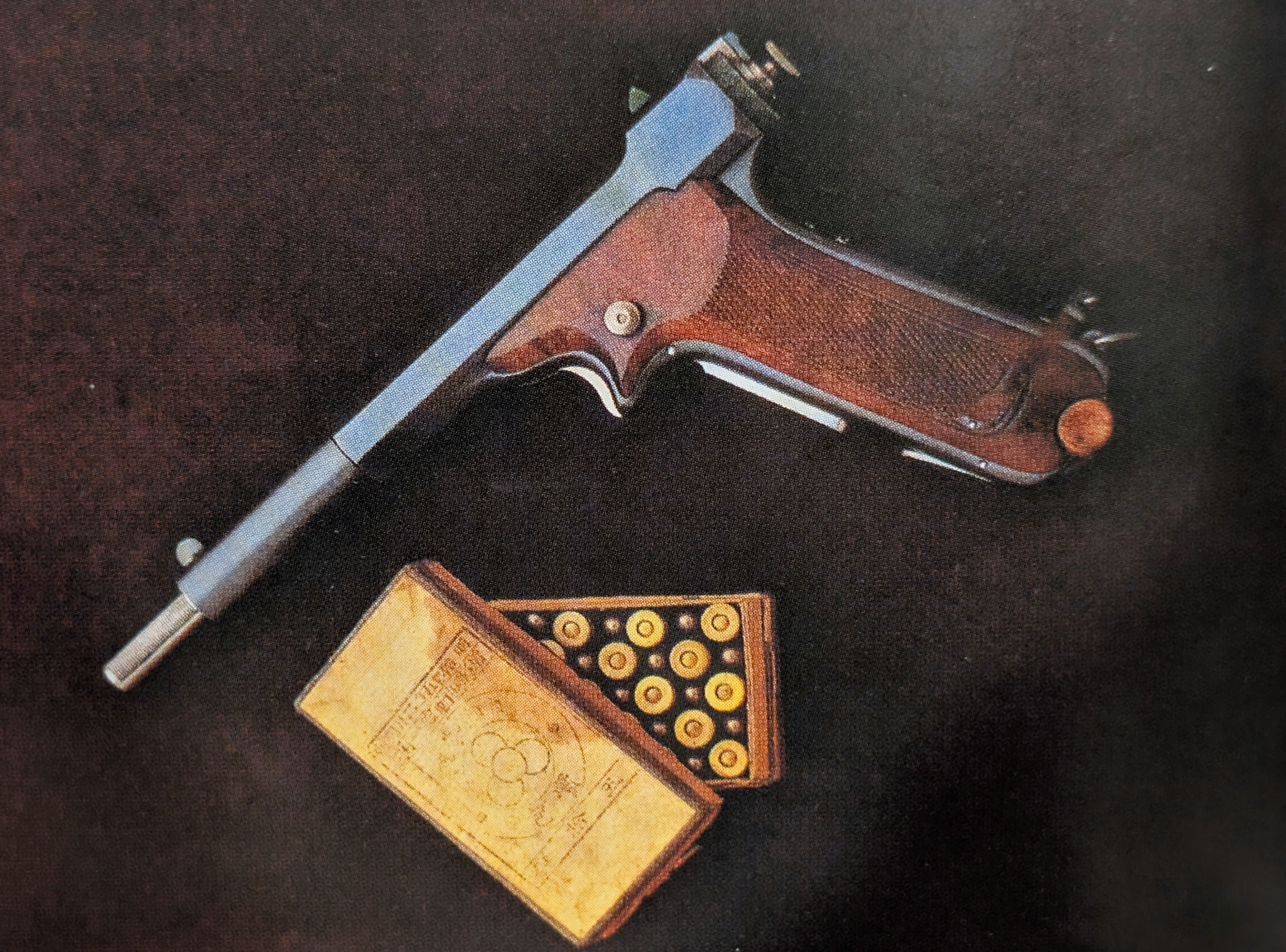
8mm Hinō-Komuro serial No. 184, with an Original 50-round box of 8x22mm Nambu ammunition.

This will be just as much of a suggestion as it will be an in-depth report of the history, development and variants based upon prior and new found information.

Due to the expansive coverage that will take place herein and the extensive length of this report, some notably large portions of text shall be condensed and categorised for ease of reading access and selection of information for the reader.

For the reader who simply wishes to know what variants, what calibres, magazine capacity and new potential function I suggest proceeding to Section (𝒅.) & Section (𝒆.)

And a special thank you to the assistance in locating specific documentation, advice and translation assistance from @_DELAVR


Specifications, Technical Info & History


(𝒂.) General Design & Specifications
1. Original Design Overview
  1. Original Design Overview
    Earliest Production Complete (7.65mm) Hinō-Komuro Pistol currently known, all original/1st Variation components
The first ever documented recording of the initial design pertaining to the Hinō-Komuro Pistol dates back to 1897, where it’s Inventor Kumazo Hinō of whom would become an Imperial Army Lieutenant by the time of 1903 December 7th, the same time at which the initial application for a Japanese Patent covering a 7.65mm (.32 ACP/7.65mm Browning) blow forward pistol design was submitted by both Hinō Kumazo and civilian Tomojiro Komuro.
Where it would be later accepted in 1904 March 5th, formally under Patent No. 7165; within the U.S and England it was additionally granted a patent in 1907, a subsequent renewal and final issuing was made in 1908.

(See section 𝒃.1&2 for a deeper comprehensive patent history)
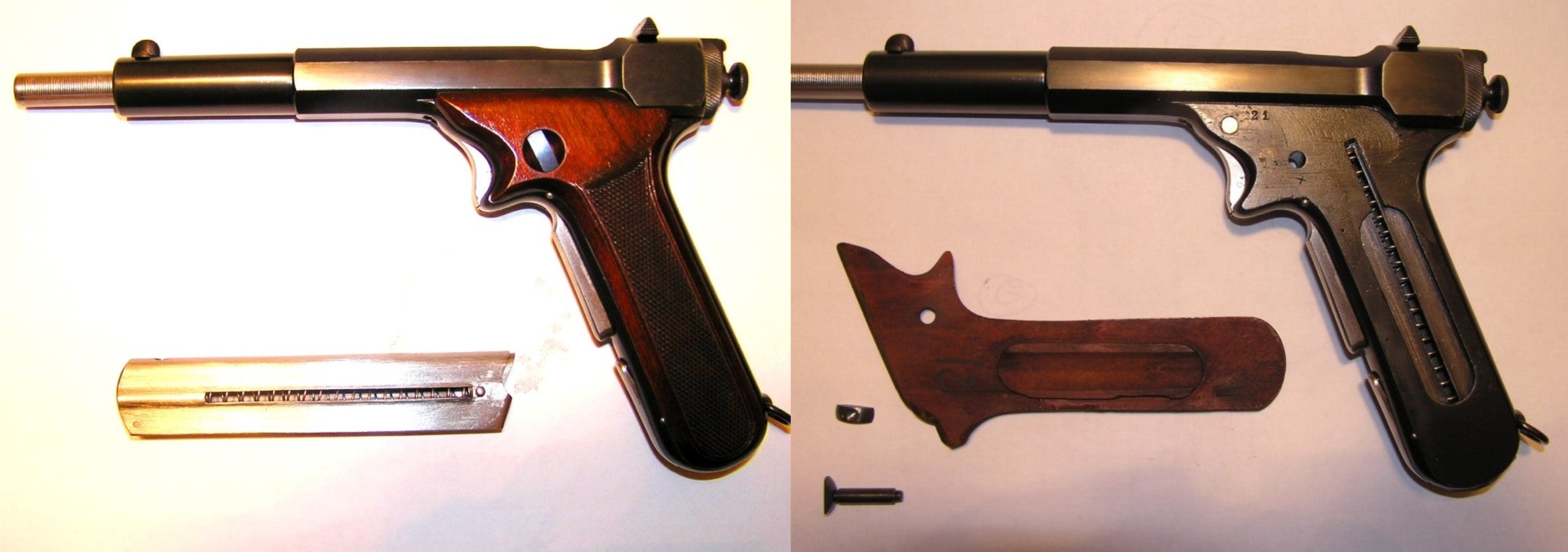
Earliest Production (7.65mm) Hinō-Komuro Pistol currently known Serial No. 21, reportedly missing some parts

The operation and manipulation of the firearm was novel and unique in a number of ways that made is distinct from many firearms even to today, though not every design decision could be called practical.
The action of the Hinō-Komuro M1904 requires the user to grip a serrated face either side of the barrel itself, pulling forward until the barrel latches forward, additionally you’ll notice the breech is clear of the barrel via the top ejection port.

Top: Pistol uncocked, Bottom: Pistol cocked (note the appearance of a cartridge where the barrel was prior)

Another way in which the user could cock the pistol in an urgent situation or due to the barrel heating from extended fire, is by depressing the trigger thereby releasing the main spring tension upon the barrel (whilst taking care to not depress the grip safety), the user can then snap their wrist downwards and the inertia alone will be enough to cock the barrel forward, readying the pistol to fire once again. Additionally the barrel extends forward 38mm when readied to fire.

After the pistol has been loaded and cocked, the user can then depress the grip safety and pull the trigger to fire a shot. The barrel once cocked additionally activates a feeder that strips a cartridge from the magazine, at the moment the barrel comes rearward the cartridge is picked up and struck against a fixed firing pin at the back of the breech.

To reload a Hinō-Komuro pistol one would simply depress the lower lever located below that of the grip safety releasing the magazine from the magazine well, insert a fresh magazine and ready yourself to fire following the cocking procedure once more if performing a full reload from empty.
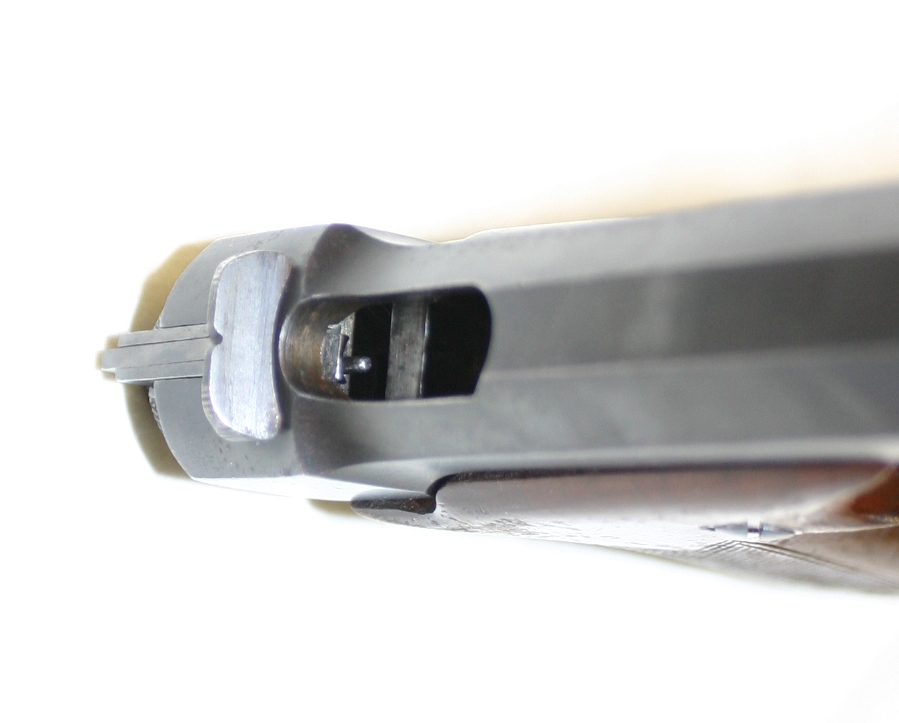
HinoKomuro06

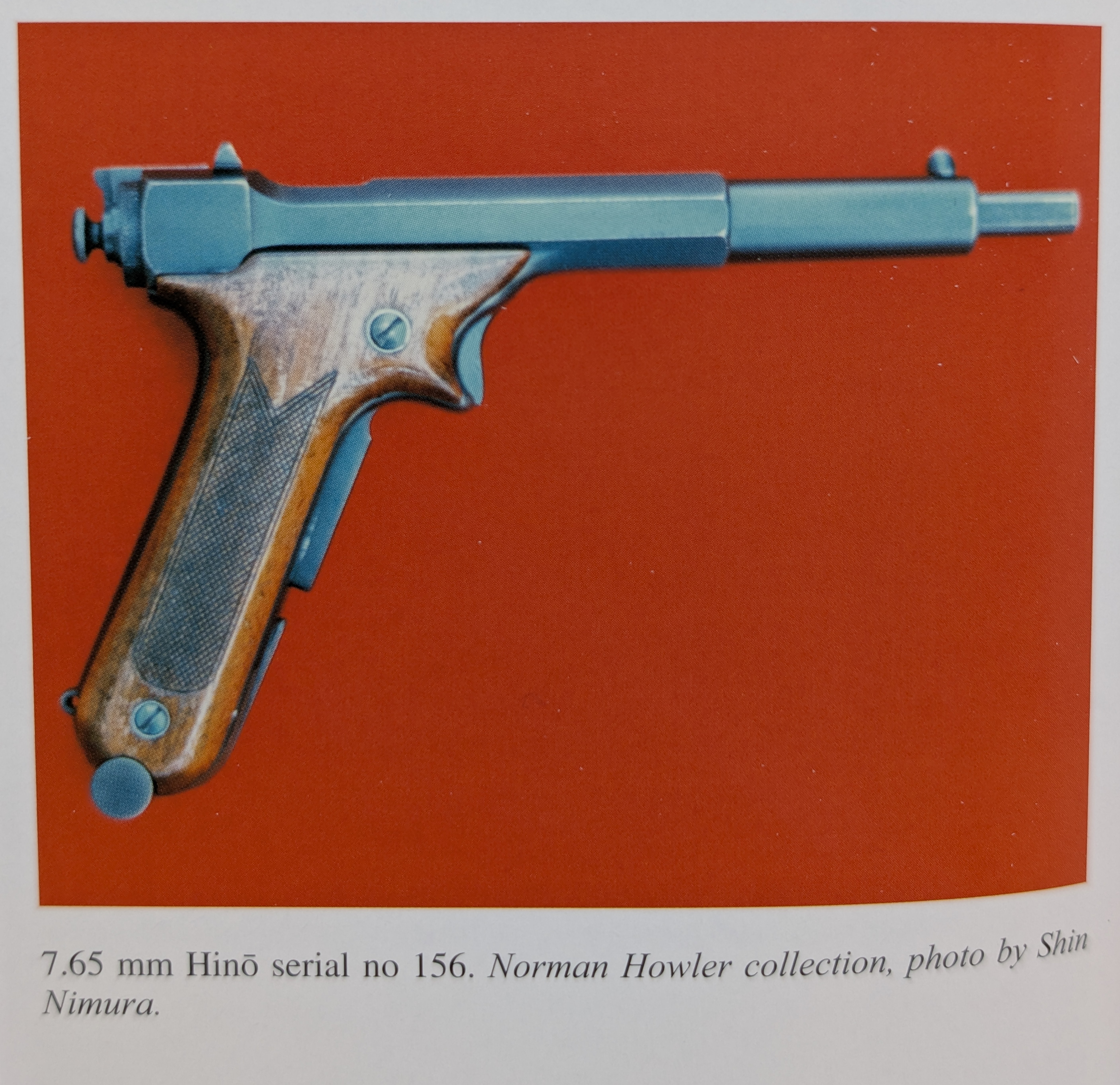
Hinō-Komuro (7.65mm) Serial No. 156, Clear view of the fixed firing pin located at the rear of the breech, barrel cocked forward

Additionally as noted in later sections 𝒄.1&2 and explained in greater detail within section 𝒆., if one depresses the trigger only partially instead of the entire length of the trigger pull, it is possible to prevent the firing and retaining detent from full engaging with the firing shoulders, thereby causing the Hinō-Komuro M1904 pistol to fire within bursts or full-auto until the magazine is emptied or the trigger is released or pulled fully rearward.

(See section 𝒆. for the full breakdown concerning full-auto/burst-fire “capability”)


2. Focus Upon The 8mm (8x22mm Nambu) Version
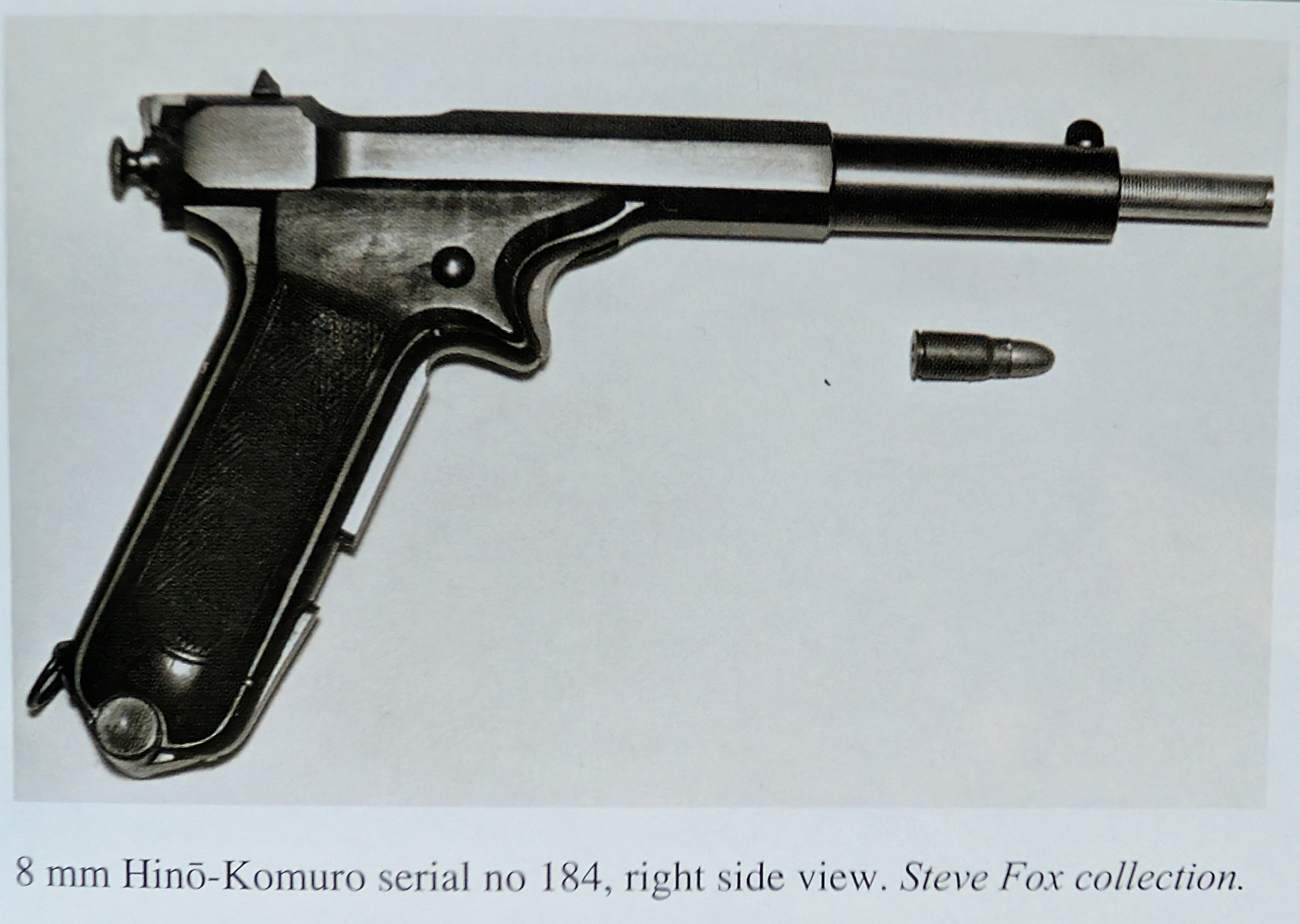
  1. Focus Upon The 8mm (8x22mm Nambu) Version

Why suggest the 8mm over the 7.65mm?
To give a brief explanation for the latter part of this report and the primary body of the suggestion, I’ll be predominantly suggesting the Hinō-Komuro M1904 chambered within 8mm (8x22mm Nambu) despite the fact that most surviving examples up to the current day have been chambered in 7.65mm (.32 ACP/ 7.65mm Browning).

The two main reasons are directly because of the intended and desired performance in game, as most of the 8mm Hinō-Komuro pistols exhibit the most modern features of the pistol’s development, in addition to the 8x22mm Nambu being a more potent cartridge than that of the 7.65mm Browning. Secondly, the magazine capacity of both calibres is exactly the same; logically it makes the most sense to primarily suggest the “best” version of the Hinō-Komuro M1904 to be put in game, first and foremost.
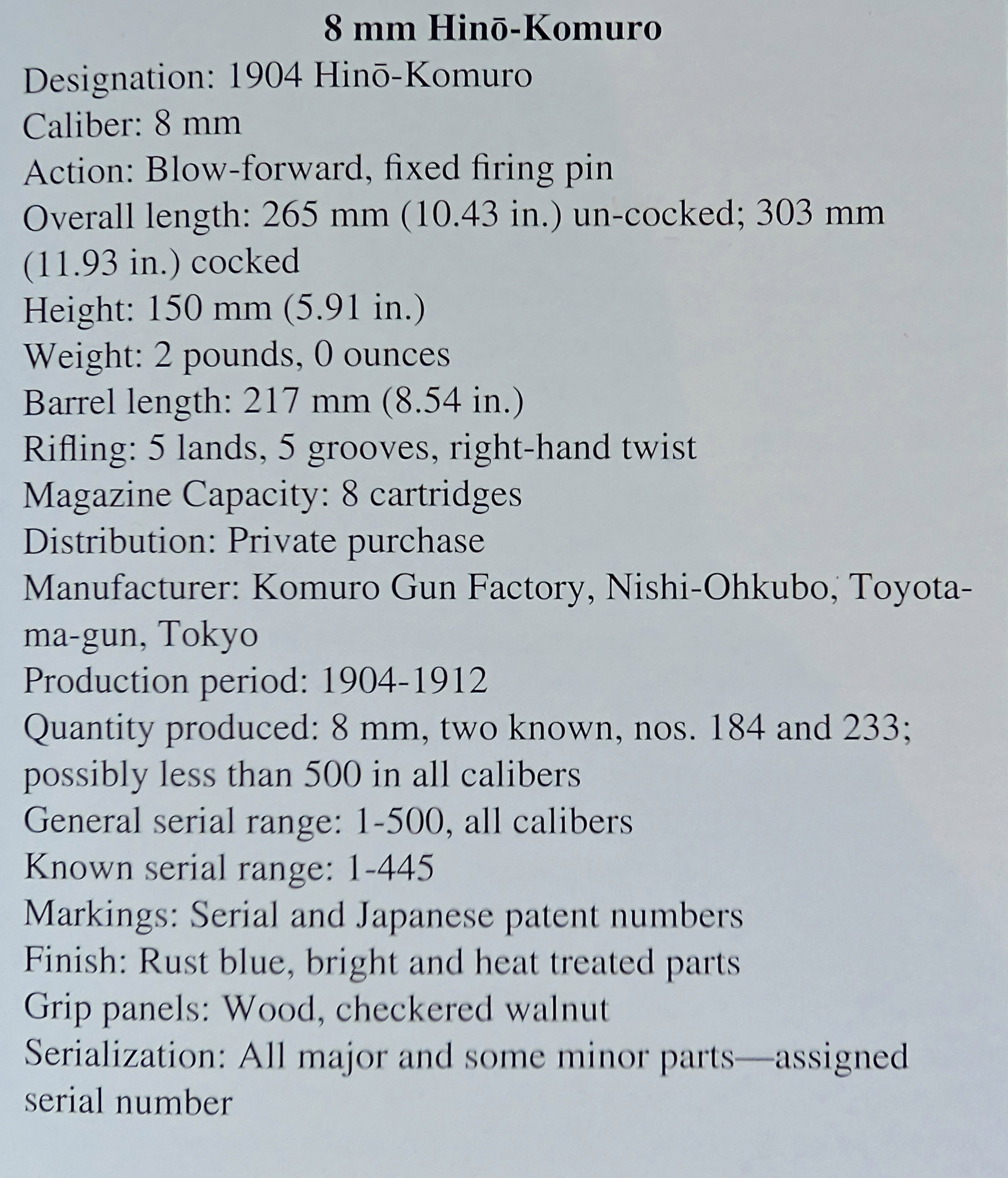
Hinō-Komuro 8mm (8x22 Nambu) full specifications, known Serial range out of date, Serial No. 126, 135 now known

Nevertheless I will still put forward the information for other possible calibre variants that come with their own distinct differences.

(See section 𝒅.2&3 to view all information concerning calibre variants and magazine capacity.)


3. Changes to the Design & Component Variation
  1. Changes to the Design & Component Variation

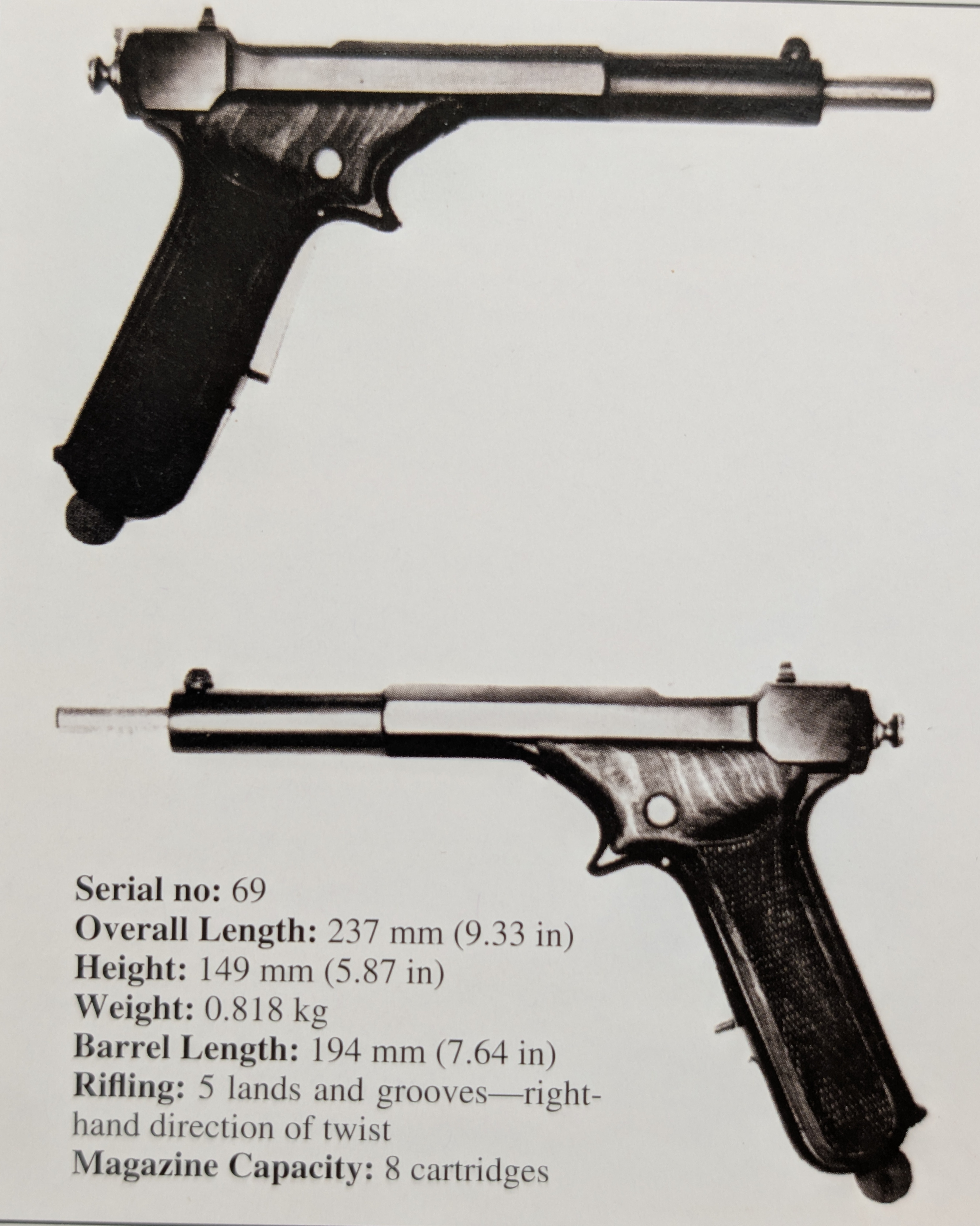
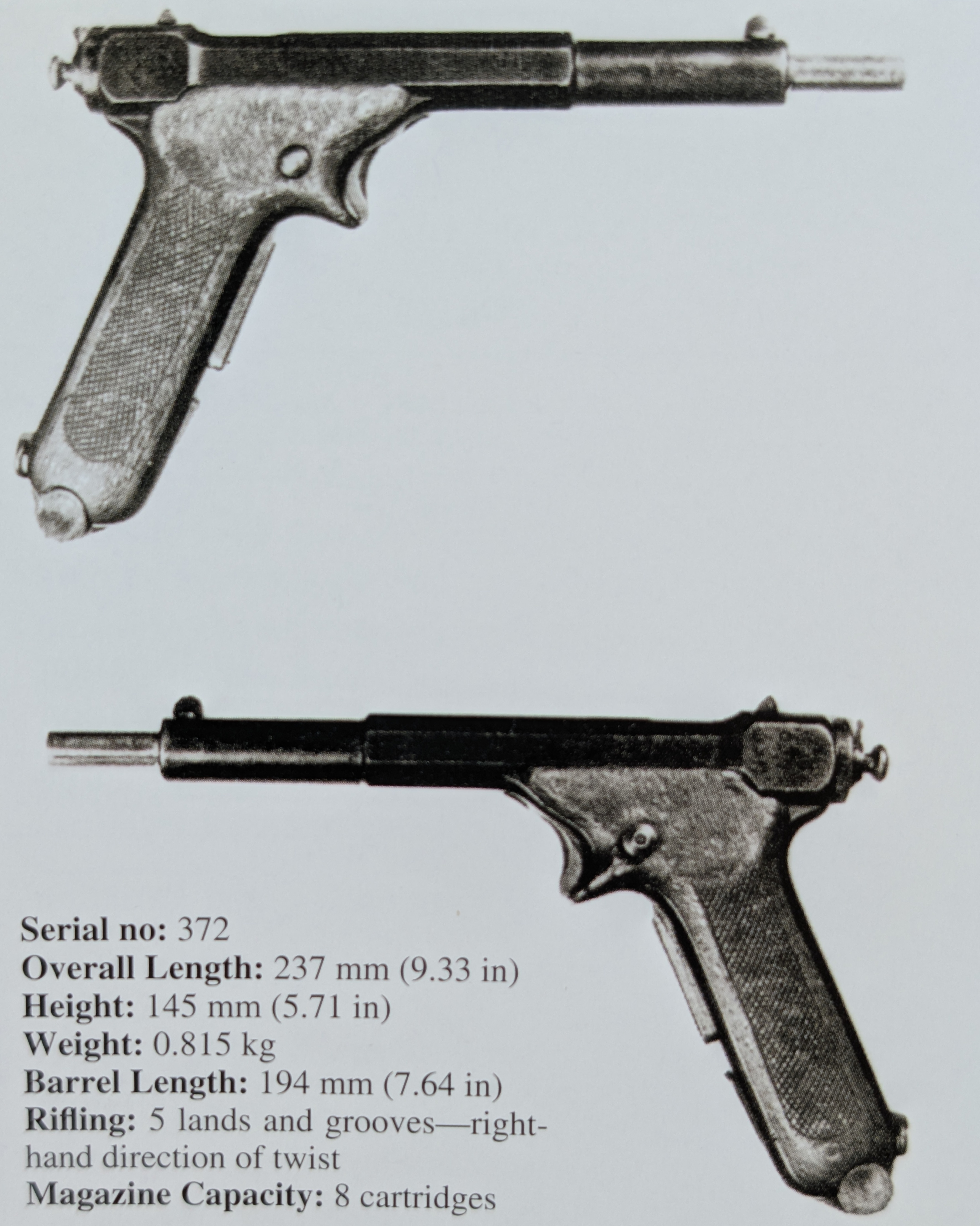
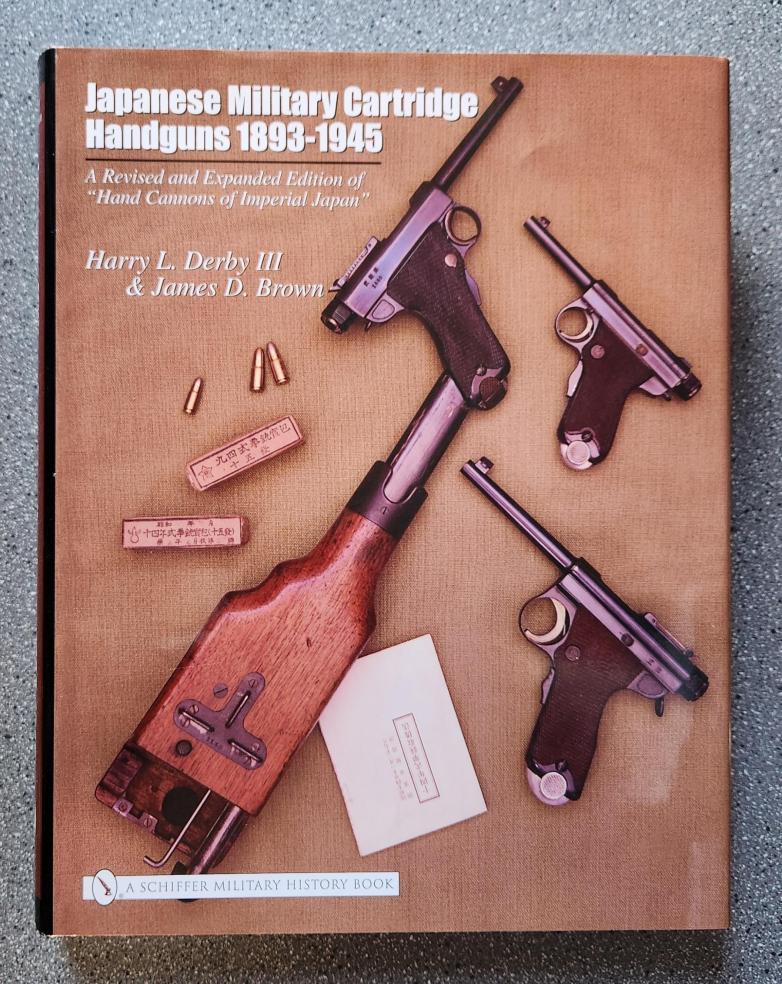
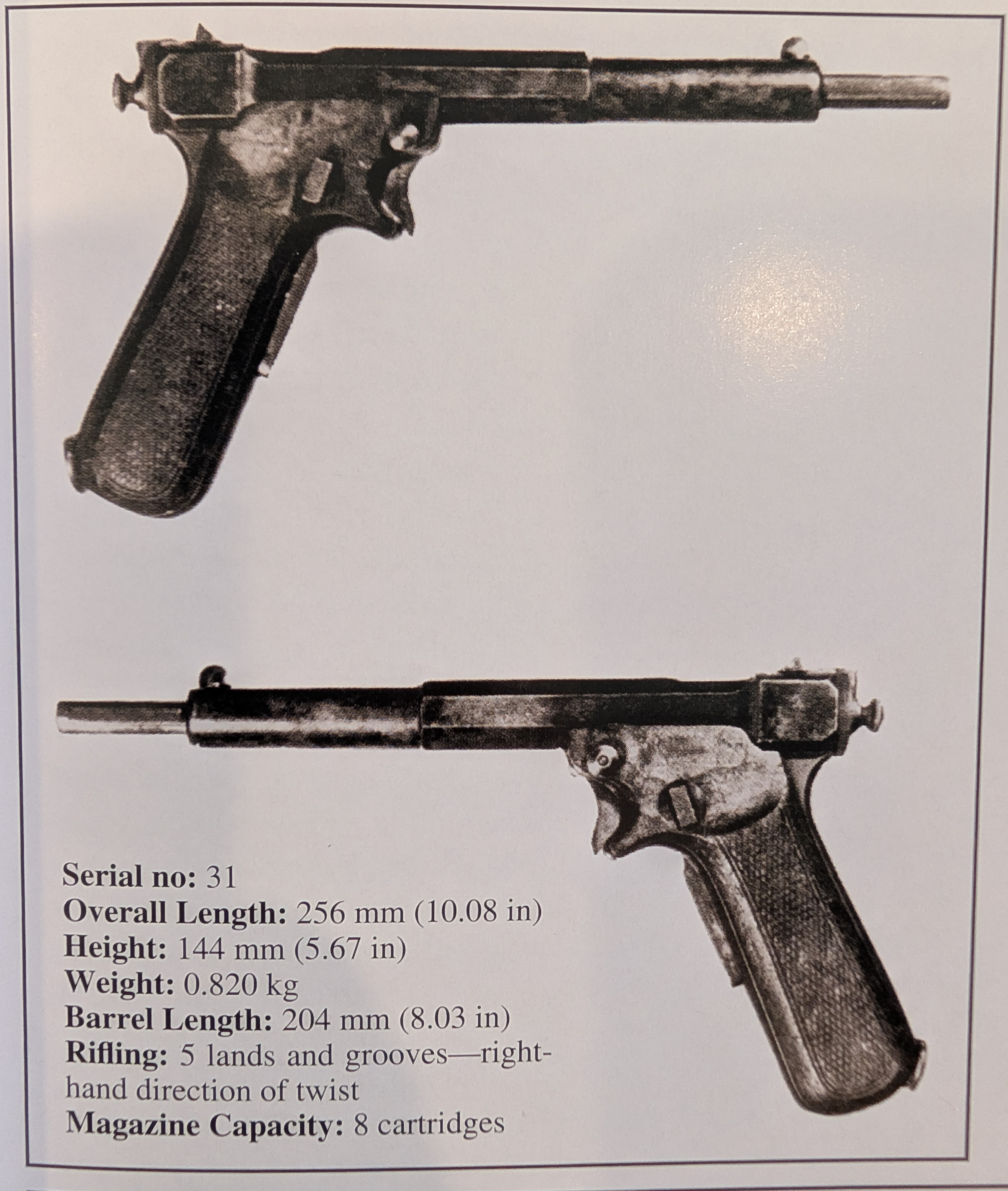
In this section I will put forward the design and component variations known thanks to surviving examples, the US and Original Japanese Patent drawing in a side by side, in addition to a table extrapolated directly from P.35, Japanese Military Cartridge Handguns 1893-1945
A Revised and Expanded Edition of “Hand Cannons of Imperial Japan”

To give a quick summary these modifications and variations primary consist of the following changes in the areas of:

  • Barrel length.
  • Firing pin and breechblock scheme.
  • Sight design.
  • Receiver contour.
  • Grip frame and safety shape.
  • Grip panel checkering pattern.
  • Grip panel retainer arrangement.
  • Magazine body design.
  • Magazine latch design.
  • Magazine base configuration.

Design Evolution of the Hinō-Komuro

Components and Features Japanese Patent United States Patent Serial No. 31 Serial No. 56 Serial No. 69 Serial No. 372
Barrel Length 203 mm 203 mm 203 mm 194 mm 194 mm 194 mm
Firing Pin and Breech Block Original 1st Variation 1st Variation 1st Variation 1st Variation 1st Variation
Sights:
• Front
• Rear
Original
Original
1st Variation
Original
1st Variation
Original
1st Variation
1st Variation
1st Variation
1st Variation
1st Variation
1st Variation
Receiver Contour Original 1st Variation 1st Variation 2nd Variation 2nd Variation 2nd Variation
Grip Frame and Safety Original 1st Variation 1st Variation 2nd Variation 2nd Variation 2nd Variation
Grip Panels:
• Checkering
• Retainer
Unknown
Original
Unknown
Original
1st Pattern
Original
2nd Pattern
1st Variation
3rd Pattern
2nd Variation
4th Pattern
2nd Variation
Magazine:
• Body
• Latch
• Base
Original
Original
Original
Original
1st Variation
Original
Original
1st Variation
Original
1st Variation
2nd Variation
1st Variation
1st Variation
2nd Variation
Non-original
1st Variation
2nd Variation
2nd Variation

Table extracted from P.35, Japanese Military Cartridge Handguns 1893-1945
A Revised and Expanded Edition of “Hand Cannons of Imperial Japan”
Harry L. Derby III & James D. Brown

For further clarity in identifying the differences refer to the aforementioned Serial Numbers and their accompanying pistols below. Additionally at bottom will be a 8x22mm Hinō-Komuro M1904, Serial No. 126 and list the component variations of said pistol.
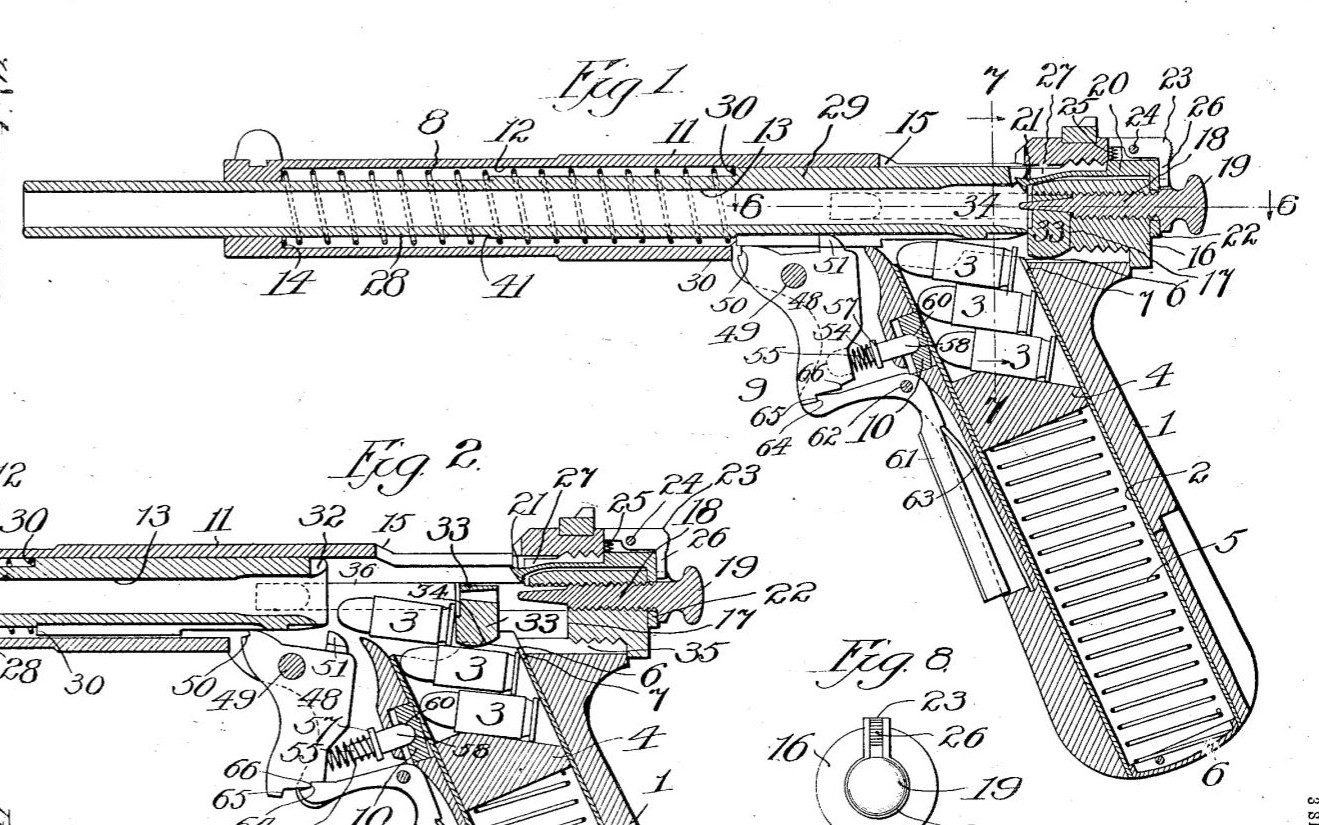
Original Japanese Patent


United States Patent


Serial No. 31 (7.65mm Browning)


Serial No. 69 (7.65mm Browning)


Serial No. 156 (7.65mm Browning)


Serial No. 372 (7.65mm Browning)


Serial No. 126 (8x22 Nambu)

Components
and Features
Serial
No. 126
Barrel Length 194 mm
Firing Pin and
Breech Block
1st Variation
Sights:
• Front
• Rear
1st Variation
1st Variation
Receiver Contour 2nd Variation
Grip Frame
and Safety
2nd Variation
Grip Panels:
• Checkering
• Retainer
3rd Pattern
2nd Variation
Magazine:
• Body
• Latch
• Base
1st Variation
2nd Variation
2nd Variation

(𝒃.) Original Patent Drawing & US Patent
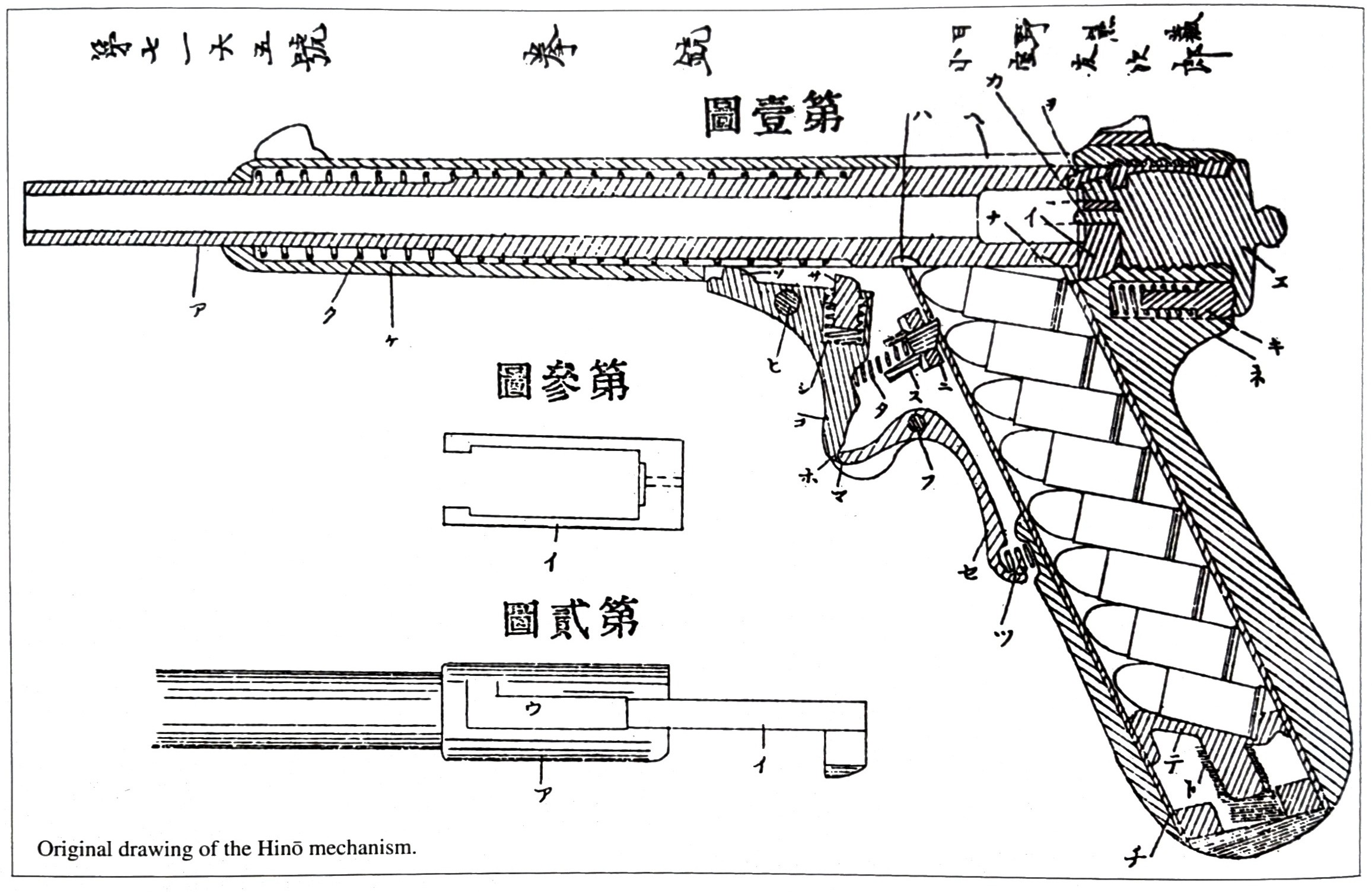
1. Original Patent Drawing
  1. Original Patent Drawing

In this section I’ll present to you the original design drawing of the Hinō-Komuro M1904 pistol and how it’s been applied in a literal sense upon the pistols themselves outside of their mechanical function.

As mentioned in the previous section (𝒂.) General Design & Specifications, paragraph 1. The original concept for the Hinō-Komuro Pistol (at times simply referred to as the Kumazo Hinō blow forward mechanism) was first recorded in 1897, the first finalised design was finished in December 1903 and was then put forth for the initial Japanese patent on the 7th of the same month. “特許 (Tokkyo) Patent Number 7165.” To which it was later obtained on March 5th, 1904.

In my research I came across a digital diary of sorts that speaks of an aviation museum located in Kumamoto Prefecture, Hitoyoshi City, Hokozo, that held an exhibit on Kumazo Hinō and his flying machines, in addition to the original patent drawing.
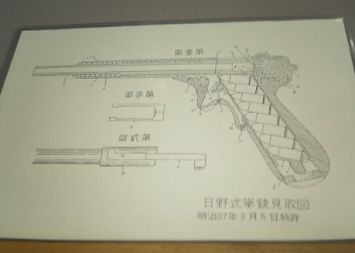
a85Hitoyosi-04


2. Subsequent Patent History & Full US Patent
  1. Subsequent Patent History & Full US Patent

An interesting point to note in the history of the patent and production of the pistols, is that on the 8mm Hinō-Komuro M1904 pistols, on the rear section upper section of the grip there’s a stamp displaying “特許” (Tokyyo) with patent number 7165 directly below it. This was believed to be further protection of the design as the 8mm variant of the Hinō-Komuro pistol was not covered in the initial patent filings.
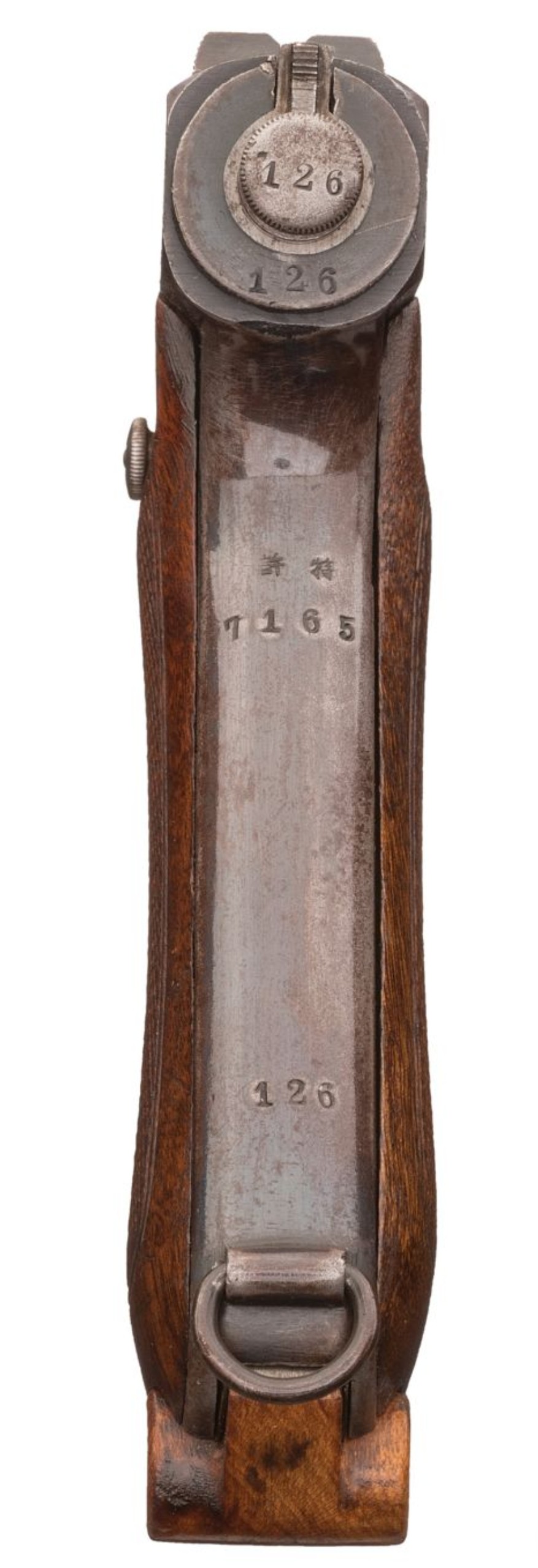
Serial No. 126 (8mm) displaying patent stamping

In the United States the patent filings for the Hinō-Komuro pistol were first submitted on September 23rd, 1904, under U.S. patent-no. 886211, the application was then renewed later on February 7th, 1908, and was then finally issued on April 28th, 1908.

I will now present to you the pages of the U.S. Patent-no. 886211 for any reader who wishes to understand the patent in full details.

UNITED STATES PATENT OFFICE.

KUMAZO HINO AND TOMIJIRO KOMURO, OF USHIGOME, TOKYO, JAPAN.

PISTOL.

No. 886,211.          Specification of Letters Patent.          Patented April 28, 1908.
Application filed September 23, 1904. Serial No. 225,681. Renewed February 7, 1908. Serial No. 414,780.
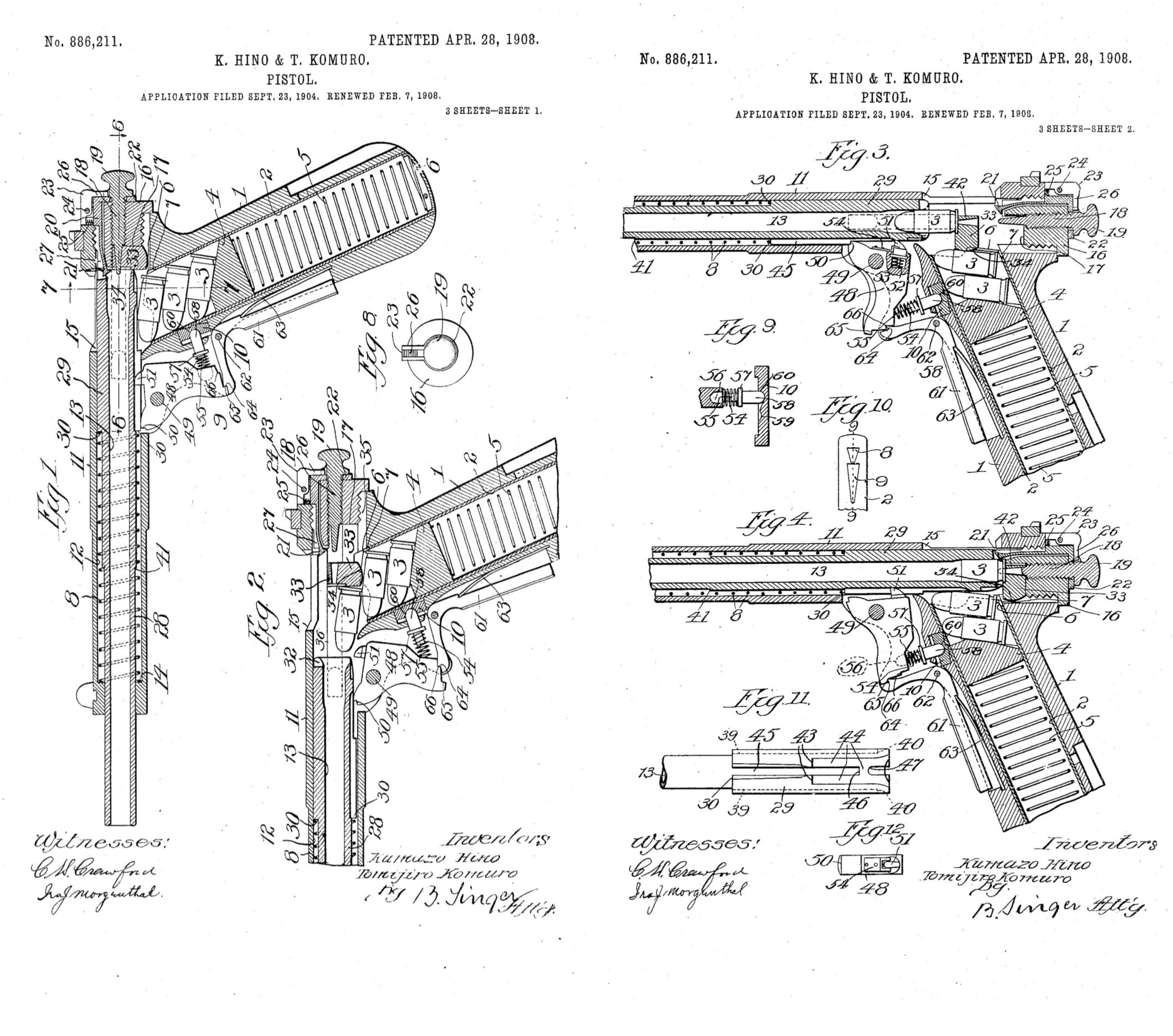
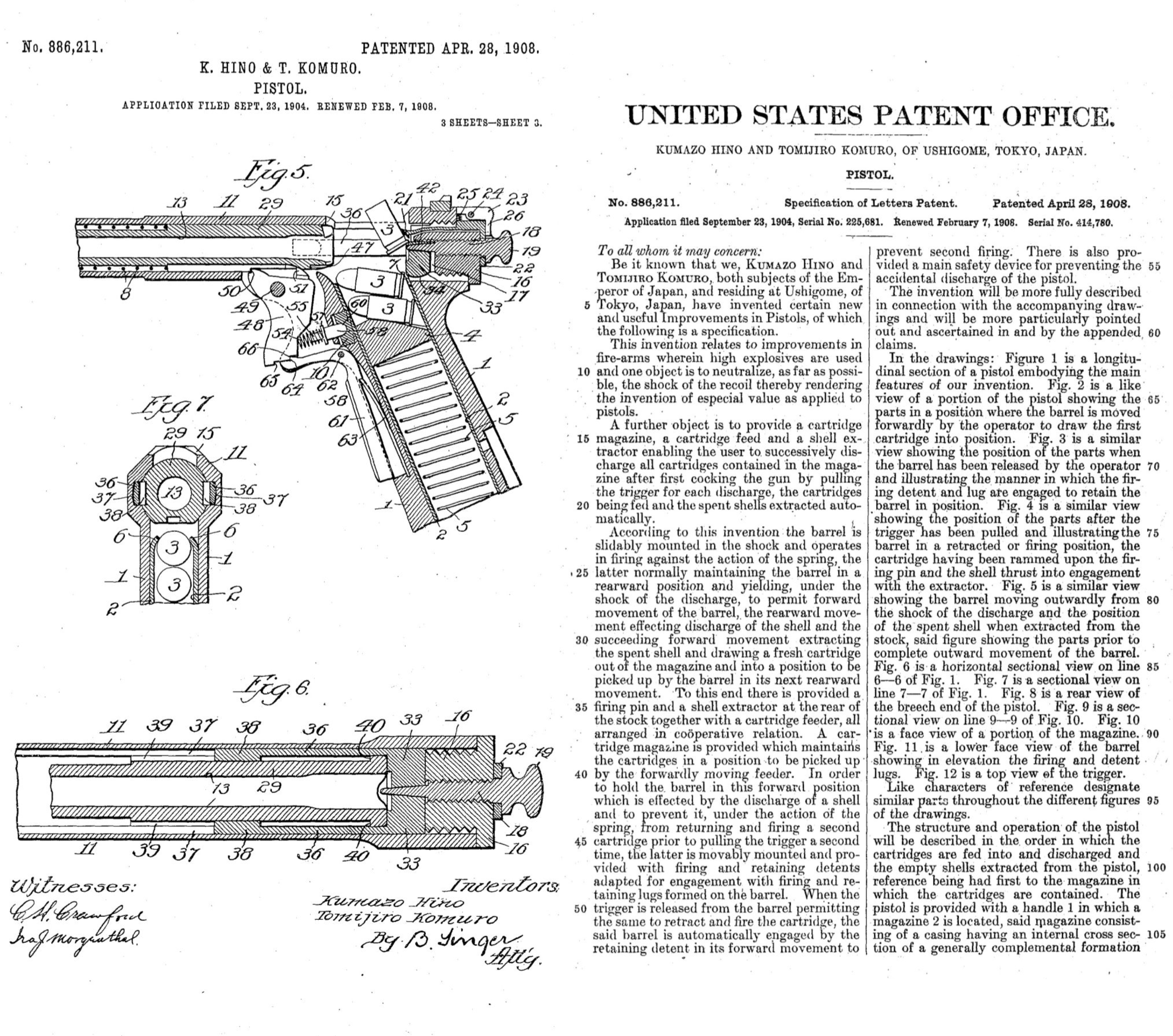
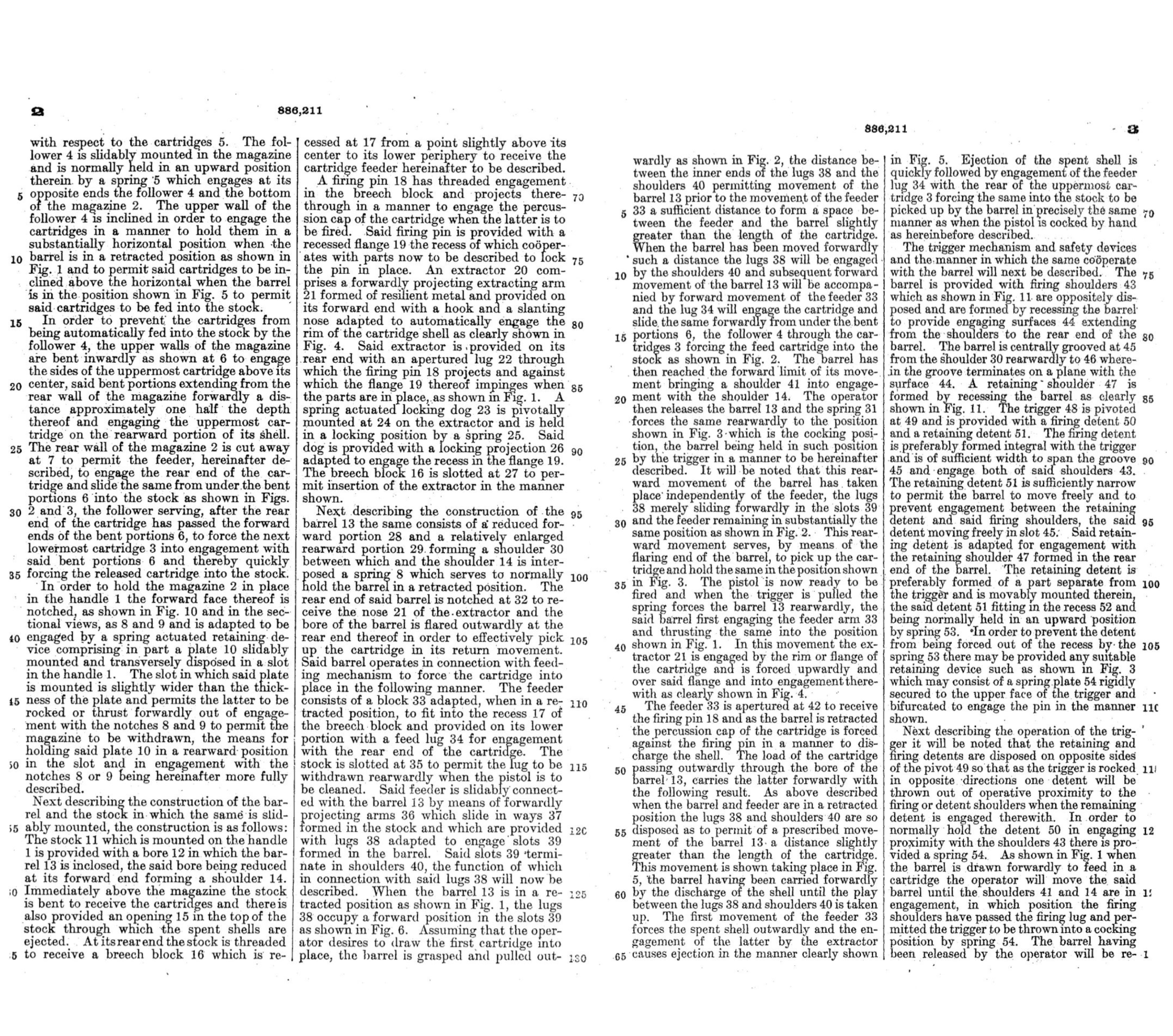
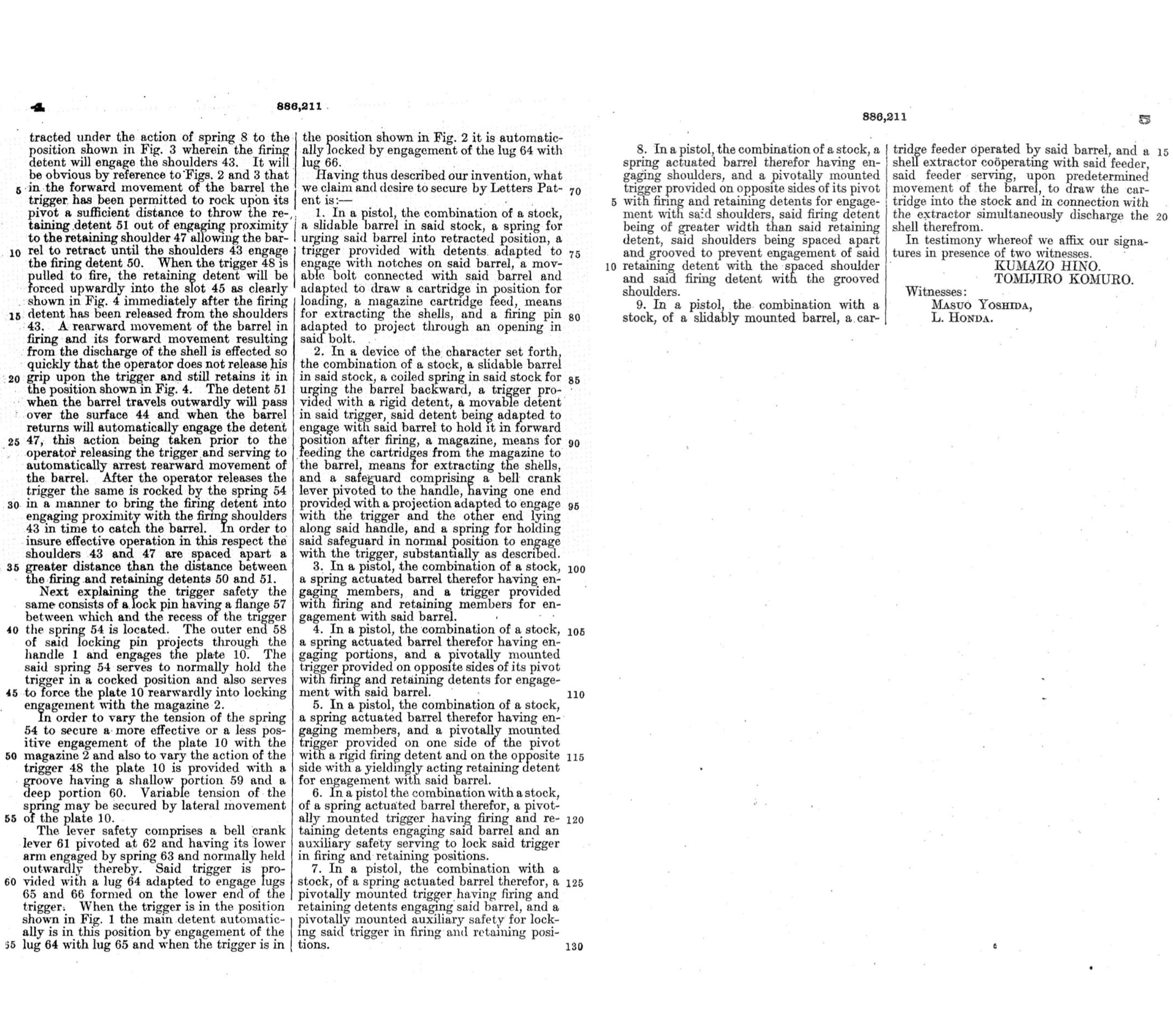
U.S. Patent-No. 886211


SECTION MOVED TO COMMENTS, EXCEEDED CHARACTER LIMIT
(𝒄.) Translation of a Factory Pamphlet in 1979 & New found Factory Pamphlet in 2026


(𝒅.) Known and Possible Variants

1. Surviving Variants
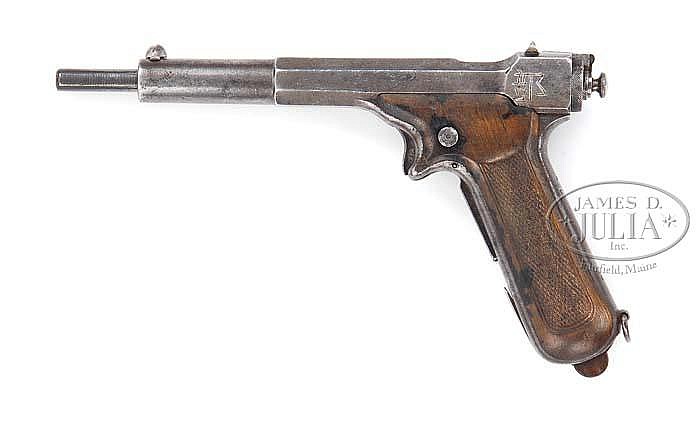
H0019-L14294805
8mm Hinō-Komuro serial No. 435, captured from Shanghai post war 1945, has engraving “滇部” (Yunnan Unit) — Property marking of a Yunnan provincial military naval unit.

Currently today the Hinō-Komuro M1904 doesn’t have many known surviving examples, whether in 7.65mm Browning and especially in concern to the 8x22mm Nambu models. It’s suspected the serial range is from 1-500 but only up to Serial No. 445 can be confirmed at the time of writing.

I’ve spoken in depth about the 7.65mm & 8mm models, so I won’t go too in depth as the reader can find out more concerning the specifications in section (𝒂.) General Design & Specifications, 1&2.
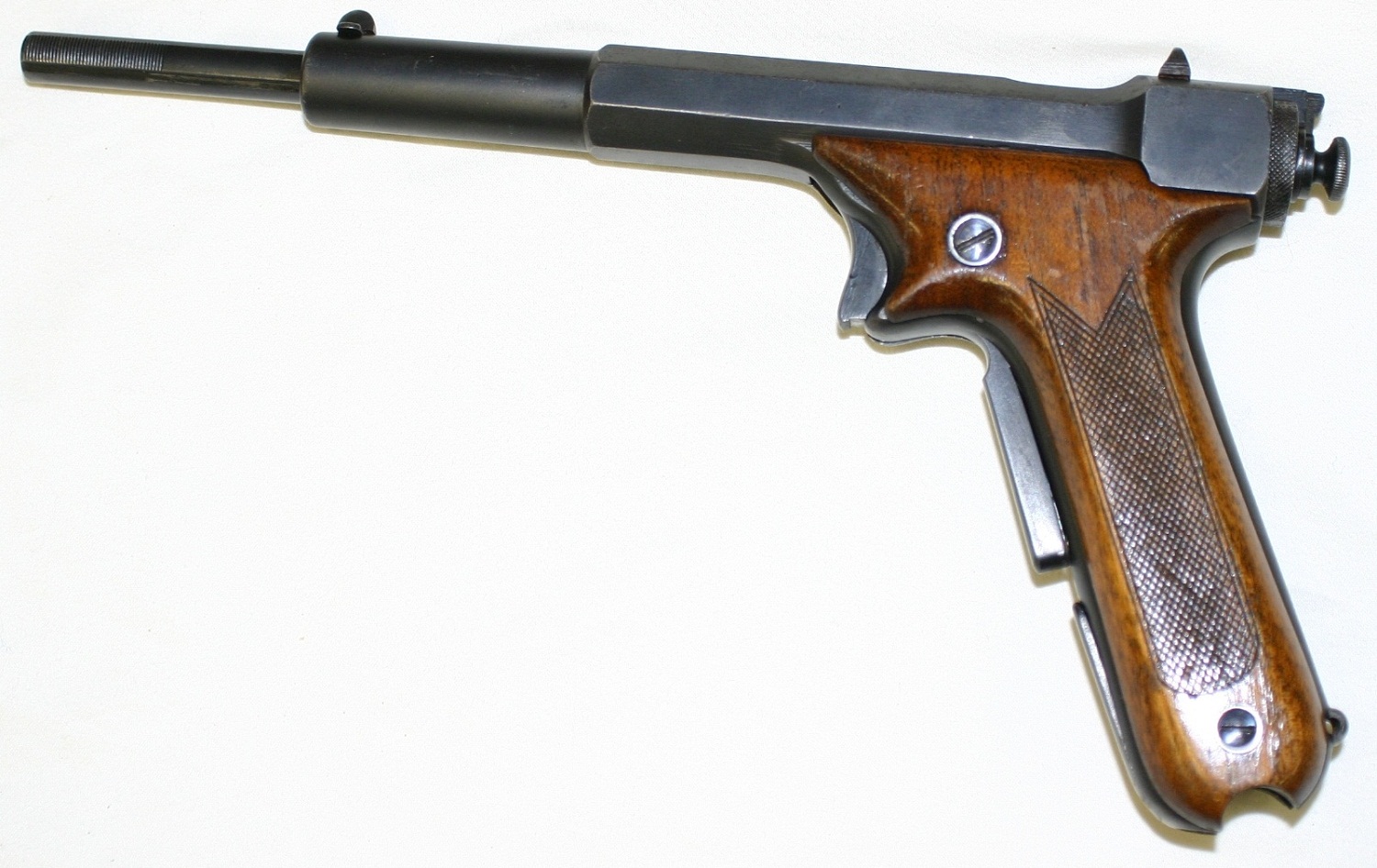
7.65mm Hinō-Komuro Serial No. 156

Here I will speak of one other currently known surviving example that is perplexing in every regard. The Hinō-Komuro 7.65mm “Rework” Serial No. 32. At the time of writing there’s still no surging documentation describing, when, where and for what reason this Hinō-Komuro M1904 was so extensively modified. What we do have is a list pertaining to these modifications as follows:
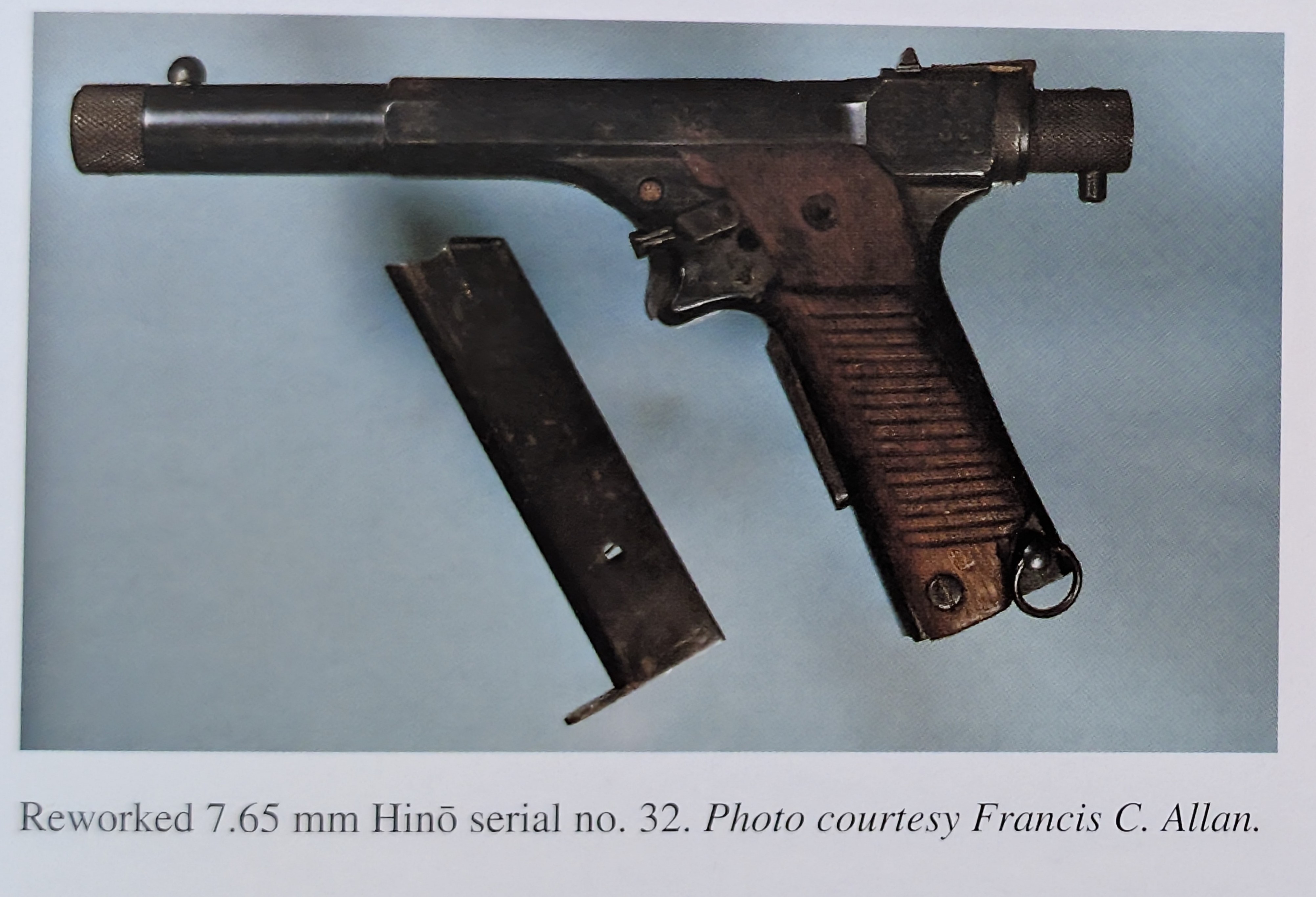
Direct quote from Japanese military cartridge handguns 1893-1945 a revised and expand&d edition of “hand cannons of imperial japan” harry l. derby iii & james d. brown, P. 37

2. Offered Calibre Variants by Factory

Until 1976 it was generally assumed that all Hinō-Komuro pistols were chambered in 7.65mm (7.65mm Browning), Serial No. 184 was discovered and was the first known 8mm (8x22mm Nambu) Hinō-Komuro M1904 pistol. (as mentioned earlier in section " (𝒄.) Translation of a Factory Pamphlet in 1979 & New found Factory Pamphlet in 2026")

later in 1979 thanks to the efforts of historian Atsushi Shibuya, author of The Life of Kumazo Hinō in preparation of the first edition volume he had made a request concerning the personal history of Tomojiro Komuro, the very one who assisted Kumazo Hinō in funding the development and production of the later known Hinō-Komuro pistol.

He was contacted about a home formerly owned by Komuro in the Saitama Prefecture. Within the basement of this old dwelling the historian uncovered early photographs of Tomojiro Komuro and an original factory catalogue. This catalogue offered great insight about the pistol and is how we know the factory initially offered and potentially produced the Hinō-Komuro pistol in calibres besides that of 8x22mm Nambu and 7.65mm Browning.

From the two factory pamphlets we can directly reference the calibre range from 5-8mm cartridges being an option, but what were they specifically? We can answer this by reviewing popular cartridges that were available for domestic purchase within Japan at the time, then with the knowledge of what cartridge we can assume the magazine capacity accordingly from the listed range of 8-15 rounds.

  • 5mm Clement, Hinō-Komuro M1904, 15rd
Ballistic performance
Bullet mass/type Velocity Energy
28 gr (2 g) FMJ 1,030 ft/s (310 m/s) 65 ft·lbf (88 J)

The only reasonable choice of pistol cartridge concerning the 5mm would be the 5mm Clement, it was manufactured as an early pistol cartridge for pocket pistols such as the 1903 Belgian Clement pistol and some other Spanish pistols.

Domestically such pistols were only likely purchased in very small amounts and even smaller amounts of ammo. Even so, it wouldn’t be unreasonable to imagine they were purchased by Japan with the primary purpose of distribution into Chinese markets; Spanish pistol producers were at the time unable to sell directly to China.

It’s a very small cartridge and I suspect it was 1 of the 2 cartridges offered with a 15 round magazine capacity. Though how many or whether any 5mm Hinō-Komuro pistols were made isn’t very likely, compounding this is the fact that after 1906 Clement shifted production to .32 ACP.
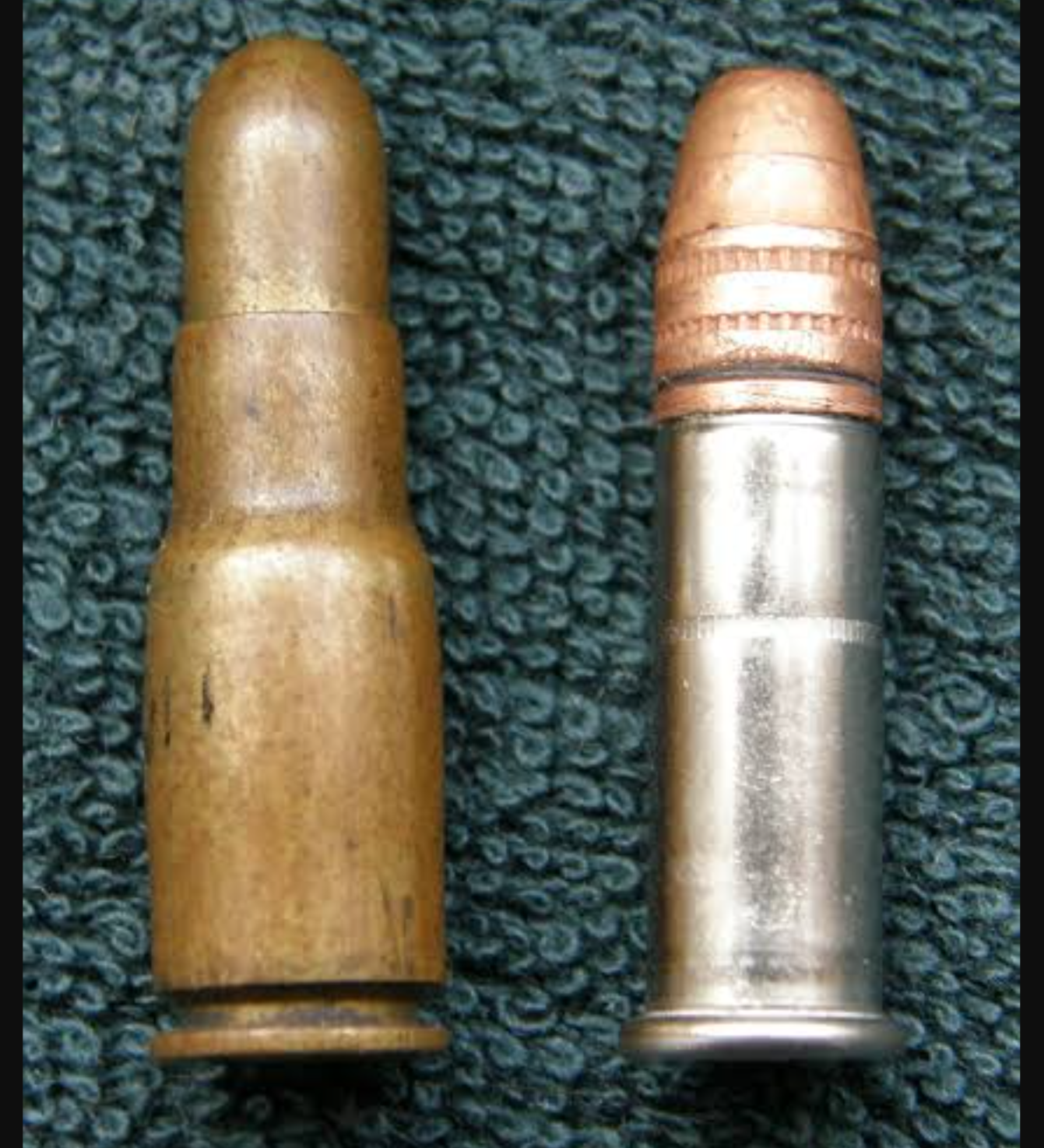
(Left:)5mm Clement compared to (right:) 22lr

  • 6.25mm/.25ACP, Hinō-Komuro M1904, 15rd
Ballistic performance
Bullet mass/type Velocity Energy
50 gr (3 g) FMJ 760 ft/s (230 m/s) 65 ft·lbf (88 J)

A comparatively much more common calibre to see for pocket carry pistols in Japan is the .25ACP, used in handguns such as the Model 1910 Mauser pistol.

This cartridge is very comparable in visual size to that of the 5mm Clement, and is even shorter due to the Clement cartridge having such a long bullet. I suspect this would also be one of the calibres intended to have 15 rounds in the magazine.

If any other calibre variations asides from the 7.65mm Browning/.32ACP or 8x22mm Nambu should exist, the 6.25mm/.25ACP variant is a likely candidate.
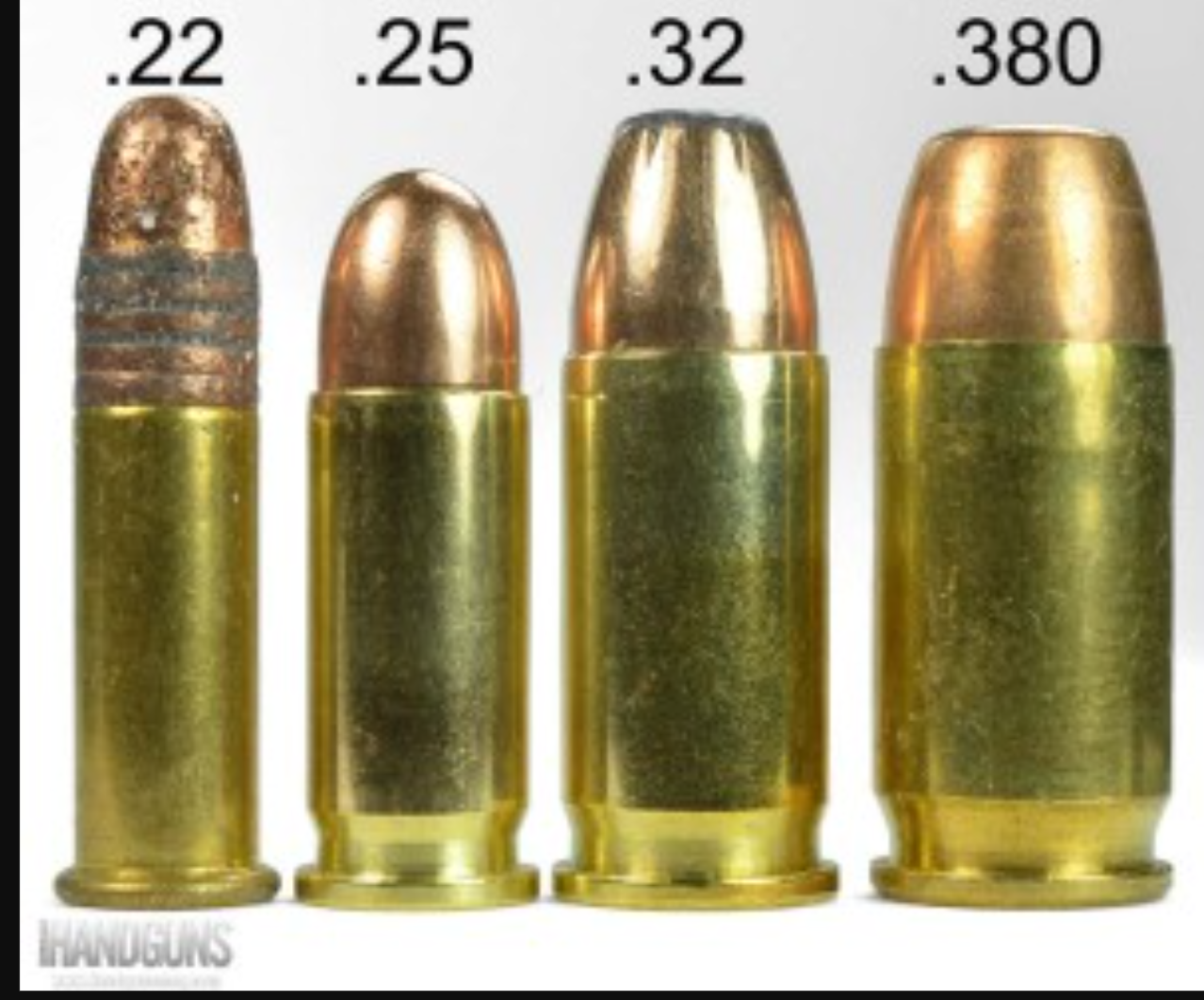
(Far-Left:).22lr, (Left:) .25ACP, (Right:) .32ACP, (Far-Right:) .380 ACP

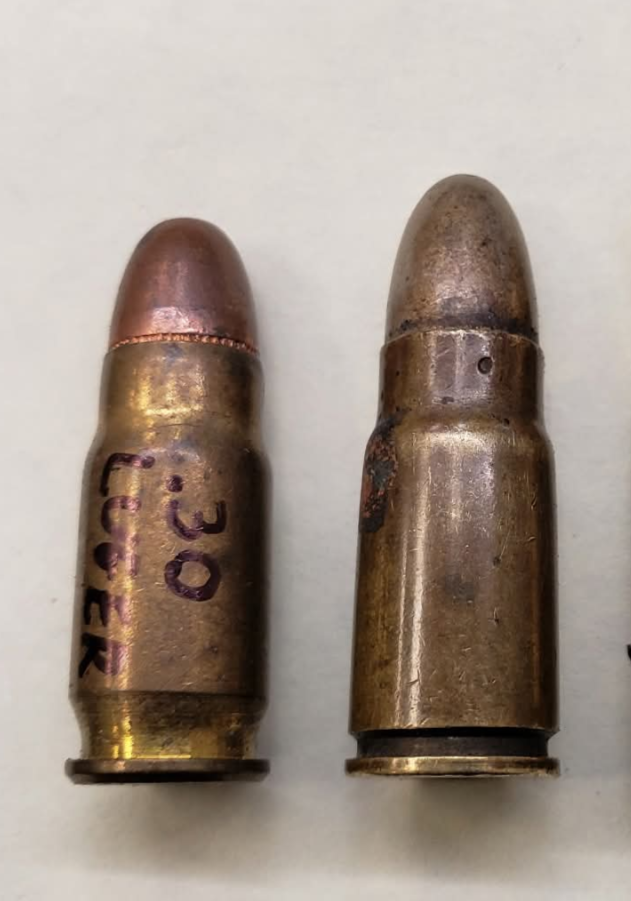
  • 7.65×21mm Parabellum/.30 Luger, Hinō-Komuro M1904
Ballistic performance
Bullet mass/type Velocity Energy
6.03 g (93 gr) FMJ 370 m/s (1,200 ft/s) 412 J (304 ft·lbf)

Another suspected calibre offered for the Hinō-Komuro M1904 is the .30 luger, but this wasn’t a terribly common round to see in Japan except for some higher end luxury purchases of luger pistols in Japan.

This dimensionally is extremely similar to the 8x22mm Nambu cartridge, though it operates at a reasonably higher pressure than the 8mm Nambu. One point for consideration is the rim of the cartridge isn’t quite the same, accordingly it’s believed extraction might’ve been a problem without slight modification.
Screenshot_20260811-194244
(Left:)7.65x21mm Parabellum/.30 Luger compared to (right:) 8x22mm Nambu

3. Possible “Carbine” Variant

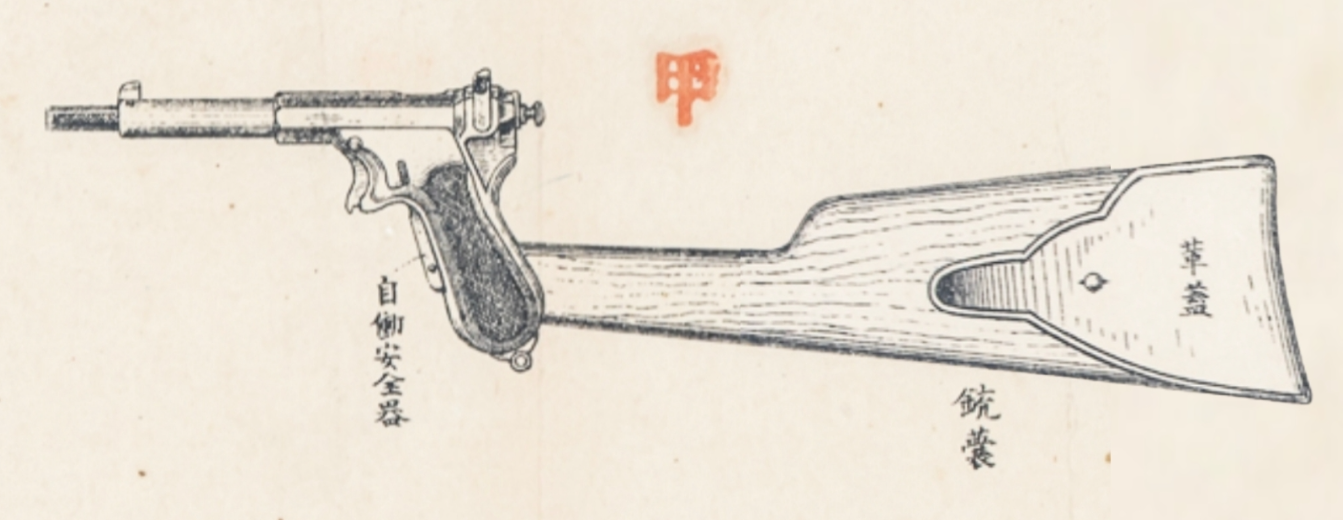
Stock-bearing Hinō-Komuro M1904

If we refer back to the 2026 factory pamphlet that was discovered concerning the Hinō-Komuro M1904 under section, (𝒄.) Translation of a Factory Pamphlet in 1979 & New found Factory Pamphlet in 2026, 2. New 2026 Factory Pamphlet Deep Dive, Reconstructed 2026 Pamphlet & Translation, “writing inside red outlined box” we can take the pamphlet in a literal sense concerning the intended purpose and function of performing like a “Carbine”. To partially quote directly from it it says as follows:

So if we follow the advertised purpose of this configuration under that of a pseudo-carbine, we could catagorise this variant under the tentative name Hinō-Komuro M1904 Carbine thereby giving Japan another “pistol calibre carbine” under a technicality.

Additionally it should be noted the mention of a purpose built shoulder-stock is mentioned, this is likely an attachment that could’ve been purchased when ordering a Hinō-Komuro M1904.


(𝒆.) New Found Potential Burst Fire & Full Auto Capability

Now for one of the most interesting and peculiar quirks of the Hinō-Komuro M1904, something that wasn’t corrected through any iteration or patent application filings, and something that was noted in the 1979 Factory Catalogue & the 2026 Factory Pamphlet is a peculiar note about the pistol requiring a full firm trigger pull.

The reason for this being as both Komuro Gun Factory pamphlets state ‘- otherwise the pistol can fire two shots or more…’ additionally an attentive eye will notice that in neither pamphlet this is labled under the “Warning” sections. I’ll now provide the direct quotes from both pamphlets.

It’s incredibly peculiar that something such as the ability to fire a burst or in full-auto via a light trigger pull/half pull wasn’t corrected in any iteration. It would be a relatively simple revision of the retaining catch and or firing shoulders.

If we take this in a literal sense whilst certainly somewhat cautionary, it seems this may have been something that was once unintended and instead became a feature of the weapon. This may very well be one of the first examples of a sort of dual-stage trigger system.

Whilst it wouldn’t be very practical in real life, this could make for an interesting additional firing mode in Enlisted thereby allowing you to shoot in a burst of 2/3 shots or to shoot in full auto, all it would take is an adjustment in pressure applied to the trigger.


Availability, Gameplay and Purpose


Availability

Based upon the extensive documentation and study of this particular pistol, I believe the Hinō-Komuro M1904 should have at least two versions in game. An 8mm Hinō-Komuro M1904 Pistol slot option, and a Stocked “Carbine” variant chambered in 6.25mm/.25ACP with a 15 round magazine. Named tentatively the “Hinō-Komuro Carbine”.

I think the pistol slot option would be great for an event item, whilst the “carbine” variant would be a unique battlepass item.

Gameplay

The gameplay of the Hinō-Komuro Pistol will provide Japan with an extremely unique domestic design, additionally if we allowed the pistol to have a select fire option of a 2 round burst or full-auto it’ll function as a domestic machine pistol.

BR
I think BR 1 is appropriate for the Hinō-Komuro Pistol & the Hinō-Komuro Carbine, even if the carbine has a burst fire or full-auto option the small magazine size plus the small calibre, I believe these are strong enough balancing levers to keep it at a low BR.

Purpose

The Hinō-Komuro Pistol shall serve as a pistol slot option, whilst the Hinō-Komuro Carbine can be considered a Pistol Calibre Carbine


Additionally Documentation, Images & References


Sources


32070049931
Japanese Military Cartridge Handguns 1893-1945 a Revised and Expanded Edition of “Hand Cannons of Imperial Japan” Harry l. Derby iii & James d. Brown


NEOBK-2794629
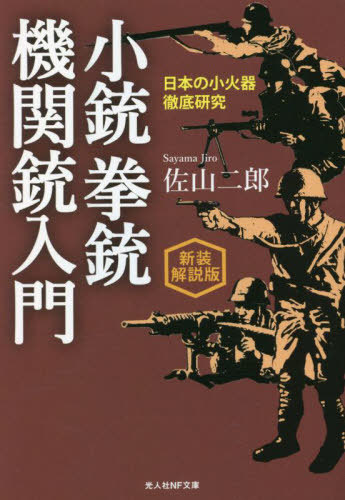
Introduction to Rifles, Pistols, and Machine Guns: A Thorough Study of Japanese Small Arms, Newly Revised and Annotated Edition (Kojinsha NF Bunko) / by Jiro Sayama

http://historypistols.ru/blog/pistolety-pod-unitarnyj-patron-avtomaticheskie/pistolet-xino-kamuro-hino-komuro/

https://bid.donleyauctions.com/auction/263-the-john-bannister/lot-1165-japanese-pistol/

https://jamesdjulia.com/item/lot-1079-extremely-rare-hino-komuro-blow-forward-semi-auto-pistol-37586/

https://www.forgottenweapons.com/wp-content/uploads/HinoKomuro/US%20Patent%20886211.pdf

https://hikokikumo.net/a8509Hitoyosi.htm


POLLING TIME!


Should Japan Receive the Hinō-Komuro M1904
  • Yes, both the Pistol and Carbine
  • Yes, Just the Pistol
  • Yes, Just the Carbine
  • No (if no explain why)
0 voters
Should the Hinō-Komuro have select fire options
  • Yes, both burst fire and full-auto
  • Yes, only burst fire
  • Yes, only full auto
  • No, only default semi-auto
0 voters

Remember your vote counts!


5 Likes
(𝒄.) Translation of a Factory Pamphlet in 1979 & New found Factory Pamphlet in 2026
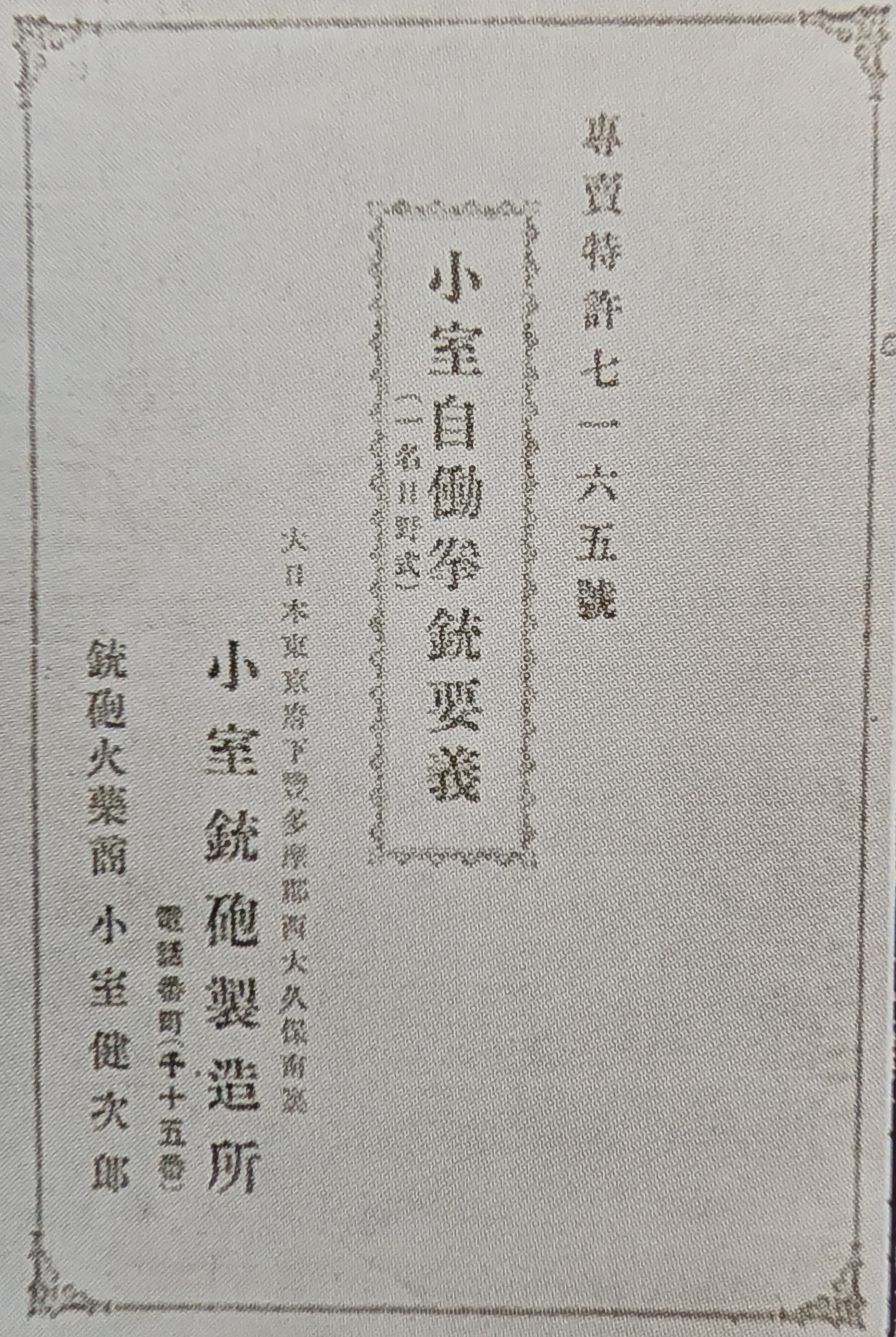
1. 1979 Factory Pamphlet
  1. 1979 Factory Pamphlet

1979 discovered Komuro Gun Factory, Komuro Automatic Pistol pamphlet cover.

Nobuyuki & Kamamoto-ken translation

Patent No. 7165 An Outline of Komuro Automatic Pistol

By Kenjiro Komuro, Dealer in Guns and Powder Komuro Gun Factory

Nishi-Ohkubo, Toyotama County, Tokyo, Japan

Telephone: 1015


English Translation

Patent Line: Patent No. 7165
Title: Essentials / Guide to the Komuro Automatic Pistol (Also Known as Hino-Style)
Address: Minami-ura, Nishi-Okubo, Toyotama District, Tokyo Prefecture, Empire of Japan
Factory Name: Komuro Firearm Manufacturing Works
Telephone: Bancho 1015
Merchant Title: Firearms & Gunpowder Merchant
Proprietor Name: Kenjiro Komuro


In 1979 through the efforts of Japanese historian Atsushi Shibuya, he was able to obtain an old factory pamphlet from the Komuro Gun Factory about the Hinō-Komuro pistol (then advertised as the “Komuro Automatic Pistol”), from an old home of formally owned by Tomojiro Komuro.

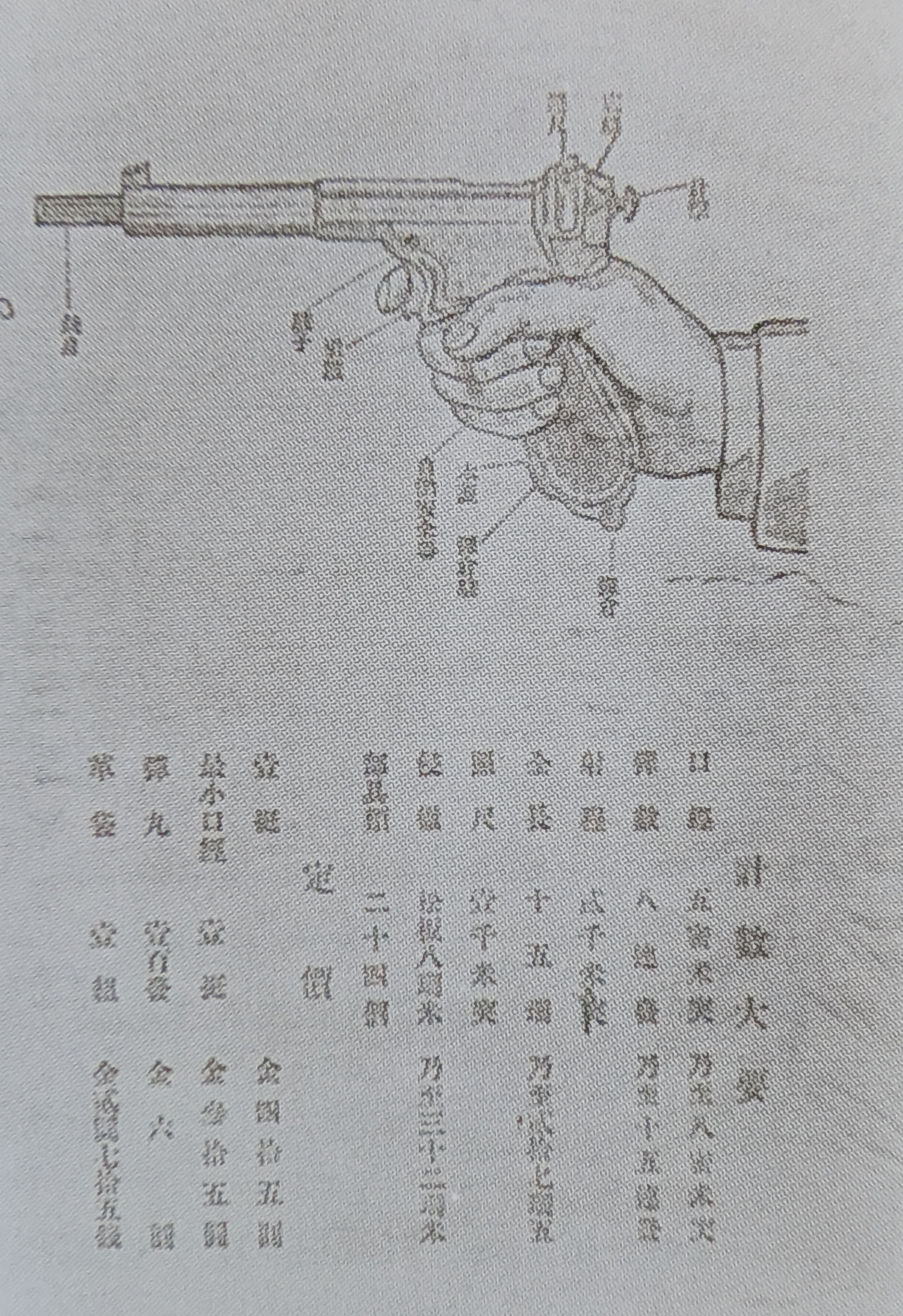
The cover page and the last page of this 8 page pamphlet have been revealed, yet the remaining 6 pages have remained within private collection. Nevertheless the supposed entirety of the pamphlet was later translated by Nobuyuki Takaki & Kamamoto-ken of Japan.

I will present their translated transcription of the pamphlet, as well as my own translation of the cover image and last image that have been made available. Unfortunately without the remaining pages being made available the veracity of the translation can’t be guaranteed, but it should still be considered credible.

See section (𝒅.) Known and Possible Variants, 2. Offered Calibre Variants by Factory, for an expanded overview of the brochure discovery.

Last page of the Komuro Gun Factory, Komuro Automatic Pistol pamphlet.

Nobuyuki & Kamamoto-ken translation

Caliber: 5 millimeters to 8 millimeters

Cartridge-number: 8 to 15

Shooting range: 2000 meters

Total length: 15 centimeters to 27.5 centimeters

Gunsight: 100 meters

Penetration: Can penetrate 8 to 32 centimeter thick pine

Parts-number: 24

Price List*

One pistol: 45 yen

One pistol-smallest caliber:35 yen

Ammunition (100): 6 yen

One leather bag: 2.75 yen


English Translation

Barrel
Front Sight
Rear Sight
Safety Mechanism
Cocking Piece / Hammer
Trigger
Trigger Guard
Grip
Magazine Release / Catch
Magazine
Lanyard Ring

Caliber (口徑): 5 mm to 8 mm
Capacity (彈數): 8-shot to 15-shot repeater
Effective Range (射程): 1,000 m to 2,000 m
Overall Length (全長): 16 cm to 27.5 cm
Sight Graduation (照尺): 50 m to 1,000 m
Penetration (侵徹): 8 cm to 32 cm of pine planking
Number of Parts (部品數): 24 components

Complete Pistol (全銃): 45 Yen
Smallest Caliber Model (最小口徑): 35 Yen
Ammunition, 100 Rounds (彈丸 壹百發): 6 Yen
Leather Holster/Bag, 1 Set (革袋 壹組): 2 Yen 75 Sen


I will now present to you the entirety of the translation that has been made available concerning the Komuro Gun Factory Komuro Automatic Pistol pamphlet, translated by Nobuyuki Takaki & Kamamoto-ken.

Full pamphlet translation by Nobuyuki Takaki & Kamamoto-ken.

Source: P.33/34, Japanese Military Cartridge Handguns 1893-1945 A Revised and Expand&d Edition of “Hand Cannons of Imperial Japan” Harry L. Derby III & James D. Brown


2. New 2026 Factory Pamphlet Deep Dive
  1. New 2026 Factory Pamphlet Deep Dive


001

For this section I will be presenting a newly discovered factory pamphlet in 2026 that was auctioned at the Donley Auction under, The John Bannister Collection - D-Day and Militaria, Lott 1165, Japanese Pistol Poster Mod 1904 Hino Komuro.

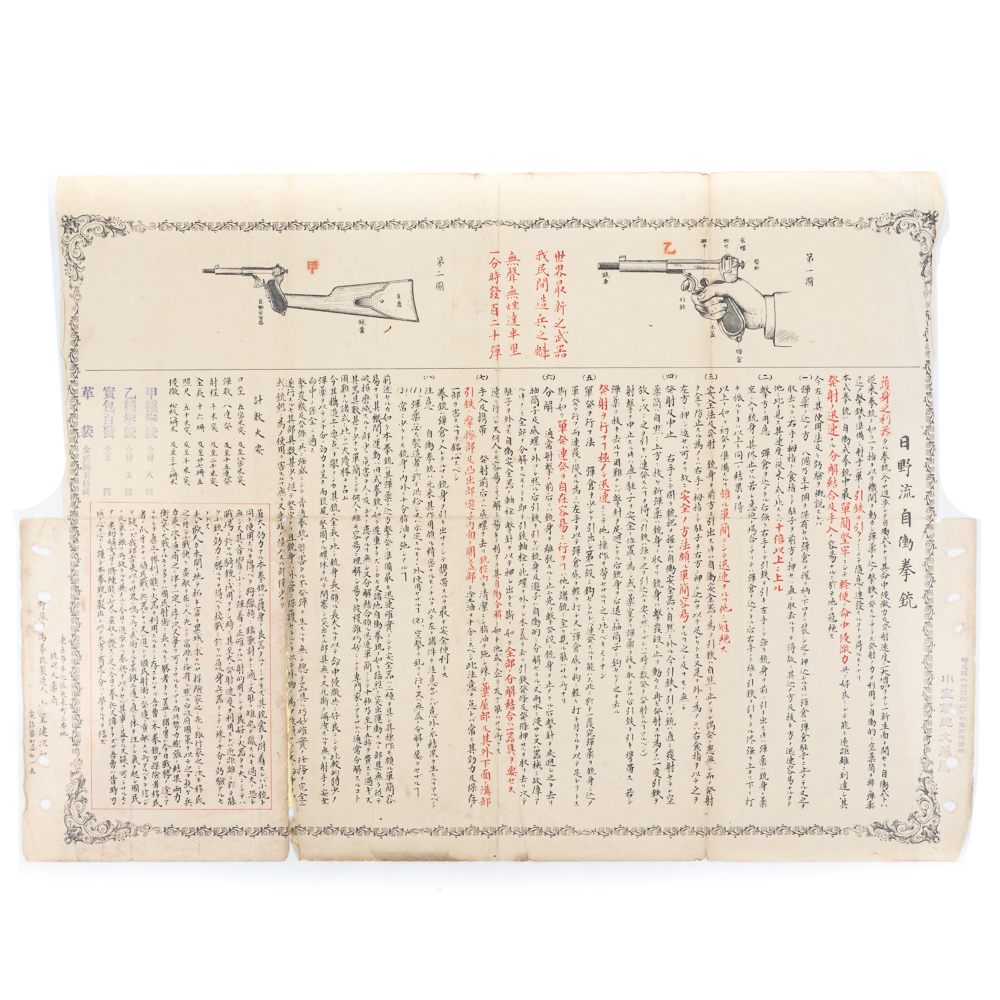
It showed an incredible specimen of a full fold out Komuro Gun Factory poster/pamphlet advertising the pistol, it’s key features, price list and additional attachments and add ons. This document combined with the former mentioned 1979 factory pamphlet is what gives are the greatest insight to the capabilities of the pistol.

Primarily in regard to the available calibres, attachments of a stock in the 2026 pamphlet, but further mention of how the pistol under a light trigger pull could result in firing a burst or full-auto fire; section (𝒆.) New Found Potential Burst Fire & Full Auto Capability will further elaborate on this.

For now I’ll present to you the original full image of the document and my own later reconstruction, using the close up images from the listing, due to the image compression of the full document within the listing. Then I will translate each section accordingly.


Reconstructed 2026 Pamphlet & Translation

Full reconstructed high resolution pamphlet


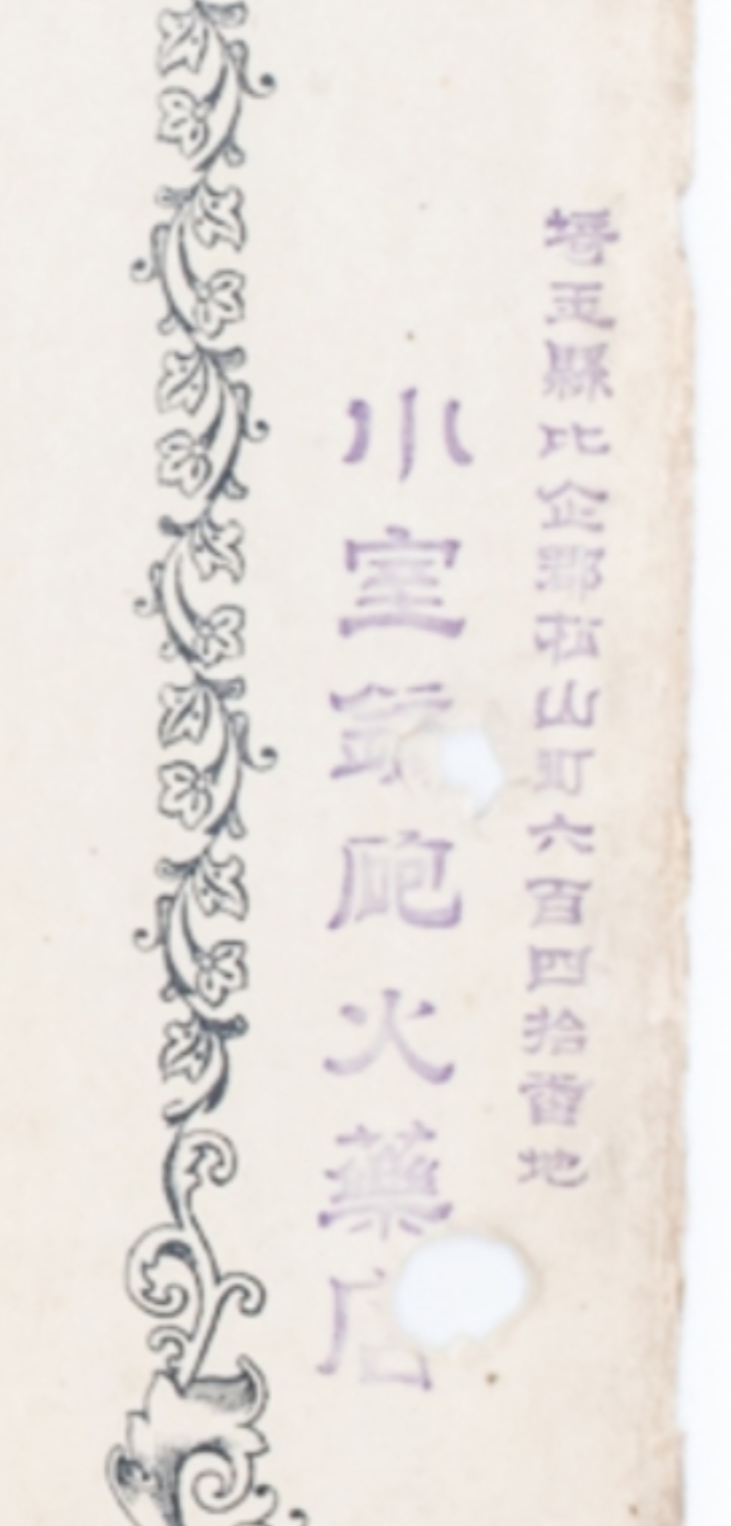
Right-most piece of writing past the right border

English Translation

Address: 640 Matsuyama Town, Hiki District, Saitama Prefecture (present-day Higashimatsuyama City, Saitama)
Store Name: Komuro Gun and Gunpowder Store


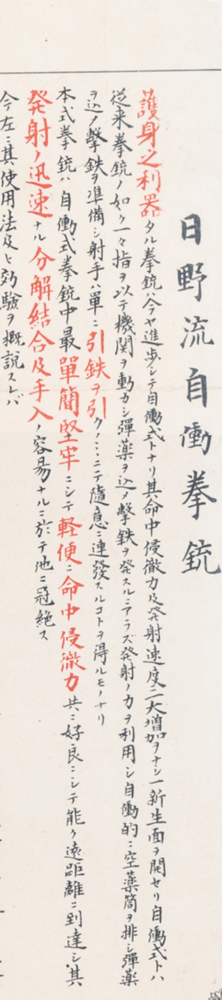
77e10dbcd15aefba796204a934a734e7e1a00a1d_2_222x1000
Writing to the right of the numbers columns, left of right border text

English Translation

Hino-Style Automatic Pistol
Pistols, as an advantageous weapon for self-defense, have now advanced into automatic types, opening a brand-new era with massive increases in accuracy, penetration power, and firing speed. An “automatic type” does not require operating the mechanism with one’s fingers step-by-step to load cartridges and cock the hammer like conventional handguns; rather, it utilizes the energy of discharge to automatically eject empty casings, chamber new rounds, and ready the firing mechanism—allowing the shooter to fire continuously at will simply by pulling the trigger.
Among automatic pistols, this model is the most simple and rugged as well as lightweight and portable. It excels in both accuracy and penetration power, reaching long distances effectively, and stands completely second to none in its rapidity of fire, ease of disassembly and assembly, and maintenance.
Below is a brief outline of its operating instructions and performance:


f628c323b4bcdc9ffa08715a68b45dd5f17eca72_2_88x1000
Column 1

English Translation

(1) Method of Loading Ammunition
Hold a magazine containing 8 to 15 rounds and insert it into the bottom opening of the grip. When pushed in, the magazine is locked in place by the magazine catch.
To remove it, use the thumb and index finger of your right hand to press the catch forward, and it can be withdrawn immediately. As a result, the speed and ease of loading and removing the magazine is unlike anything seen anywhere else—increasing speed by more than 10 times compared to conventional designs.


f197f5ad64ec913b40a27ac5b18756855b32c30e_2_120x1000
Column 2

English Translation

(2) Preparation for Firing
After inserting the magazine, firmly pull the trigger with your right hand while using your left hand to forcefully pull the barrel forward. The cartridge will enter the barrel’s chamber, and the barrel will lock in the forward position.
In an emergency, after inserting the magazine, pull the trigger firmly with your right hand and vigorously flick the gun downward from top to bottom; this achieves the exact same result (allowing for one-handed operation).
Preparing the initial shot in this manner is extraordinarily simple and rapid, standing completely second to none.


783a4529bffebc79f9ec826f9eed3bd0b8d11c3d_2_90x1000
Column 3

English Translation

(3) Safety Method and Firing
When the barrel is pulled forward, the automatic safety device naturally locks the trigger, eliminating any risk of accidental discharge.
Furthermore, to completely lock out firing, it is sufficient to push the safety catch to the right with your right thumb. To disengage the safety, simply push it back to the left using your right index finger. Consequently, this safety method is exceptionally simple and effortless, with nothing else that compares to it.


1a62b397916b659ad7eea008c4bef473dab566a8_2_168x1000
Column 4

English Translation

(4) Firing and Ceasefire (Halting Fire)
When you grip the handle firmly with your right hand, the automatic safety disengages naturally. Pulling the trigger fires the gun immediately; the empty casing is automatically ejected upward, a new round enters the barrel chamber, and the barrel locks at the cocked firing position.
To fire again, release the trigger once and pull it again to continue firing (the trigger must be pulled firmly; otherwise, multiple rounds may fire automatically at once).
When stopping fire, immediately move the safety catch to the safe position, or release the trigger after removing the cartridge from the chamber. If removing the cartridge proves difficult, disengage/turn back the firing pin, then retract the barrel so the extractor hook catches and removes it.
Executing firing in this manner is extremely swift and requires no extra effort, standing unmatched by any other firearm.


17dacdd83a84f9b59f774fe06fd9ec1b1e447dfb_2_92x1000
Column 5

English Translation

(5) Method of Single-Shot Firing
If you pull the magazine out slightly and let it catch on the first-stage notch, rapid/continuous fire is disabled. In this state, a single cartridge is loaded into the barrel at a time to execute single-shot firing.
To return to continuous fire, it is sufficient to simply tap the base of the magazine lightly with your left hand or tap the magazine base against a nearby object.
Switching between single-shot and continuous fire freely and effortlessly in this manner is something completely unmatched in any other firearm.


a8ca74ab7a80ee8743cbcf9ad58624f404aafbe2_2_150x1000
Column 6

English Translation

(6) Disassembly
Before and after routine firing, it is sufficient to simply detach the barrel. First, lock the barrel in the forward cocked position, then twist back the firing pin and remove it. Next, unfasten the extractor and the bottom screw; after that, pulling the trigger causes the barrel and bolt (breechblock) to automatically separate and disassemble.
If the gun is submerged in rainwater or experiences a mechanical malfunction, a complete detail disassembly should be performed: unfasten the female nut on the trigger pivot pin, remove the wooden grip panel, take out the trigger spring and spring retainer, and then remove the catch latch. The pivot pin for the automatic safety can be pushed out using the firing pin itself.
In this manner, complete disassembly and reassembly require not a single tool and can be performed swiftly. It holds the advantage of being easily understood by anyone—a level of automatic disassembly that competing designs cannot hope to match.


7592acef8c7de10ea36f20404dea3739b950255a_2_122x1000
Column 7

English Translation

(7) Maintenance and Carrying
Maintenance: Before and after firing, remove the bottom screw, clean the inside of the barrel bore, and apply lubricating oil. Be particularly thorough in oiling the chamber section, the grooves on its outer bottom surface, the friction surfaces and protrusions of the trigger, and the recessed circular portion on the inner surface of the bolt. Keep firmly in mind that neglecting this maintenance will always compromise the firearm’s performance and preservation.
Carrying: Carrying the pistol with the magazine inserted—but without pulling the barrel forward (leaving it uncocked)—is the safest and most convenient method.


8572859a284a8879c16246c378f0c332135cef1e_2_106x1000
Column 8

English Translation

(8) Precautions / Important Notes
Because automatic pistols inherently operate on highly precise mechanisms, failure to observe the following points may lead to unexpected malfunctions or negative results:
(1) Never use ammunition other than that supplied or specifically designated by the manufacturer.
(2) Do not dry-fire the weapon recklessly, nor perform unnecessary disassembly repeatedly.
(3) Always ensure that both the interior and exterior of the barrel are thoroughly lubricated with oil at all times.


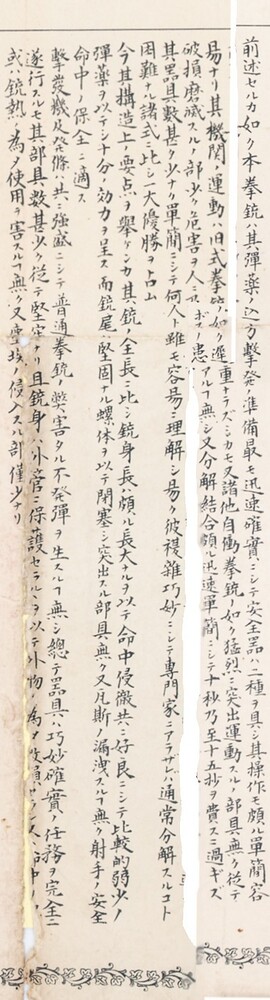
47bf89a5488fd9e82b00bae9e799df9a88f23c48_2_270x1000
writing to the left of the columns, right of the red outlined box

English Translation

Overall Design & Mechanical Superiority
Speed, Safety, and Operation:
As stated previously, loading ammunition and preparing to fire this pistol is extraordinarily fast and reliable. It features two types of safety mechanisms that are remarkably simple to operate. Its action is neither slow nor heavy like older revolvers, nor does it feature heavy external components that violently slide or protrude backward like other automatic pistols. Consequently, there are few parts subject to wear or breakage, eliminating the risk of injury to the shooter. Furthermore, field disassembly and reassembly are lightning-fast, taking no more than 10 to 15 seconds.
Simplicity Over Complexity:
Containing an extremely low part count, the mechanism is simple enough for anyone to understand easily. Compared to overly intricate foreign designs that are nearly impossible for non-experts to disassemble, this pistol holds a decisive advantage.
Accuracy and Power:
Regarding its construction key points, the barrel is exceptionally long relative to the overall length of the handgun. This produces excellent accuracy and penetration power, achieving full ballistic performance even with relatively modest powder loads. The breech is securely sealed by a heavy-duty threaded bolt plug with no protruding external parts or gas leakage, preserving both shooter safety and shot consistency.
Reliability and Protection:
The firing mechanism and mainspring are built exceptionally strong, virtually eliminating misfires—a frequent issue with conventional handguns. While every part performs its task with precision and reliability, the low part count makes the overall frame rugged and durable. Additionally, the barrel is enclosed and protected within an outer sleeve tube, preventing external impact damage, keeping heat from burning the shooter’s hands or hindering operation, and leaving almost no gaps for dirt or dust to enter.


Untitled67_20260723165201~14
writing above the red outlined box

English Translation
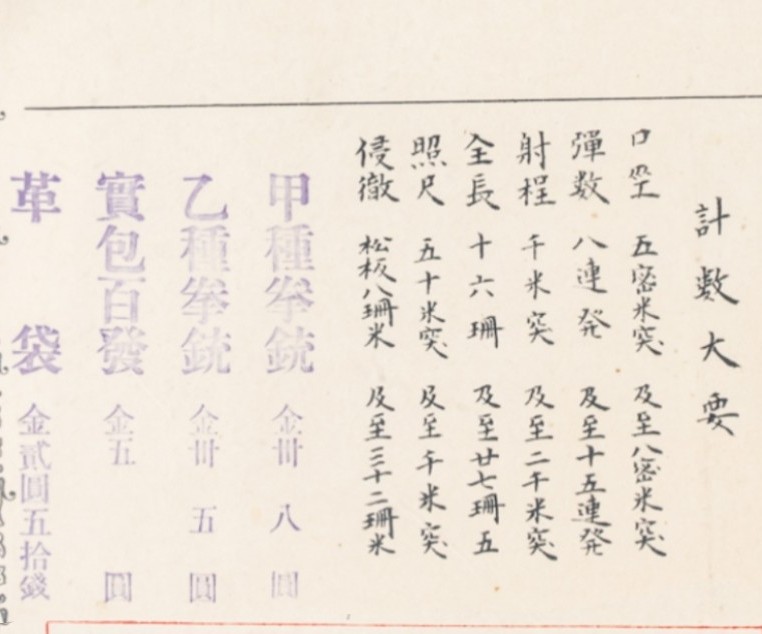
Specification Metric Value Historical Terms Used
Caliber (口徑) 5 mm to 8 mm 五密米突 及至 八密米突
Capacity (彈數) 8-shot to 15-shot repeater 八連發 及至 十五連發
Range (射程) 1,000 meters to 2,000 meters 千米突 及至 二千米突
Overall Length (全長) 16 cm to 27.5 cm 十六珊 及至 廿七珊五
Sight Graduation (照尺) 50 meters to 1,000 meters 五十米突 及至 千米突
Penetration (侵徹) 8 cm to 32 cm of pine planking 松板八釐米 及至 三十二釐米

Price List (Purple Stamped Text)

Type A Pistol (甲種拳銃): 80 Yen (金八〇圓)

Type B Pistol (乙種拳銃): 50 Yen (金五〇圓)

100 Live Cartridges (實包百發): 5 Yen (金五圓)

Leather Holster (革袋): 2 Yen 50 Sen (金貳圓五拾錢)


734daa5634d7152eb13e550b35bb8876a1b4e487_2_588x1000
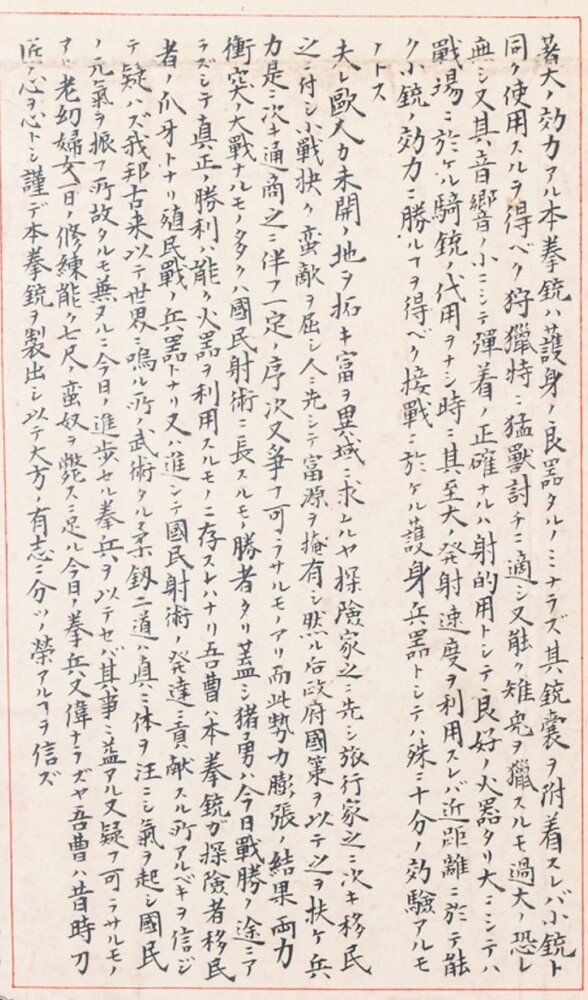
writing inside red outlined box

English Translation
  1. Practical Utility & Versatility
    This extraordinarily effective pistol is not merely a fine weapon for self-defense; when its shoulder stock is attached, it can be utilized just like a rifle/carbine. It is well-suited for hunting—especially when facing fierce wild beasts—yet can also hunt pheasants and rabbits without damaging the game excessively.
    Furthermore, its light report (firing noise) and precise shot placement make it an excellent firearm for target shooting. On a larger scale, it can serve as a substitute for a cavalry carbine on the battlefield. When taking advantage of its exceptionally high rate of fire at close range, its effectiveness easily surpasses that of a standard rifle, proving extraordinarily potent as a personal defense weapon in close-quarters combat.

  2. Defense Rationale & National Spirit
    When Europeans open up undeveloped lands and seek wealth in foreign realms, explorers go first, followed by travelers, and then settlers. Through frequent small skirmishes, they subdue hostile natives and secure resources before others. Only then does government policy support them, followed by military force and commerce—this sequence of expansion is undeniable.
    When the expansion of power inevitably leads to major conflict, victory usually belongs to the nation whose citizens excel in marksmanship. Blind, reckless courage is no longer the path to military victory today; true victory belongs to those who master the use of firearms.
    We firmly believe without a doubt that this pistol will serve as the claws and fangs of explorers and settlers, as a vital weapon in colonial warfare, and contribute to the advancement of popular marksmanship.
    In our country, the ancient art of Jujutsu has long been world-renowned for conditioning the body, awakening the spirit, and invigorating the nation’s morale. Today, adopting advanced handguns builds directly upon this proud tradition. With just a single day of practice, even the elderly, the young, or women can easily strike down a seven-foot-tall adversary—is today’s handgun not truly magnificent?
    Crafted with the same devotion and heart as the swordsmiths of old, we reverently manufacture this pistol and consider it an honor to offer it to all interested supporters.


Untitled67_20260723165201~16
Left-most writing outside of left border

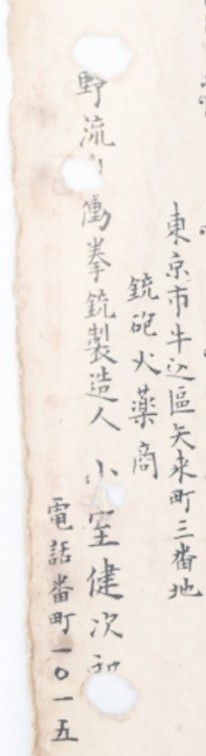
English Translation

Address: No. 3 Yarai-cho, Ushigome Ward, Tokyo City
Business Type: Firearms & Gunpowder Merchant
Manufacturer of Hino-Style Automatic Pistols: Kenjiro Komuro
Telephone: Bancho 1015


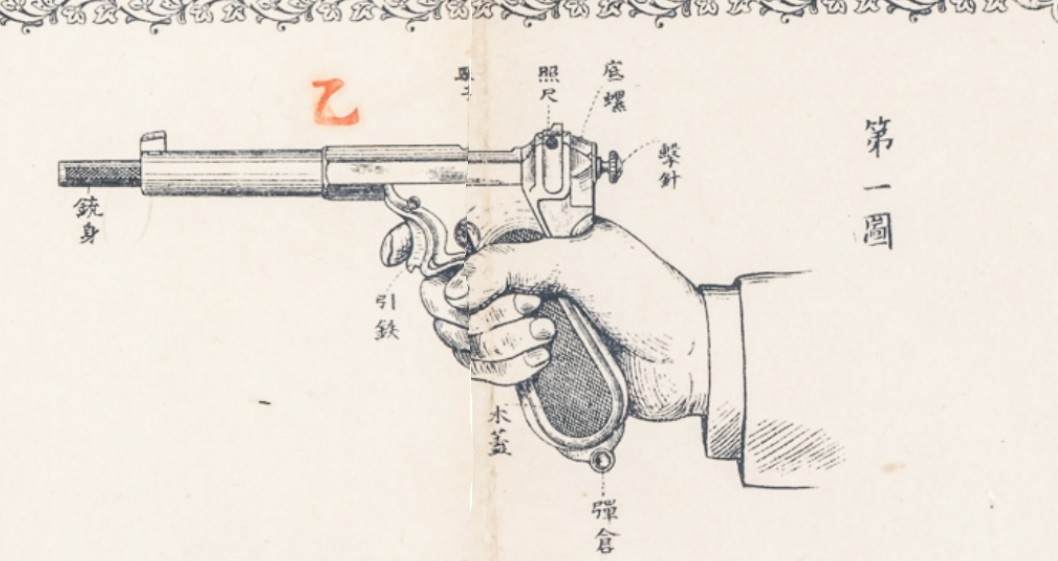
Top right hand Hinō pistol drawing

English Translation

Figure 1
Type B Pistol
銃身: Barrel
引鐵: Trigger
照尺: Rear Sight
底螺: Breech Plug Screw (Bottom Screw)
擊針: Firing Pin / Cocking Piece
木蓋: Wooden Grip Panel
彈倉: Magazine


Top left hand Hinō pistol drawing

English Translation

第二圖 (Far Right Text): Figure 2
甲 (Red Stamp): Type A Pistol
自働安全器: Automatic Safety (Grip Safety)
銃嚢: Gun Case / Holster-Stock (The wooden shoulder stock doubles as a holster case)
革蓋: Leather Cover / Flap (The leather closure for the holster compartment)


Untitled67_20260723165201~18
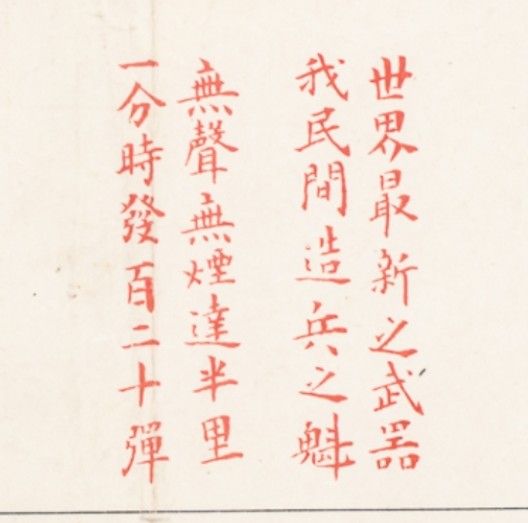
Writing between the two pistol drawings

English Translation

The world’s newest weapon
The pioneer of civilian-manufactured weaponry in our nation
Noiseless and smokeless, reaching a range of half a ri (approx. 2 km / 1.2 miles)
Fires 120 rounds per minute


1 Like

Closing Notes


  • So as it turns out there’s a 50,000 character limit and I exceeded it with an amount of 74,463. I originally had old Japanese transcripts for the factory catalogue, the modern Japanese writing them into English but I had to unfortunately cut it.
    Noted for next time. Anyhow I hope you enjoy it even though I could fit it all in one post!

(Original closing notes)
Well this one was extremely long and took me around a week and a half to put together. But I think it was worth it, and I truly do hope you enjoyed my suggestion and my comprehensive study and history lesson on this extremely unique pistol.

This one will likely be the longest suggestion I make but I’m proud of it.

Nevertheless most of all thank you for taking the time to read this. Here’s to the next one ladies and gentlemen.

With much love
:jp::japanese_ogre:

2 Likes

Looks like something id see in star wars, ehh why not Japan and all factions could use more side arms.

1 Like

As always, fantastic work!

1 Like

Thank you very much. And thank you again for your help and what lead me into the Hinō rabbit hole haha :smile:

1 Like

Not that odd with how much original trilogy weaponry was WW2 or WW1 equipment

1 Like

I think I did a post of this pistol, glad someone reworked it <3

1 Like