Introduction
Greetings and salutations, friends!
I write to you once more, this time on the topic of British weapon designations, which I believe are in need of updating. Many British small arms currently in-game are either incorrectly named (in more ways than one, which I will get back to), or use names that inspire little confidence or authenticity (“Lewis .303”… really?).
I have raised this concern in the past in replies on other topics, and with the recent correction of the Colt M1911A1 following community feedback, I believe this is an opportune moment to actually write a dedicated suggestion on the topic.
The 1926 British rifle nomenclature change
A collective explanation specifically for the proposed rifle name corrections
In 1926, the British Army formally changed its rifle nomenclature system, not unlike the United States, which introduced its own changes a year earlier. Prior to this reform, British service rifles were designated using letter-based abbreviations (for example “MLE” or “SMLE”), followed by a Mark number in Roman numerals, with the occasional “*” suffix where changes were deemed insufficient to justify a new Mark. There were exceptions, such as with the Pattern 14 rifles, which followed another standard.
Following the reform, rifle type names were standardised into a numbered system according to the sequence of adoption, beginning with “Rifle No. 1” and proceeding sequentially. The first new rifle to enter service under this system was the Rifle No. 4 Mk I in 1939. However, unlike the United States, the British did not leave older weapons still in service with their old designations. Instead, all rifles still in service were retrospectively redesignated.
This resulted in:
- Rifle No. 1 (formerly the SMLE)
- Rifle No. 2 (.22 training conversions of the SMLE)
- Rifle No. 3 (formerly the Pattern 1914 Enfield)
In other words, names currently used in-game such as “SMLE Mk III” or “P14” are outdated and incorrect for a WW2 setting. Their continued use implicitly assumes that the Commonwealth followed the same approach as the United States in retaining old designations, which they did not.
In the interest of historical accuracy, faction identity, and internal consistency — especially given the Commonwealth’s current overlap with the US faction — I believe all British rifle names should reflect the post-1926 nomenclature that was in use during the period depicted by Enlisted, the Second World War.
Individual Changes
I will aim for a balance between legibility, authenticity, and internal consistency with Enlisted’s existing naming conventions. For this reason, I will adopt the currently used “Lee-Enfield No. 4 Mk I” format as the template for other British rifles. While this is a slight deviation from the strictly correct historical format (“Rifle No. X Mk Y”), it remains authentic, readable, and consistent with the game’s presentation.
These suggestions also extend beyond rifles to include machine guns, because some of them also require corrections.
- SMLE Mk III —> Lee-Enfield No. 1 Mk III
Explanation
After the 1926 nomenclature change, this rifle was officially designated “Rifle No. 1 Mk III”. The proposed name simply adapts this designation to Enlisted’s already established format.
The WW1 name is of course very iconic, and a epitaph for the name SMLE should definately be added to the description of the No. 1 rifle if this new name is adopted.
- Aye, change the name to the above suggested.
- No, I prefer WW1 names in my WW2 game.
- Meh, I don’t care either way (I have no idea why I even voted).
- SMLE Mk III* with grenade thrower —> No. 1 Mk III with cup discharger
Explanation
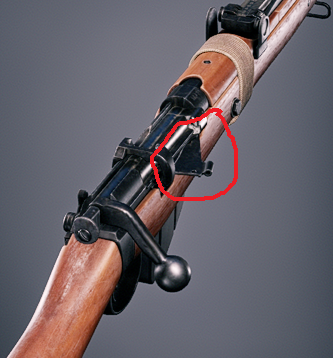
Firstly, the rifle depicted in-game clearly features a magazine cut-off (as shown below). The defining difference between the Mk III and the Mk III* is precisely the removal of this feature. Since the in-game rifle retains the cut-off, it is, by definition, a standard Mk III and not a Mk III*.
Secondly, the device fitted to the rifle was officially known as the “Burns Cup Discharger”. Referring to it generically as a “grenade thrower” is both inaccurate and unnecessarily vague, especially when the British Army used a specific and well-documented designation.
Thirdly, using the correct name helps clearly distinguish this British system from the American rifle grenade systems in game, which were mechanically and doctrinally different. Correcting the name therefore improves both authenticity and faction clarity.
I left the “Lee-Enfield” out on this rifle, for brevity’s sake. Console players exist, after all. The bonus here, the new name is actually shorter than the original. This naming solution is similar to the M1903 grenade rifle in game.
- Aye, change the name to the above suggested.
- No, I like having not just a outdated, but actually a outright incorrect name in-game.
- Meh, I don’t care either way (I have no idea why I even voted).
- Enfield P14 —> Enfield No. 3 Mk I*
Explanation
Following the nomenclature reform, the Pattern 1914 Enfield became “Rifle No. 3 Mk I*”.
The “*” is important here: shortly after production began, an internal modification was made involving slightly enlarged bolt lugs.
All No. 3 rifles retained in service after WW1 were of this updated pattern, meaning any No. 3 rifle appearing in-game must, by definition, be a Mk I*.
Whilst not as iconic of a name as the Smelly, I still think that “Pattern 1914” should show up in the description of the No. 3 rifle as well.
- Aye, change the name to the above suggested.
- No, I prefer WW1 names in my WW2 game.
- Meh, I don’t care either way (I have no idea why I even voted).
- Enfield P14 (T) —> Enfield No. 3 Mk I* (T)
Explanation
The same logic applies to the scoped variant. While both old and new official designations included a manufacturer’s suffix (“W”, because all No. 3 (T) rifles were Winchester manufactured examples), I believe this would be excessive for the purposes of the game, especially given that manufacturer markings are not otherwise used for rifle names.
Old WW1 designation in the description here as well, just like with the tech tree version.
- Aye, change the name to the above suggested.
- No, I prefer WW1 names in my WW2 game.
- No, I need that W in the name as well, make it “Enfield No. 3 Mk I* W(T)” instead.
- Meh, I don’t care either way (I have no idea why I even voted).
- Lewis .303 —> Lewis Mk I
Explanation
“Lewis .303” is not a name, it’s a cry for help.
This is a especially poor name choice and should be corrected to the proper British service designation. Beyond authenticity, this change also future-proofs the game, as variants such as the Lewis Mk I* would otherwise appear inconsistent or awkwardly named.
By the way, we’re all still patiently for a Lewis gun in the Allied tech tree, which should be - nay, must be - the Lewis Mk I*.
- Aye, change the name to the above suggested.
- No, I like the current name (chaotic evil choice).
- Meh, I don’t care either way (I have no idea why I even voted).
- Vickers Mk I No. 2 —> Vickers G.O. No. 2 Mk I
Explanation
Here, I have corrected the order of the number and Mark designations, and added “G.O.” (Gas Operated). This is both historically appropriate and useful for future differentiation, particularly if the Vickers Mk I (water-cooled MMG) is ever added as a Commonwealth buildable MG nest.
- Aye, change the name to the above suggested.
- No, I like the current name.
- Meh, I don’t care either way (I have no idea why I even voted).
- Vickers-Berthier —> Vickers-Berthier Mk III
Explanation
While multiple Marks of the Vickers–Berthier existed, the weapon currently represented in-game corresponds specifically to the Mk III, the main production variant for the Indian Army. Correctly naming it also leaves room for future additions, for exmaple; a Latvian Mk I VBs as a Soviet Event/BP/Premium.
- Aye, change the name to the above suggested.
- No, I like the current name.
- Meh, I don’t care either way (I have no idea why I even voted).
Why these changes matter
While historical authenticity is an important motivation, these corrections achieve more than greater accuracy alone.
-
Firstly, they improve consistency. Mixing pre-1926 and post-1926 naming conventions within the same game is confusing and undermines clarity, especially when the weapons in question are mechanically similar/identical.
-
Secondly, they reinforce faction identity. Britain made a deliberate choice to standardise and retrospectively redesignate its weapons. Respecting that decision helps distinguish Commonwealth equipment from American equipment, which is particularly important given the current faction structure in the game.
-
Thirdly, these changes future-proof the game. As new weapons, variants, and conversions are added, incorrect legacy names will increasingly clash with later, correctly designated equipment. For example, a WW2-era Australian scoped “Lee-Enfield No. 1 Mk III* HT” appearing next to an “SMLE Mk III” would look strange despite representing essentially the same rifle.
-
Finally, these corrections require no gameplay changes, balance adjustments, or new assets. They are low-effort, high-impact improvements that enhance immersion, clarity, and polish. Additionally, the new names are not meaningfully longer (and, in one case, is actually shorter) than their originals, all names fall within current and accepted name sizes.
Conclusion
In summary, correcting British small-arms nomenclature would improve historical accuracy, internal consistency, faction identity, and long-term maintainability of future additions to the game. These are small changes on paper, but meaningful ones in practice, and I believe they would significantly improve the presentation of Commonwealth equipment in Enlisted.
Please, tell me below what you think; Maybe I missed something very obvious…? Maybe there needs to be a note or correction to my proposed name changes…? Maybe you, for reasons beyond my comprehension, disagree with the entire premise of this topic…?
Thank you for your time and consideration. And remember: standardisation is next to godliness.
Signed,
Lt. Ogge King, 3rd Experimental Tea Infusion and Small Arms Appreciation Company, Home Guard (Reserve),
God save the King.