- Yes
- No

| Year | 1937 |
|---|---|
| Vehicle Type | Self-Propelled Anti-Tank Gun |
| Origin & Designer | Britain-Belgium/Vickers-Familleheureux |
| Numbers Produced | 194 |
| Crew | 4 (Commander, Gunner, Loader & Driver) |
| Main Armament | 1 x 47mm L/33 SA-FRC 1932 Gun |
| Elevation | -5° to +20° |
| Turret Traverse | 360° (Powered) |
| Gun Sight | Telescopic |
| Secondary Armament | 1 x 7.65mm FN 30 Machine Gun |
| Ammunition Carried | 42 x 47mm & 1.380 x 7.65mm |
| Height | 1.84m |
| Width | 1.87m |
| Length | 3.65m |
| Combat Weight | 5.084 kg |
| Ground Clearance | 0.30m |
| Fording Depth | 0.60m |
| Trench Crossing | 1.0m |
| Obstacle Clearance | 0.50m |
| Armour | Hull Front: 7mm |
| Hull Sides: 7mm | |
| Hull Rear: 7mm | |
| Hull Top: 7mm | |
| Hull Bottom: 3mm | |
| Gun Mantle: None | |
| Turret Front: 9mm | |
| Turret Sides: 9mm | |
| Turret Rear: 9mm | |
| Turret Top: 7mm | |
| Engine | Vickers-Armstrong 6-Cyl (Petrol) |
| Transmission | 4 Forward & 1 Reverse |
| Maximum Road Range | 400 km |
| Maximum Road Speed | 40 kph |
| Maximum Cross Country Speed | 25 kph |
 |
|
.jpg&ehk=LcO11S%2bQhPZrNBIK5XEnBKCxsdHonQR5%2fcixIBqwTew%3d&risl=&pid=ImgRaw&r=0) |
|
 |
With over 250 made this lightly armored tank destroyer would fit well in br1 as an event or even tech tree if going by axis standards of production. Armed with a weak 47mm tank gun this tank would feel right at home in br1. A small low profile tank destroyer it would fall to the middle or bottom of br1 tanks in game. it would make a better br1 infantry swatter than an anti tank platform.
.jpg&ehk=vzi7AtrilqInsEdVvbCFwjGX6TOeO9kkhlyPrQbvRSE%3d&risl=&pid=ImgRaw&r=0)

https://poczetczolgow.blogspot.com/2014/02/t13-b1b2b3.htmly
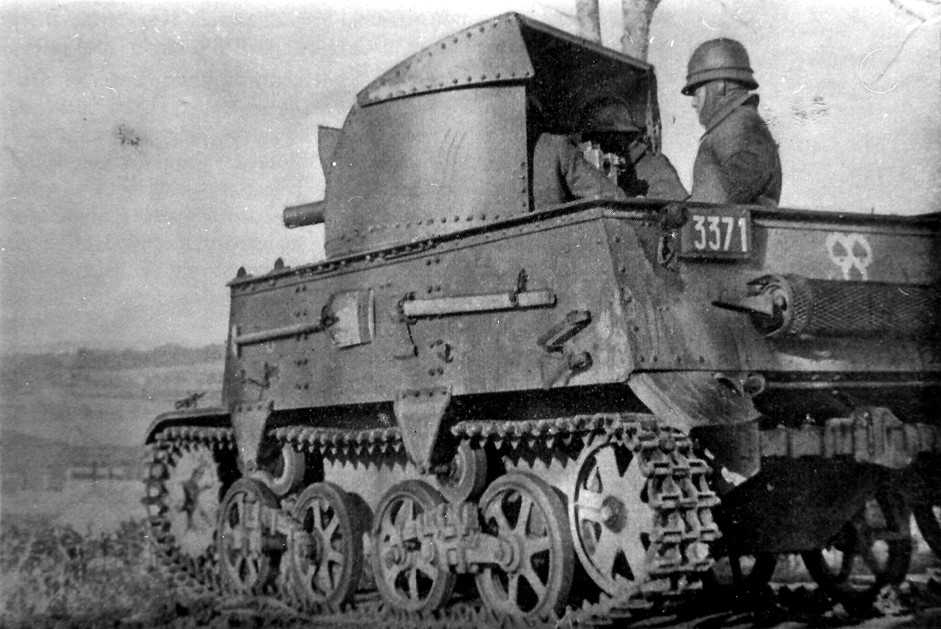
The T-13 is a Belgian tank destroyer developed during the 1930s. It was primarily used by the Belgian Army before and during World War II. The T-13 was based on the Vickers-Carden-Loyd tankette chassis and was equipped with a 47 mm anti-tank gun . There are three main variants: B1 , B2 , and B3 . The B1 variant had limited armor and was produced in small numbers, while the B2 introduced some improvements, and the B3 featured a fully rotating turret for better combat performance. The T-13 was primarily used for defensive purposes during the German invasion of Belgium in 1940, although it suffered from inadequate protection against modern anti-tank weapons.
47 mm (1.45 in) FRC Mod.32 specifications
- Rate of fire: 5 rpm
- AT shell
- Weight: 1.55 kg
- Velocity: 675 m/s (2214 ft/s)
- Penetration: 40 mm (1.57 in) at 600 m
- HE shell
- Weight: 1.65 kg
- Velocity: 450 m/s (1476 ft/s)
- Range: 3000 m (3300
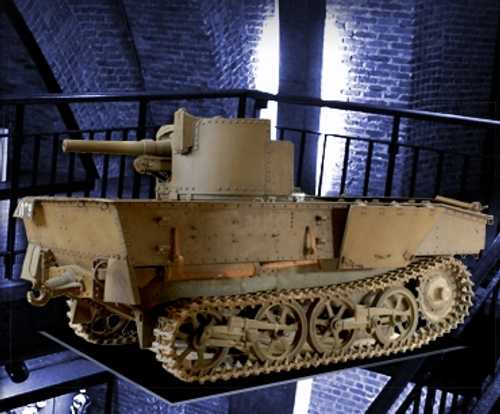
On 10 May 1940, after it had crossed the small country of Luxembourg at night without encountering much resistance, the reconnaissance group of the German 1st Panzer division got pinned down by a single T-13 of the 4th company of the first mountain division ‘Chasseurs Ardennais’ at the border town of Martelange, a couple of armored vehicles getting knocked out in the process.[14] On a different occasion, in the afternoon of 12 May 1940 the 3rd regiment ‘Lansiers/Lanciers’ of the Cavalry knocked out a German reconnaissance group that was advancing on the road between the towns of Zoutleeuw and Drieslinter, and succeeded in wiping it out completely, finishing off the remaining infantry with machine gun fire.[15] On one occasion, a single 47 mm hit pierced the hull of a Panzer IV on both sides of the vehicle, continuing its trajectory afterwards.[16]
Also, with four crew members assigned to each T-13 B3 (B1 and B2 versions had a crew of three), workload was well divided and when adequately trained, most T-13 equipped units were able to make good use of their tank destroyer. Confronted with soft targets, the T-13s fared well: T-13s participated in the successful counterattack at Kwatrecht near Gent on 20 May 1940, which succeeded in throwing back the German Army’s 192nd and 234th infantry regiments, until British troops to the south of Oudenaarde received the order to retreat to Dunkirk on 22 May 1940 and broke contact with the Belgian front one day later.[17]
German use

Confiscated Waffen-SS T-13 B3
After the Battle of Belgium ended in German occupation on 28 May 1940, the Wehrmacht took over all usable T-13 vehicles that had not been sabotaged by their crews. They were hastily marked with Balken crosses to distinguish them from enemy units. Apparently, some of these participated in the war with the remaining French army, although it is unclear how many of the T-13s got used in this way. The German designation for this vehicle was “Panzerjäger VA 802(b)”.[18] Most of these vehicles however had very likely never left Belgium, apart from being used for scrap metal later in the war. They were mostly assigned to driver training and target practice, light support duties, airfield security, counter insurgency and possibly as part of the Atlantikwall coastal defenses. However, apart from some photographic evidence, very little is known about the German use of the T-13.[19]
