The Heinkel He 162 A-1 (Salamander / Volksjäger) was an emergency lightweight jet interceptor designed late in the war to counter mass Allied strategic bomber formations. While it holds the status of being a turbojet aircraft, its historical design compromises, armament limitations, and lack of ground-attack ordnance make it a prime candidate for a low-tier specialized interceptor at Battle Rating III, rather than competing against late-war prop fighters and advanced jets at BR IV or BR V.
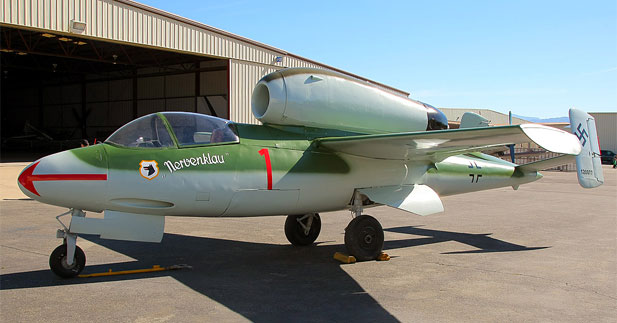
Why I think the He 162 A-1 Belongs at BR III?:
-
Severely Restricted Firepower & Zero Ground Utility:
Low Ammo Count & Poor Ballistics: The A-1 variant is equipped with two 30mm MK 108 cannons with only ~50 rounds per gun (~100–120 total). The MK 108 fires at a low muzzle velocity (540 m/s) with extreme ballistic drop. At high jet approach speeds, leading target aircraft requires immense skill, and missed bursts quickly empty the magazine.
No Bomb or Rocket Payloads: Unlike typical BR III/IV workhorses (such as the Bf 109 G-6 with 250kg bombs or Fw 190 with rockets), the He 162 carries zero secondary ordnance. It cannot clear capture points, destroy fortified spawn points, or eliminate enemy armor. Its contribution to ground objectives relies solely on difficult strafing runs. -
Extreme Fragility & Engine Vulnerability:
Composite Wood Construction: Built under critical material shortages, the wings and portions of the airframe were constructed with glued plywood. It cannot withstand sustained fire; a short burst from Allied .50 cal (12.7mm) MGs or 20mm cannons causes catastrophic structural failure.
Exposed Dorsal Engine Mount: The BMW 003 turbojet sits entirely exposed on top of the fuselage. Any incoming fire from the rear or upper angles directly damages the turbine, causing immediate engine seizure or fatal fires. -
Flight Dynamics: The Trade-Off of Speed vs. Acceleration:
The Single Advantage (Top Speed & Dive): In level flight, the He 162 can reach roughly 790–840 km/h, making it the fastest aircraft at BR III. This allows it to hunt high-altitude bombers (like Allied call-in bombers) and perform pure Boom-and-Zoom (BnZ) passes.
Horrible Low-Speed Acceleration: Early axial-flow turbojets have very sluggish throttle response. If a pilot bleeds energy in a turn fight, the aircraft takes a long time to regain airspeed, making it a sitting duck for nimble BR II–III props (Spitfires, P-40s, Yaks, and A6M Zeroes) in low-altitude dogfights.
Role in Enlisted:
At BR III, the He 162 A-1 would act as a dedicated anti-bomber / high-speed interceptor. It introduces jet gameplay without disrupting ground balance:
It cannot bomb objectives or wipe squads.
It gives Axis players a fun counter against enemy bomber strikes, while remaining extremely punishing to fly due to paper-thin armor and tiny ammo pools.
And you ?
- Yes
- No