- br1 tank
- br2 tank
- br2 driver/rider
- br3 rider/driver
- no
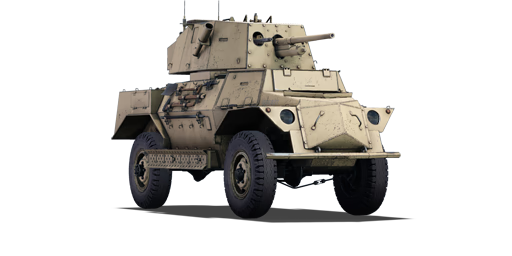
The Mark IV was a completely redesigned vehicle, though still based on the same engine and Marmon–Herrington components. The rear-mounted engine and the transmission were bolted directly to the welded hull.[5] Armour protection was still thin at only 12 mm to the front and 6 mm thick elsewhere. A QF 2 pounder anti-tank gun was mounted in a two-man turret. The gun used an artillery mounting as the turret was not up to the stress of a tank mantlet mounting.
| Mass | 6.4 t (14,000 lb) |
|---|---|
| Length | 15 ft (4.57 m) |
| Width | 6 ft (1.83 m) |
| Height | 7 ft (2.13 m) |
| Crew | 3 - 4 |
| — | |
| Armour | up to 20 mm |
| Main | |
| armament | QF 2 pounder gun |
| Secondary | |
| armament | 1 or 2 x 7.62 mm M1919 Browning machine gun |
| Engine | Ford V-8 petrol |
| 95 horsepower (71 kW) | |
| Power/weight | 14.2 hp/tonne |
| Drive | 4×4 |
| Suspension | Wheeled |
| Operational | |
| range | 200 miles (322 km) |
| Maximum speed | 50 mph (80 km/h) |
Late production vehicles had a coaxial Browning MG. An anti-aircraft Vickers or Browning MG was mounted on the turret roof. Over 2,000 units built. After the war many Jordanian examples had the turret lengthened at the front and fitted with a 6 pounder (57mm) gun, while others had the turret removed and a 3.7 in (94 mm) mountain howitzer fitted in its place. In total, 5,746 Marmon–Herrington armoured cars were built. About 4,500 were used by South African units, while others were employed by British, Indian, New Zealand, Greek, Free French, Polish, Dutch East Indies, and Belgian forces.
- tt
- bp
- event
- premium