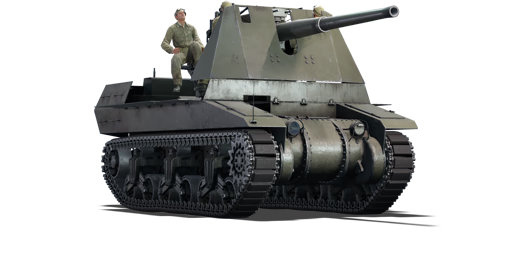

The Ordnance QF 32 pounder was developed from the 3.7-inch gun and armed the Tortoise heavy assault tank. Canada also experimented with mounting the 3.7-inch gun on the Ram tank chassis. Neither vehicle saw service. Another experimental derivative was the 28 pounder fitted to TOG2.

1 Like
It looks pretty interesting.
First of all, it can outperform the neighbouring 88mm anti-aircraft gun by a wide margin.
The only thing comparable to it is Germany’s VFW, but only if DF implements the animation for its three foldable armour plates.
It has the same problem as the Panzer VI airborne tank.
Otherwise the VFW will end up like a stiff figure with no articulated joints, constantly getting snagged on trees and cover wherever it goes.
This vehicle has tracks on one hand, letting it cross obstacles with ease. On the other hand, apart from its gun shield, it has no protruding attachments that get caught on trees while moving.
It’s very streamlined.
In a way, it is the fully tracked version of the 88mm anti-air truck, stripped of all unnecessary parts.
It serves as an excellent anti-air and anti-tank weapon.
It may not be all that useful against aircraft along flight paths, but its anti-air capability and firepower are interesting enough that players would ditch Shermans and Hellcats to use it.
2 Likes
plus ited be a canadian unit wich the game sorely lacks


5th canadian
The 5th Canadian (Armoured) Division was a Canadian division during World War II. It was formed on 27 February 1941 as the 1st Canadian Armoured Division. However it was later redesignated as the 5th Canadian (Armoured) Division on 26 June 1941.[2] Following its redesignation from 1st Canadian Armoured Division, the bulk proceeded overseas in one main convoy, arriving in the United Kingdom at the end of November 1941.

The 5th Canadian (Armoured) Division spent two years of the war uneventfully in the United Kingdom, before finally transferring to the Mediterranean theatre in November 1943 to join the 1st Canadian Infantry Division as part of I Canadian Corps, under command of the British Eighth Army. The division moved without its tanks and vehicles, inheriting heavily used equipment as a legacy from the veteran British 7th Armoured Division (“The Desert Rats”) who they relieved on the Italian Front. The majority of the vehicles were completely worn out, having first been issued in North Africa or were two-wheel drive–useless in Italy. It took several months for the division to be fully equipped with new vehicles, including M4 Shermans. Only the 11th Canadian Infantry Brigade was committed prior to 31 January 1944.[3]

The 5th Armoured took part in the Italian Campaign until the end of 1944, seeing notable action on the Hitler Line after the Allied breakthrough at Cassino in May 1944 and also during Operation Olive on the Gothic Line in August 1944. During the latter battle its single infantry brigade was augmented by a second, which was raised using reinforcements and units serving in other roles. Among them was the 4th Princess Louise Dragoon Guards–1st Canadian Division’s armoured reconnaissance regiment. As with other Allied armoured divisions in the Mediterranean, local resources were used to establish an additional infantry brigade, the 12th Canadian Infantry Brigade. Based on the colour of its shoulder patch, the division became known as the “Mighty Maroon Machine”.[4]
A Sherman Firefly of the 5th Canadian (Armoured) Division assists British troops of the 11th Battalion, Royal Scots Fusiliers, British 49th Infantry Division, to clear the Germans from Ede, the Netherlands, 17 April 1945.

In January 1945, the division, together with the 1st Canadian Infantry Division, as part of Operation Goldflake, moved by truck, train, and naval transport to Belgium via Livorno and Marseille. After arriving on the Western Front, it disbanded the 12th Brigade, and re-equipped to join the First Canadian Army in time to participate in the final advance into Germany.

In April 1945, the Irish Regiment of Canada was assigned to Operation Cleanser in the Netherlands. They had to liberate the route from Arnhem to Harderwijk. This unexpectedly resulted in a fierce fight at the Battle of Otterlo.

Some countries would add flavor, finland, romania, poland, france. Some countries need better representation (Canada), canada had its own beach on d-day. canada had cruiser and carriers in ww2, canada made its own tankds. Canada man for man fought as hard as any country in ww2. subfactions need to be added (Commonwealth/Italy) canada needs more units, honor there sacrifices.


