-
I’m not sure this point has actually been debunked, stating “I debunk thee” does not make it so. The key issue isn’t whether disguises existed in history, but whether they fit the type of combat Enlisted represents.
Enlisted maps represent active frontline combat zones rather than rear-area infiltration operations. A mechanic centred on long-term disguise and infiltration therefore risks clashing with the game’s existing battlefield structure. -
The overlap concern isn’t just about playstyle. Both classes appear designed for behind-the-lines disruption.
If two classes fill broadly similar tactical niches, the question becomes: what meaningful gameplay role does the new one add that the existing one cannot? That distinction hasn’t yet been clearly explained. -
This is risk assesment, which is not just valid - but expected - pre-release. At the moment we don’t have enough information to know how it will affect balance. However, the design raises concerns because the class appears to have:
reduced reinforcement impact - faster reuse potential - and incentives for operating away from the objective.
Mechanics like these have historically influenced player behaviour (fact). The concern is not certainty, but risk to be assessed, not ignored. -
That’s exactly why feedback is being given now. Once a system is implemented and balanced around, it becomes much harder to change.
Early feedback allows potential design problems to be considered before they become entrenched mechanics. Better to nip it in the bud before it’s here to stay. -
This is opinion v opinion… Part of the concern is cumulative. Over time the increasing presence of captured equipment does gradually blur faction identity, which has been a recurring discussion within the community. You might say that that this is a small and isolated thing… Whilst it might be “small”, it’s certainly not isolated.
-
Combined arms simply refers to the interaction between different battlefield elements such as infantry, armour, and aircraft.
Even in arcade-style games, these interactions still exist. Enlisted already relies on cooperation between infantry, tanks, and aircraft to capture objectives and counter threats. -
False equivelancy. Marks are a usability tool rather than a realism feature. They exist because players lack real-world communication methods such as radios, military training, proximity voice-chat, and shared situational awareness.
Removing markers would not increase realism in a meaningful way; it would simply reduce gameplay clarity. Which is, actually, precisely on point when it comes to Saboteurs, who’s consequences contribute the same exact issue here discussed. -
(& 9.) This is contradicted by the game itself… Players already do mark vehicles, rally points, and enemy positions regularly, especially in coordinated matches.
The concern raised in the original post is that reconnaissance should remain a universal player responsibility, rather than being concentrated into a single specialised class.
The truth of the matter is, players universally optimise for the easiest path to rewards, not the intended gameplay loop. So, if the lone-wolf Saboteur class rewards operating away from objectives, many players will choose that over contributing to the frontline, which risks weakening the core squad-based gameplay that the rest of the game is built around.
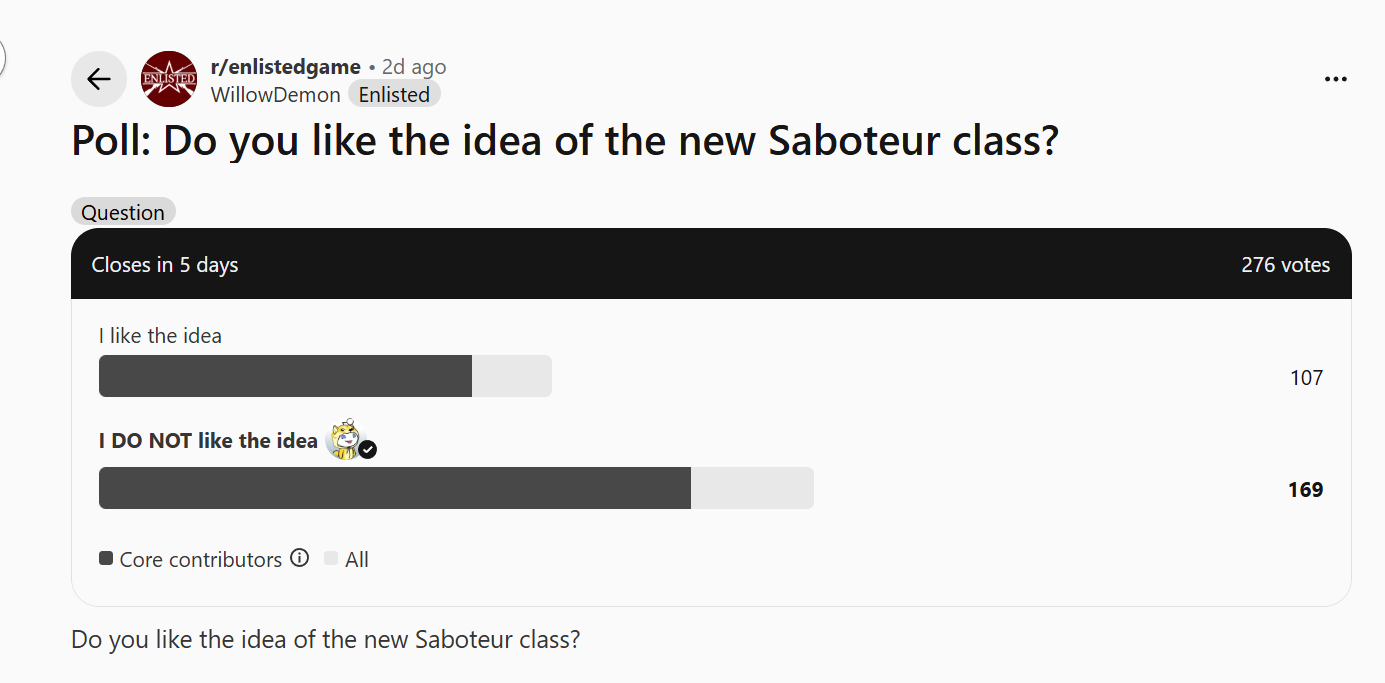
This point, will never be countered. The Saboteur doesn’t fit in.
I haven’t yet seen a convincing gameplay argument for why this class actually improves the game.