
- Calvary
- Calvary with bayonet
- Type 3 prototype
- Type 100 prototype
- all
- no
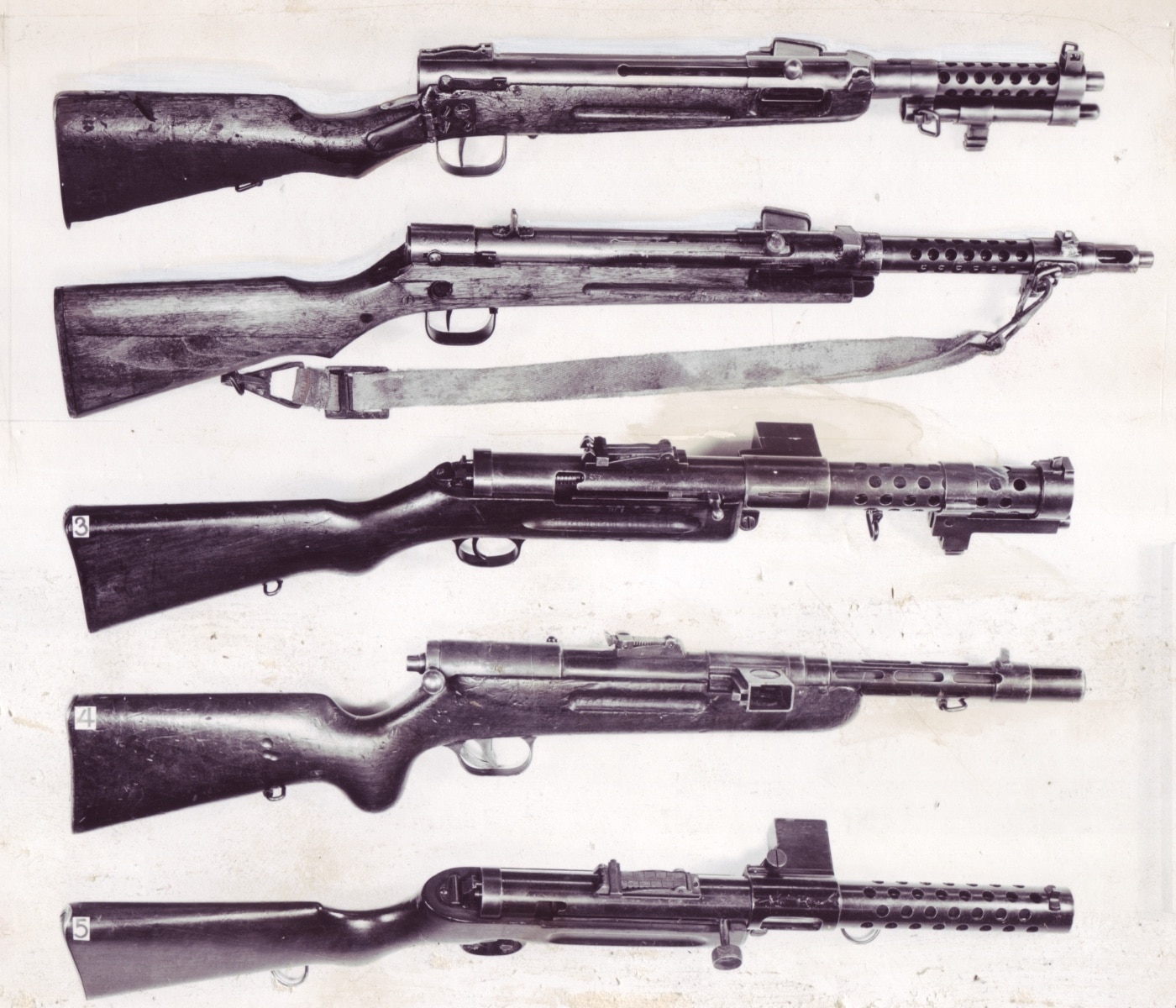
These submachine guns were used or tested by Japan during World War II. Top to bottom: Type 100 (1940), Type 100/44, MP 28 Type BE, and the Bergmann MP 35 (a Spanish copy of the MP 28 II). Image: NARA
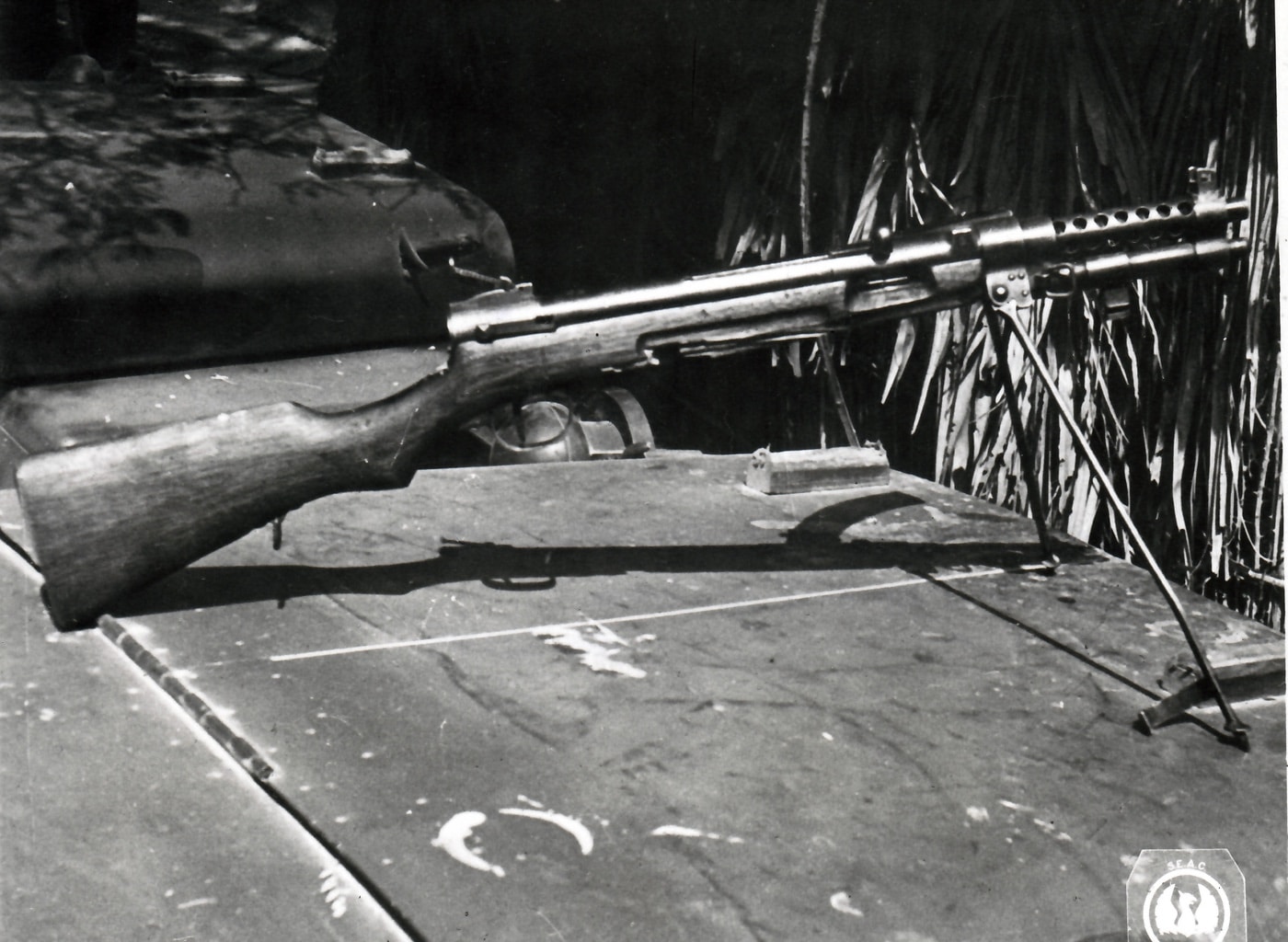
Cavalry Variant of the Model 3B Type 100 SMG
The cavalry variant of the Nambu Model 3B Type 100 submachine gun was a special early production configuration designed for mounted troops, and it is now a rare collector’s item.
According to historical accounts, the cavalry variant was a very early Model 3B Type 100 that differed from the standard infantry version in two key ways
- No muzzle brake — unlike the standard Type 100, which had a muzzle brake to reduce recoil, the cavalry version omitted it.
- Equipped with a bipod — allowing the gun to be supported on the ground or a saddle when mounted, useful for cavalry fire support.
- Extended sight range — it had a sight calibrated up to 1,500 meters, which was unusual for an SMG and more typical of a light machine gun role
These changes were intended to make the weapon more suitable for mobile, mounted units that needed sustained fire support in open terrain.
The cavalry variant was not widely produced and was in service only in the very early stages of the Type 100 program. It was captured by British forces during the late stages of the Burma Campaign in 1945, when Japanese reinforcements arrived in the theater
The Type 100 was the only Japanese submachine gun produced in significant numbers, developed by Kijiro Nambu and first introduced in 1942. The Model 3B was the refined version adopted in 1939The cavalry variant’s unique features reflect the Japanese military’s need to adapt existing designs for specialized roles, even in a small-scale, experimental way.
Because of its limited production and the fact that it was captured in combat, few if any original cavalry variants survive . Known examples are rare in museums and collector circles, and most surviving Type 100s are standard infantry models

Experimental Type III submachine gun
After the final and final tests of the Type II A submachine gun of the 1934 model in December 1938, unsatisfactory results were obtained regarding accuracy (with single fire at all distances, and good with automatic fire at short distances), and reliability of the automatic operation (with long-term shooting and increased contamination of mechanisms, overheating of the return spring and clogging of the pneumatic shock absorber), the requirements for the projected jidou-tanjuu “short machine guns” (製短機関銃) were revised.
Model Type III A, designed by 1938, was a model based on ideas close to the design of the Bergmann MP 18/I submachine gun, to which numerous changes were made by the design department of the company Chuo Kogyo K.K (in December 1936, Namby Arms Manufacturing Company changed its name) under the leadership of Colonel Sadamitsu Toguchi.Initially, the Type III prototype (試製三型機関短銃(原型) was a Nambu training machine gun adapted for 8x21mm pistol cartridges instead of the 6.5x5mmSR intended for training with a short lead bullet.
Also, instead of a barrel with a smooth bore, a rifled barrel was installed on the prototype.
The 228 mm long barrel with 6 right-hand rifling is removable and attached using a transverse wedge bolt to the receiver; the inner surface of the barrel, including the chamber, is chrome-plated in order to increase resistance to corrosion and wear.
To supply ammunition to the submachine gun, a 30-round magazine with a double-row exit from the 1934 model was used. The magazine was attached through a milled neck on the left.


Type 100 prototype