This post will be credited to Arawasi, who did everything for this post and I suggest and consider pay a visit to their page, they do a great labor finding interesting stuff, now, let’s start:
- Crew: 1
- Length: 9.66 m (31 ft 8 in)
- Wingspan: 11.11 m (36 ft 5 in)
- Height: 3.92 m (12 ft 10 in)
- Wing Area: 20.5 m² (221 sq ft)
- Empty Weight: 3,645 kg (8,036 lb)
- Max Takeoff Weight: 5,228 kg (11,526 lb
- Powerplant: 1 × Mitsubishi Ha-43 Model 12 (MK9D) 18-cylinder air-cooled radial piston engine, producing 2,130 hp
- Propeller: 6-bladed metal constant-speed pusher propeller
- Maximum Speed: 750 km/h (466 mph) at 8,700 m
- Service Ceiling: 12,000 m (39,360 ft)
- Range: 850 km (528 miles
For load, we can use the one he have in War Thunder
[poll type=regular results=always chartType=bar], and now, allow me share some videos and the whole info Arawasi share in the videos for more context:
The video today features the first prototype of one of the most unique Japanese aircraft ever produced, the Kyushu J7W “Shinden”, during taxiing tests.
The original 8mm film was shot by Engineer Kiyohara Kunitake, an 8mm film enthusiast who, at the time, served as Deputy Chief of the First Design Section at Kyushu Aircraft and oversaw the aircraft’s equipment, piloting, functions, powerplant, and armament teams. It was developed after the war, the image quality is not very good and yet it is a most valuable record of this rare aircraft type.
The location is Mushiroda Airfield in Fukuoka. The airport was built in 1944 by the IJAAF and was named Mushiroda Airfield. After the war, the United States Air Force used the airfield as Itazuke Air Base from 1945 to 1972. Today it is called Fukuoka Airport, the principal airport on the island of Kyushu and the fourth busiest passenger airport in Japan.
The exact date is unknown but most sources mention that these taxiing tests were conducted in late July 1945.
After being transported to the runway and purified by a Shinto priest, the president of the Kyushu Hikoki, the Chief Designer LCDR Tsuruno Masayoshi performed a ritual offering of sacred branches. The engine was then started, and the taxiing test finally began. An Army Type 100 Reconnaissance Aircraft Model 3 can be seen in the rear left.
Below are some captions from the old blue FAOW explaining what we see in the clip.
Before the test run began, LCDR TSuruno, wearing a Navy cap, took the pilot’s seat himself to check the engine’s condition. This first prototype was finally completed shortly after June 10 and transported to Mushiroda Airfield on the 15th; however, modifications and maintenance to the radiator and hydraulic systems took a full month, and the final inspection was conducted in mid-July inside the tunnel hangar at Mushiroda.
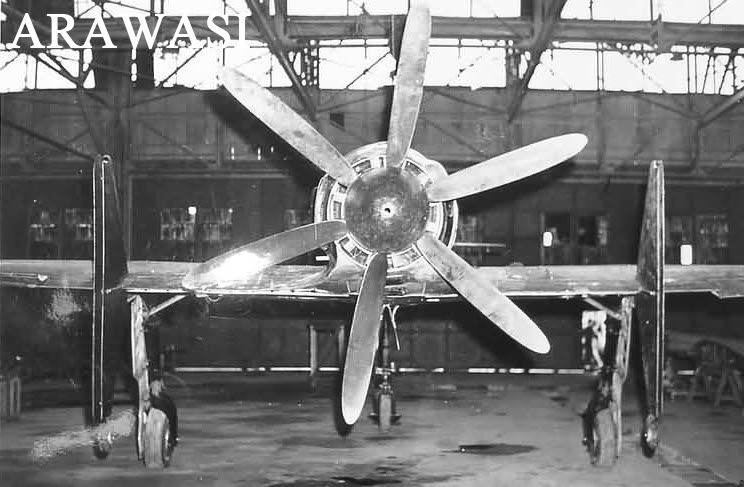
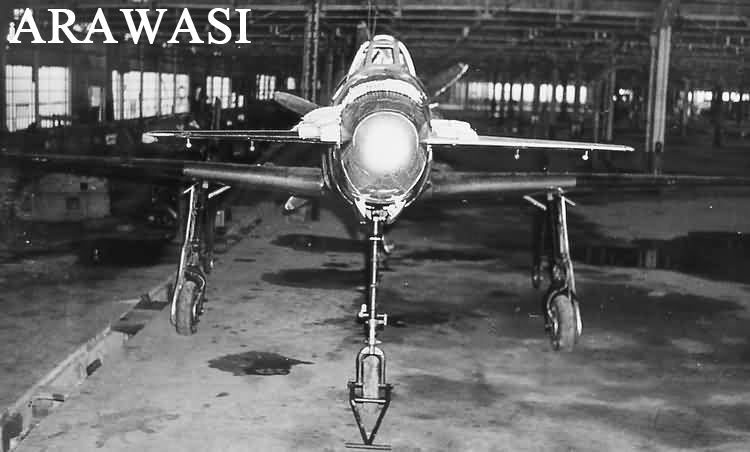
A view from the front during the engine test run. The Mitsubishi Ha-43 Model 12 engine, with a takeoff power of 2,030 hp (2,900 rpm), rotates powerfully, emitting a distinctive, piercing roar. Because the cockpit is high off the ground, a long ladder was placed against the No. 1 prototype; a boarding mechanism allowing for quick entry was scheduled to be installed before mass production began.
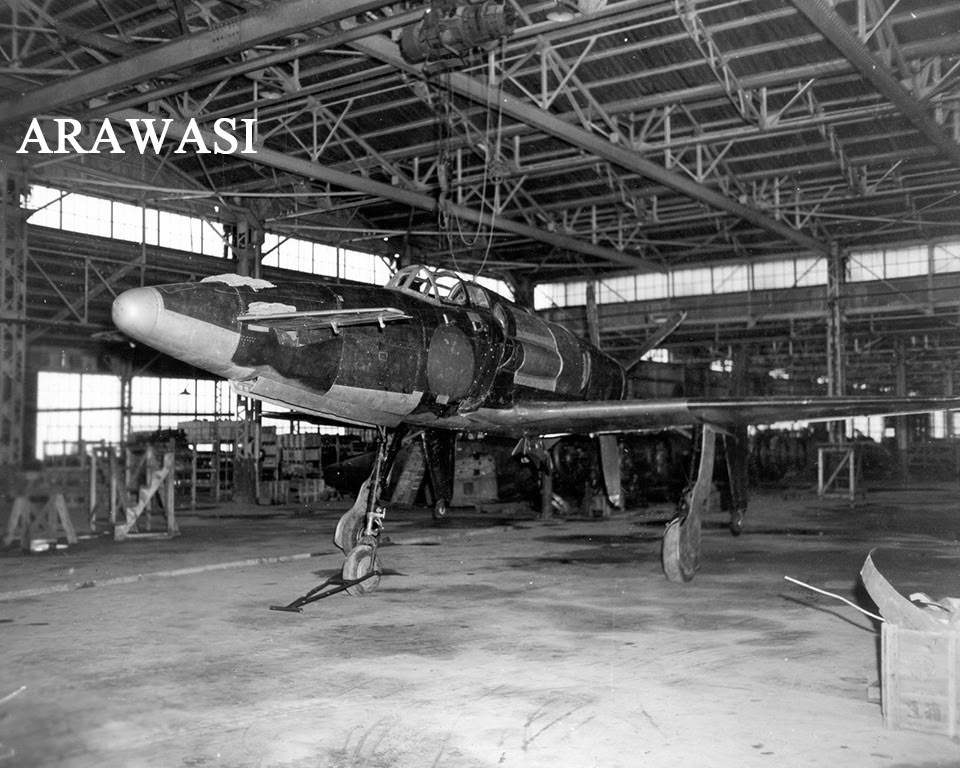
The taxiing test is about to begin. LCDR Tsuruno, with a tense expression, is about to enter the cockpit. The antenna mast protruding from the right side of the nose is for the Type 3 Ku-1 radio telephone. There is another one below the front windshield of the cockpit.
A view from the front-left just before the taxi test. With the engine at full throttle, the shadow of the 6-bladed propeller, 3.400 m in diameter, is clearly visible. The designers and prototype development staff watch over the scene.
The first prototype of the Shinden J, piloted by Major Tsuruno, took off in a cloud of dust, but just as it seemed the nose was lifting slightly near the north end of the runway, the aircraft spun halfway around and came to a stop. It is shown here taxiing back a short while later.
Upon shutting down the engine and inspecting the aircraft, it was found that the tip of the propeller had bent about 50 cm. This was caused by the nose rising too high during the run, causing the propeller to strike the ground. Afterward, the tail wheels from Kyushu K11W “Shiragiku” were temporarily attached to the underside of the wing. The propeller was replaced with one intended for the second prototype, and the “first flight” took place on August 3, here is the first video
the first Kyushu J7W “Shinden” prototype taking off for the very first time, on August 3, 1945, from Mushiroda Airfield in Fukuoka. In the cockpit is a Kyushu Aircraft test pilot (Blue FAOW says it’s LCDR Tsuruno!), and as you can see the small tail wheels helped a lot to prevent another propeller accident.
Here’s some interesting information about the aircraft from the Japanese Wiki:
From 1942 to around 1943, LCDR Tsuruno Masayoshi of the Aircraft Division at the Naval Air Technical Arsenal (Kokugisho) conceived and researched a forward-swept-wing fighter, aiming to develop an innovative fighter that would significantly exceed the performance limits of conventional fighters. Additionally, in 1943, CDR Genda Minoru, who had been appointed as a staff officer at the Naval General Staff, believed that the Zero-sen had likely already been thoroughly studied by the enemy. Seeking a groundbreaking fighter distinct from the Zero, he explored the development of a high-speed fighter but lacked the technical knowledge to propose such a design. However, thanks to Tsuruno’s presence, who shared this vision, the development of the “Shinden” began.
Even during the development of the “Shinden”, some held the opinion that “a shape not found in nature must have some sort of flaw. Tsuruno simply hasn’t realized it yet.” However, the project gained widespread support on the premise that, as long as the design was fundamentally sound, it was worth pursuing.
The Navy, which had already anticipated an invasion of the mainland by high-altitude bombers, tentatively approved the development of a prototype in February 1945. Kyushu Aircraft was selected as the joint development partner to handle the detailed design and manufacturing, as the company had recently completed development of the land-based patrol aircraft “Tokai” and had more capacity available than other aircraft manufacturers. Tsuruno and others from the Naval Technical Arsenal were assigned to the company to provide technical guidance.
When determining the required performance specifications, there were calls from the operational side (led by staff member Kofukuda) to equip the aircraft with air combat flaps, but the design team argued, “The premise is that this aircraft will not engage in dogfights.” Team member Kitano also countered, “If the flaps are fully extended, drag increases; if they are only half-extended, they will be inferior to the Raiden’s air combat flaps”. The Aircraft Division and Science Division of the Aviation Technical Arsenal questioned their effectiveness and advocated avoiding close-range dogfights, instead adopting a hit-and-run tactic that leveraged high speed, similar to the U.S. Army Air Forces’ P-51 and P-38. Despite a directive from CDR Genda, a staff officer at the Naval General Staff, stating, “We are pursuing this because we want a high-speed fighter capable of over 400 knots; we must not impose too many additional requirements that would reduce its speed”, it is reported that they ultimately decided to proceed with the installation of automatic air combat flaps and continued their deliberations.
Prototype
In May 1944, the 18th Experimental Interceptor Fighter “Shinden” was officially ordered into production, with the primary objective of intercepting Allied heavy bombers. Initially, the Navy’s requirement was to begin drafting in April 1944 and complete the aircraft by the end of that year. To meet this, Kyushu Aircraft mobilized not only local residents but also many female students and conscripted laborers from places such as Amami Oshima, Tanegashima, and Kumamoto to establish the necessary production capacity. At its peak, the workforce exceeded 50,000 people, and it was estimated that once mass production began, the plant would be capable of producing 300 aircraft per month. Additionally, regarding materials, there was a requirement to consider using iron, which was expected to be relatively abundant in the future.
In November 1944, Kyushu Aircraft, having assembled its engineers, completed the drafting work—which normally takes a year and a half—in just six months, producing approximately 6,000 drawings. That same month, Franz Paul, a German engineer from Henschel [couldn’t find anything about him. Leave a comment if you know more] , visited the facility. Under his guidance, the team began creating modified drawings designed with mass production in mind.
From December 1944 through April 1945, the Nagoya Plant of Mitsubishi Heavy Industries, which was developing the “Ha-43-42” engine scheduled to be installed in the “Shinden”, suffered catastrophic, irreparable damage from air raids by the U.S. military. This led to significant delays in development.
In March 1945, following a B-29 air raid on Tachiarai Airfield, Kyushu Aircraft decided to evacuate its factory to Harada in present-day Chikushino City. Parts were transported by ox-drawn carts in the middle of the night [as usual].
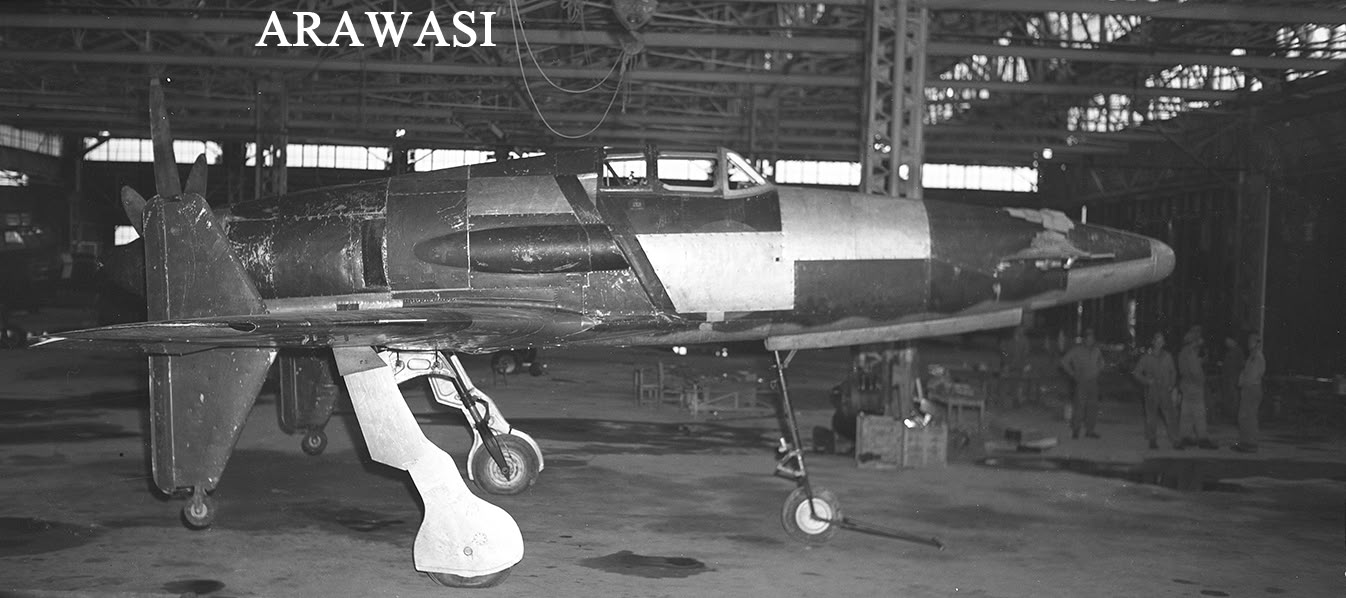
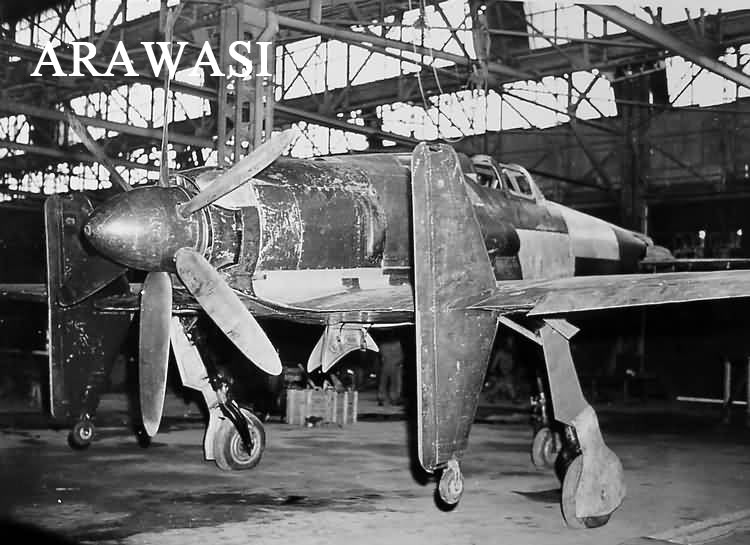
As we saw in the previous post, the aircraft suffered a propeller mishap and small tail wheels from “Shiragiku” were installed. For mass-production models, the main landing gear was planned to be moved rearward, and no wheels were to be attached under the vertical stabilizer.
On August 3, 1945, the aircraft successfully completed its maiden flight during a test flight. Test flights were conducted on the 6th and 8th as well, but an engine malfunction occurred, and the war ended while the team was in the process of contacting Mitsubishi Heavy Industries to order replacement parts. Here second video
Some photos from Arawasi in next post
- Yes, tell what br
- No, why not